
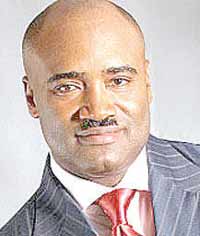
’People need to be taught to be socially responsible’
Pastor Paul Adefarasin, the Senior Pastor of the House on The Rock, in this interview, speaks on Christianity, politics and leadership. He also speaks on the idea behind the Rock Cathedral, a Social Justice and Transformation Centre, through which the church makes special interventions in technology, education, training, and empowerment among others.
By Olayinka Ajayi
House On The Rock, where did it all begin?
House on The Rock started at No. 4 Molade Okoya-Thomas at an all-night prayer meeting on July 15, 1994, with just seven people in attendance.

From left; Former British Prime Minister Tony Blair; President Goodluck Jonathan and Rev. Paul Adefarasin, Senior Pastor All House on the Rock at he opening cremony of the Rock Cathedral Metropolitan Church of Christ, yesterday, in Lagos.
What is House on the Rock’s mission?
House on the Rock is an agency for transforming the world by training and influencing the value system and culture of people using the principles taught in God’s Word. It is a national transformation centre, where we groom and train people to be part of the transformation process in our nation.
What really are the factors that facilitated the church’s growth?
There are 13 core values that drive our ethics at the House on the Rock. First is prayer (warfare); second is worship; third is the Word (the Bible); others are networking, excellence, user-friendliness, leadership (and I refer to servant leadership), innovation, empowerment, social responsibility, embracing diversity and training.
The Rock Cathedral prides itself as being a centre for social justice. How does this description tie into what it does?
This facility (the Rock Cathedral) is built on about 40,000 square feet, and the auditorium is less than 50 percent of the project. In the building, we have capacity for 250 executive personnel; we have a 4-bed in-patient hospital, with capacity for diagnostics and consultancy.
The hospital will become the hub for 46 mobile clinics (by the time the vision is fully implemented) – that’s one for each local government area (of Lagos State) for primary healthcare delivery. We have collaborated with Lagos State government hospitals and other private hospitals for medical cases beyond our capacity. Every single doctor or paramedic or nurse or pharmacist in the church is potentially a part of our medical unit.
There are 25 teaching spaces in the building to partly cater for five school systems we’re developing – A primary school, a secondary school, a Bible school, an institute of leadership and governance & an artisan school. This gives us the opportunity, amongst many others, to provide education to children with special needs.
Artisans are a very important part of any economy. In the days I grew up, we had electricians; today, you have ‘rewires’. The artisan school will help us provide various technological opportunities to people who want to develop their talents in that area.
Furthermore, we are quite involved with Lagos State schools, and have provided upwards of 540 computers for about 16,000 students through our Lagos State Computer Lab Project. Several schools have benefited from this.
The schools provide us with an empty classroom that we refurbish, provide with air conditioning, resurface the inside (floors and walls) and equip with computer systems. Our goal is to provide a minimum of 100 schools in Lagos State with this same facility. It is also the first deployment of the windows multi-point server in all of West Africa.
In addition, we have an urban alternative service, which caters to over 700 area boys, drug addicts, prostitutes and ex-convicts whom we feed, provide with primary health care and expose to skill acquisition programmes, so they can go back into society, empowered to make a contribution.
We even send some to university.
We also run a very vibrant prison ministry, where, in the prisons, we feed, counsel, provide health care and train the inmates in different skills, so that when they are out of prison, they become viable partners in the local workforce. Of course, we pass them through our church system and integrate them back into society as people who enjoy the endorsement and the accreditation of the church leadership.
This probably gives them a second opportunity of life. You find a number of them who have languished in prisons are often not convicted. Others are unjustly incarcerated or often serve many more years than the proper length of their sentence, mainly because of a lack of legal aid and representation.
So, one of the other things we do is provide free legal aid for hundreds of inmates in the Lagos area prisons. And this cut across the spectrum of House on the Rock churches across the country.
That to us is a significant joy – that House on the Rock is able to positively affect communities.
On education, other countries are literarily investing hundreds of billions of dollars every year, and Nigeria barely invests a few million dollars.
This does little to empower our human capital so they can deliver on Nigeria’s best possibilities. Certainly, we, like the rest of the church, are in the vanguard of challenging the issues of human capital development in Nigeria. I am happy that in our country today, the best universities are actually Christian-run/ church-based or faith-based.
Do you think the church is doing enough in nation building?
I think the real church is contributing to nation-building and I know that may not be easy to identify but the Bible says that ‘By their fruits, we shall know them’. If the fruit is positive and it is making a positive impact on the nation, then, you can identify that as the genuine church.
In the days of our parents, the church person — clergy and laity — were taught that your worship, your priesthood and your work were to be sequestered within the four-walls of the church. And that the role of priesthood, that is, going to God on behalf of the people, was the preserve of the clergy.
The entire Christian body, by the scripture, is called a royal priesthood and royal infers a governmental priesthood — a priesthood that is also in the service of its generation: at the same time, a priesthood that intercedes for its generation.
How well are Christians carrying out those responsibilities today?
That has not been the message or the emphasis. The church has not taken the responsibility for the transformation of the earth and the world systems into godly systems, godly culture, godly values, godly rules, and godly regulations because it is, today, consumed with going to heaven and, as a result, has not taken much responsibility for earth.
I will give you quick examples: some mythologists who are Christians, demographers and statisticians tell us that Christendom is a majority of Nigerian demographics and that, in spite of the numbers, Nigeria remains one of the most corrupt countries in the world. Yet, we have crusades and several events where people are consumed with ‘I must make heaven, I must make heaven’.
God is just; He is humanitarian; He is equitable. He loves fair play and we need to bring these values to the way people live on earth. People are still being taught on how to go to heaven; but they need to be taught to become socially responsible for the land in which they live.
I struggle with Nigerians amassing vast amount of wealth and living in their most palatial homes while right outside their gate, the gutter is blocked; there are potholes on the roads… I struggle with that.
How would you describe the economic impact of the Experience Lagos, especially regarding the huge turnout?
With The Experience, I am told one of the international news agencies reported that the economic impact on the Nigerian economy in that one weekend was $25million. I don’t know how they arrived at their statistics, but if true, you will agree with me, that impact is huge.
The value would be from airfares, the memorabilia orchestrated by different people who take advantage of the Experience, the transportation in and out of Lagos, the hotels and all of that.
The Experience has also helped re-brand Nigeria, in the sense that many Americans, who would have said, “can any good thing come out of Nigeria?” come to the Experience in shock and awe that something of this magnitude is done here.
It has also given the opportunity to raise the profile of Nigerian gospel musicians and created opportunities for their collaboration with people like Don Moen and Grammy award winning musicians.
It has helped lift the profile of Nigerian gospel music and this is important to us because we see the same thing happening in the secular music industry. Nigerian music has come of age and become a very powerful part of the international society and entertainment. Likewise, Nigerian gospel music is taking her place with her international counterparts, and the Experience is an important part of that global process.
The Experience is multi-layered; it is also a big unifier for the church because, though denominational dogma and doctrine will often divide the church, we all worship to the same music. So, instead of dividing us, worship tends to bring us together because it is not involved with arguments about doctrines. And that has allowed us to bring together the various denominations to have significant discussions.
Have you ever thought of monetising The Experience Lagos?
We will never charge a gate fee or take a financial offering at the Experience. It will defeat the purpose. When you have many people worshipping and praying together, it causes convulsion in the kingdom of darkness.
It sends a message that Christianity is here to stay; it sends a message that we are a united people, who can work together and provide significant leadership, especially to the youthful generation; that we are people who govern ourselves well.
How much belief do you have in Nigeria as a country?
I believe in God; and I believe in His belief in us fulfilling His mandate for the geographic area in which we live. I must believe in Nigeria and when I look at the talents in my church members — the passion for progress, the excellence with which they have created all the different things that they create — I am moved to believe deeply in Nigeria.
I just think that the best have not had the opportunity to serve the rest and as a result, the values and the ethics that drive the various aspects of the ship called Nigeria are not functioning with their best possibilities.
But the church and other faith-based communities must now begin to create pathways and other deliberate opportunities for the best to serve and lead the rest. And by the best, I mean people, who are conscientious, who have capacity and have competence.
2015 is around the corner, what would be your advice for politicians?
Entering elected offices must not be a do or die affair.
Another advice to politicians is: ‘Please don’t go into public office nor seek political appointments if you don’t intend to bring positive change. There are few areas we need change: we need real infrastructural development; we need security; we need education (we need to develop our human capital); we need industry and very key to industry is electricity.
Disclaimer
Comments expressed here do not reflect the opinions of Vanguard newspapers or any employee thereof.