
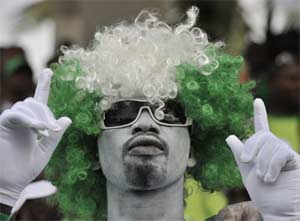
A Nigerian supporter attends the 2014 African Nations Championship (CHAN) qualifying football match between Ivory Coast and Nigeria on July 27, 2013 at the Robert-Champroux Stadium in Abidjan. Ivory Coast defeated Nigeria 2 – 0. AFP PHOTO
A memo to the National Conference
By TONY MOMOH
PREFACE: I wrote To Save Nigeria Let’s Talk in 2002 when I had monitored our return to Civilian Rule every week in the Sunday Vanguard for three years. In 2005 when the Constitutional Reform Conference was held under the presidency of Chief Olusegun Obasanjo, I produced 500 copies of the booklet for distribution to the delegates.
Many of our countrymen and women who had copies of the publication are also at the National Conference now meeting in Abuja. Having monitored our outing in civil rule continuously from 1999 to 2011, now available in three volumes – Democracy Watch, A Monitor’s Diary Vols 1 -3, I have no doubt in my mind that the future of Nigeria, and indeed the fulfillment of the mission spiritually ordained for it, will be determined by how we played our part, as creatures, in the cosmic ordering.
Cosmic ordering
We are a country, like America, China, France, Brazil, Kenya. We have a road map which is our Constitution, just as other countries have their road maps, written or unwritten. Our Constitution is the supreme law of the land, and is no more and no less a documentation of delegated powers. Sovereignty belongs to the people of Nigeria, not to some of them, but all 170 million of them.
The powers itemized for performance in the Constitution are what the people have given and are clearly stated in chapter 2 of the document, section 14, which we ignore because it is not justiceable when in fact it is the chapter that spells out in detail what duties the people want performed to access welfare and security. In this short presentation, I make a case for the decongestion of the political space which will automatically lead to economic deregulation. I even provide a framework for achieving the changes constitutionally through the Council of State and the packaging of the changes which the National Assembly will pass into law without debate and the state assemblies will endorse.
I have sought in vain for information on a country, apart from Nigeria, where democracy preceded development. A country that wants to grow takes that quantum of freedom that will drive development and growth. In a crude way of saying the same thing, the performance of duties in the polity determines the enjoyment of rights. Where you spend more than 20 per cent of your earnings on administering a polity, you must sit down and think. Where less than 17,500 public officers pocket more than 75 per cent of a country’s earnings, then it is time to talk. Yes, we have talked and talked, but have been consistently ignoring the outcome of the deliberations. Can the National Dialogue make the difference?


Delegates at the on-going national conference
Introduction: There is not one Nigerian today who is not worried at the amount of money we spend on the political arm of government, that is the Legislature and the Executive. Once upon a time, we had a unitary government. Later, we had three regions, then four. With the arrival of the military, we had 12 states, then 19, 21, 30, and the present 36 that constitute the federating units of the Federal Republic of Nigeria.
Presidential system
Once upon a time, we were ruled from Britain. At independence we chose their form of government in which there is an elected parliament where the chief executive is the Prime Minister. He is a member of Parliament and is there to answer all questions from everyone and on everything. Later we chose the Presidential system, as practised in the United States of America. In this arrangement, those who make law are separate and different from those who execute law. In choosing this path, we pushed for three levels of government in which we had a chief executive at the Federal level in an elected President; at the State level in an elected governor; and at the Local Government level in an elected local government chairman. But there is not one Nigerian today who has not complained of the expenses involved in sustaining this political arm of government.
Something has to be done. And those who say we must remain where we are, are unfair to history, and must be ignorant of the fact that the only permanent thing in the life of man and of institutions is CHANGE. So, no arrangement is permanent, and can be permanent. Where there are problems, the stakeholders of the system meet and discuss. They may argue and quarrel and hit their fists on the table; but no one goes beyond the armoury of democracy, which is the dictionary where all words used can be found. It is when the weapon of argument is short-changed and abused and undermined that other ways to right wrongs are thought of, and wrought on the system.
Before the Americans chose the road they took in late 18th century, they argued and discussed and voted. The document they produced has been amended a couple of times because of exigencies and experiences of life and living.
Simple solutions
We in Nigeria are overcrowding the Democracy High-way we are walking. And the way is developing bumps and manholes and craters, and these problems are yelling for attention. So, we just have to talk. We must talk.
Call the forum a Sovereign National Conference, a National Conference, a Meeting of Nationalities of the Federal call it. But we must meet and talk. All of us stakeholders in the Nigeria Enterprise. This little presentation is my naïve appreciation of the problem, and I have simple solutions which I know can work magic. My suggestion is that we restructure Nigeria so that we can have a truly federal arrangement where the federating units are viable and cost effective. The restructure proposed here is a rearrangement of existing constituent parts as follows:
Present proposed: Three-tier arrangement Three-tier arrangement •Federal Government ,Federal Government, •State Government, Regional Government, •Local Government, State Government
The Local Government system as today reflected in the present three-tier arrangement should be an affair of the Regional Government which will ensure its existence, structure and funding. You may not agree with me, but I have presented herein the problem and proffered solutions. Please read what I have put down, and give your own answers to the problem. Table them and discuss them with your family, your club members, your schoolmates. Take them to the church and your mosque, to your cultural meetings.
Table them at your political party meetings. Be part of seminars, workshops and outings where these problems that defy development and growth are discussed. At the end of the day, you would have discovered what you believe we need to get going fruitfully. Bring this to the Conference that must hold sooner than later, the sooner the better.
I plead from my heart that we save Nigeria by looking its problems in the face, dispassionately, and solving them so that we can say that though tribe and tongue may differ in the Nigerian arrangement, in brotherhood we can stand. For, the sacrifices we accommodate today will make the difference between joy and sorrow, for our children, and their children. Let us sow joy for posterity and our offspring shall never reap sorrow.
Part two: A severely stressed country & a severely stressed people: The country is severely stressed because the structures to make it function are faulty. There is too much government. Government is a national bakery where those who work in it must share the bread they refuse to help bake. The idea of protection of what belongs to all of us has not been effectively infused into us who serve in government. But are we, who are in the public service of the governments of the Federation, not the same people who belong in religious and cultural groups? Nobody in charge of funds of a church or the cultural union of his community would touch the money without a sense of betrayal. But in government, there are massive collusive programmes of deliberate theft of public funds; aren’t there?
The people themselves are severely stressed. The more welfare they expect, the less they get. The more they are told about peace and security, the more they are harassed both by the private armies of the powerful few; and hoodlums who are the products of inequities, deprivation, and urban denials.
Deprivation andurban denials
Our law-enforcement agencies are few, ill-equipped and inadequately motivated. The society itself has not been trained to ask questions from those who make it by simple procedure of joining the political class; understandably, because government is a stranger to the people, and is a place where taking what is not yours is an achievement to be celebrated, and for which national honour can be conferred.
The laws that protect the public coffers are strict, but they are kept more in the breach than the observance. The provisions on corruption were prohibitive enough to discourage infringing them before the present anti-corruption and related crimes law was passed. But everyone laughs at the latest provisions, as they did the ones preceding them, and this will continue until the causes of stress are identified, addressed and removed.
•Unstressing the nation: We are a federation and we must operate as a Federation. The 36 states are too weak to constitute the federating units. We need another buffer between the states and the federal, and that is the present zones that have naturally emerged. They are six, and should constitute the federating units.
•The powers at the Centre are too many. The power of the National Assembly as the de facto law-maker for everything both on the exclusive and concurrent lists is not healthy for the Federation. Government is too involved in businesses, and this promotes corruption. Why would any government be the effective monopoly in the major areas of the economy? Section 16 of the 1999 Constitution even entrenches the preponderant place of government running the economy of the nation.
There is no doubt that when government is decongested, the economy will automatically be deregulated. Political deregulation must precede economic deregulation.•The people must be brought together as a nation, and this can better be done through integrative programmes. This area is addressed in a little book, Thoughts on Governance Without Tears, which I wrote in 2000. But the political problems will focus this presentation. We should use what we have to get what we want. All the raw materials are there to make Nigeria grow into a world power if only we are willing to use them to the benefit of the people. The key is in political deregulation through restructuring, and the acceptance of informal and cost effective governance through active use of the traditional institutions.
Part three: Where we are, where we can be
•The present arrangement: There is one Central Government that is headed by an elected President who has a constitutional responsibility of appointing at least a minister from each state of the Federation. At present, there are about 50 ministers. There is also a large army of presidential advisers and assistants who themselves have personal assistants. There are hundreds of parastatals which have hundreds of party men who are board members and constitute a heavy charge on the mean resources of the parastatals.
•There is an elected National Assembly made up of the Senate and the House of Representatives. Members of the National Assembly have a large army of personal staff paid for by the Government. They also are entitled to funds for opening and running constituency offices.
•The National Assembly has power to make laws in 93 areas (Exclusive List and Concurrent List), and this means that the President has 93 areas of preponderant law-execution. There is no federal arrangement anywhere in the world that is this top heavy to the detriment of the federating units.
Federatingunits
There are 36 State Governments headed by Governors who are independent of the Centre and cannot be effectively checked by State Houses of Assembly. It would seem that the only time they appear at the State Assemblies is when they go there to have any input from the State Assembly. Experience since 1999 has shown that they can be laws unto themselves if they so decide.
There are 774 Local Government Councils with executive chairmen who are also laws unto themselves.They appoint non-elected councilors to their ‘cabinets’. The councilors are a direct charge on the Federation Account and this charge includes drawing money for a house staff of five! This means that the emoluments of an elected councilor who has the equivalent of a school certificate and is just out of school, are higher than those of a professor in the university or a judge of the High Court of a State. Yet both entitlements come from the Federation Account!
Looking back to May 29, 1999 when we started this walk on the Democracy Highway, it is obvious that the cost of sustaining the different political arms of each of the tiers is becoming unbearable. The President has said so, and so has the President of the Senate. Our expenditure profile shows that we spend about 92 per cent of our resources on recurrent expenditure. This means that we have very little left for funding development. It is, therefore, a question of time before we would be borrowing to sustain the system of government we have opted for. There is no doubt therefore that the present arrangement is not healthy for us.
It cannot work in any federation. Every stakeholder in Nigeria sustains a system of government that assures the best for the citizenry. We cannot eat the future in the present by imposing structures we are unable to sustain. The way out of this problem is restructuring the political arrangement to make it more manageable and less demanding on our resources. You may have your own approach to this re-arrangement of our political structures or, indeed, what you believe can replace them. A debate just has to begin and hereunder is my proposal.
Part four: My proposal: We should retain a three-tier arrangement – The Central Government, the Regional Government and the State Government. The present local government structure should be an affair of the Regional Government, and be funded by it. •The Central Government will continue to be headed by an elected President so that we may all continue to have a sense of ownership of the head of the Nigerian state. If we revert to the Westminster model, then the prime minister will be elected from his constituency and the problem of religious politics will automatically disappear.
•The law-making body should be the present Senate of 109 members. There should be a nominated Upper House of Elders, one from each state of the Federation and Abuja. The number will thus be 37. This would be like the arrangement in the First Republic Senate.
The powers of the centre should be reduced and only those powers that would mould the federating units should be retained exclusively by the centre, like defence, external affairs, citizenship and currency. Let us be advised by the experience of the United States of America over the years. There should be six regional governments on the lines that have emerged as Zones – North-West, North-East, North-Central, South-West, South-East and South-South. These and not the 36 States should be the federating units.
The law-making bodies in the Regions should be those elected from the present House of Representatives constituencies. Each Regional Government should be headed by a Governor. He may be elected by the Region or appointed by the party that forms the majority in the Regional House. Many of the powers moved from the Centre will anchor in the Regional and State Governments.
There will be 36 State Houses of Assembly as at present. They ought to be less. But the only reason they will be retained is that no state would like to lose its autonomy. It is a fact we have to live with. The position of executive governor is unnecessary and untenable and should be cancelled. We should restore the parliamentary system at the state level. The present office of Governor should be re-designated Premier as we had in the First Republic.
He will contest elections to the House like any other member of the House, and can be appointed by his party if it wins the majority of seats in the House. 10) All members of the State Executive Council would come from the House of Assembly. If what the Governor does now can be better done in the House, the expense of electing him to straddle the state treasury and do what he likes with it, as has happened to many state governments since May 29, 1999, can be saved and channeled to development of the state. There are at present 774 local government councils with elected council chairmen and councilors who are “working” fulltime.
This level of government is the greatest fraud that has been visited on our democratic outing since May, 1999, and has been responsible for the lack of growth in the local government area. We should have elected councilors who will elect one of themselves as chairman. Each councilor should earn a N10,000 sitting allowance, with such sittings not being more than once a month.
The chairman should earn N20,000 per sitting. The day-to-day running of the council should be the responsibility of the Secretary who would be appointed by the Local Government Service Commission.
To be concluded
Disclaimer
Comments expressed here do not reflect the opinions of Vanguard newspapers or any employee thereof.