
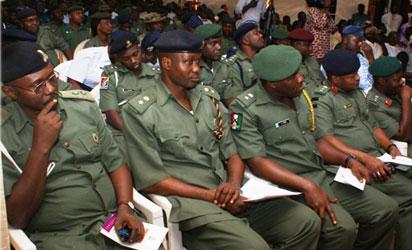
Cross Section of Top Military Officers
By Is’haq Modibbo Kawu
Last week, I made a case for Nigerians to support our armed forces as they confront the greatest security challenge facing the nation since the Nigerian Civil War. I illustrated my narrative with examples drawn from my years of encountering our valiant soldiers in far-flung areas of the world.
No Nigerian who encountered the NIGBATT in Nyala, South Darfur, that would not have been impressed with the organisation of the camp; the general cleanliness and order; the deployment of modern communication gadgets and the innovative spirit in the field. I saw the practical deployment of our forces during a Route Assessment Patrol that took us several kilometres from the camps of Nyala.
Nigeria’s army prided itself on its regimental tradition and was always conscious of its leadership role amongst other armies in Africa. I received testimonies to that effect from other African soldiers.
It is therefore a source of worry that the army that received plaudits from around the world has arrived at the critical juncture today when soldiers are refusing to engage insurgents and are even being court-martialed for mutiny.
There are serious underlying problems to deconstruct, for the army’s sake and of the country’s. Unfortunately, these issues are out in the open. Appearing before the US House of Representatives Committee on Foreign Affairs last Wednesday, Sarah Sewall, Under Secretary for Civilian Security, Democracy and Human Rights, noted that corruption is hindering Nigeria’s efforts at ending the Boko Haram insurgency.
The military “must overcome entrenched corruption and incompetence” to be able to rescue the abducted Chibok Girls. Despite Nigeria’s $5.8 billion security budget for 2014, Sewall said: “Corruption prevents supplies as basic as bullets and transport vehicles from reaching the frontlines of the struggle against Boko Haram”, adding that: “Morale was low and (…)desertions were common among soldiers in the 7th Army Division fighting the insurgents”.
If that is a view from outside, Nigerian newspapers also reported lamentations by the military, of “the negative impact of inadequate funding for military operations”, in the North East. The disclosure came from Major General Abdullah Muraina, Chief of Accounts and Budget of the Nigerian Army, at a training programme in Jaji, Kaduna State.
The General said: “Ethno-religious crisis and terrorism has left serious financial demand on the Nigerian Army”. The Nigerian Army was “enmeshed in the bureaucratic bottleneck for funding approvals for military operations”.
The “budgetary allocation for the military is inadequate to meet the contemporary security challenges and also cater for the welfare of the Nigerian Army”. To explain the magnitude of the problem, General Muraina said: “This year N4.8 billion was allocated for capital projects for the Nigerian Army. Of this amount, because of security challenges, the army decided to buy ballistic helmets and fragmented jackets (two items) for 20, 000 soldiers, at a cost of $1500, it will amount to N3 billion.
Meanwhile, about nine items are needed for the soldiers”. The sum of N3 billion is more than 50% of the capital budget of N4.8 billion, and as the officer noted, that is just only an item of expenditure.
It gets even more curious, to read in LEADERSHIP newspaper of Saturday, May 24, 2014, that the Ministry of Defense, MoD, washed its hands off allegations of corruption related to underfunding or ill-equipment being alleged in the military, because the military “receives its capital expenditure direct…while the Presidency releases money to the military without the involvement of the ministry”.
An unnamed source added that: “The ministry knows little or nothing about how the military spends its capital votes…We know next to nothing about how the military spends its money…
The military purchase their arms and ammunition by themselves and, as we are talking now, some of them are in Turkey shopping for APCs”. The anonymous source was asked about underfunding by the Presidency, he answered that: “We may not know here; probably the military is in the best position to say this”.
Well, THE NATION newspaper of the same day had the answer. Finance Minister, Ngozi Okonjo-Iweala, confirmed that: “The military received N130.7 billion between January and April, 2014, while another N3.8 billion had been approved…but was still being processed…”.
The N130 billion Ngozi Okonjo-Iweala said she released in the first four months of 2014, obviously piqued the Sultan of Sokoto, Alhaji Sa’ad Abubakar, a retired General himself.
Addressing an event last weekend, the Sultan said to his audience: “If you have been reading newspapers recently, the Minister of Finance…said over N130 billion was given to security agencies in four months. Now where is the money? These are questions we should be asking ourselves”.
And just in case there are people about to question his position on this, the Sultan reminded that: “I spent most of my life in the military”! There are too many sordid details that are not clear to us in respect of provisioning of our troops and the spending of budgeted monies. A combination of acts of corruption, impunity, crass irresponsibility and gross incompetence are rubbing negatively off our fighting men and women.
Those in charge must be held accountable for the opprobrium that is being visited on our armed forces today. We must insist that our troops are properly provisioned to be able to carry out their duties of securing Nigeria and Nigerians effectively!
Chibok girls, Israel and Iran: A gift horse’s mouth
It is instructive that the abduction of the young girls from Chibok has unleashed a worldwide offer of assistance to Nigeria. These offers came from the United States which made good its pledge by deploying officers in its Abuja-based Embassy to commence intelligence cooperation with Nigeria; overfly with intelligence-gathering aircraft, and by the beginning of the week, it located a military group in Chad as part of the assistance to break the abduction logjam.
The British also weighed in, while France hosted a regional meeting in Paris, of Nigeria and its neighbours: Cameroun, Chad, Niger and Benin, to develop a collective security strategy against the Boko Haram danger to the West African sub-region. Even China offered satellite-based intelligence to Nigeria’s security forces as a show of solidarity.
The international groundswell of feeling also touched hearts in Israel too, because they have also offered assistance. The fact is that Israel has been embedded within the Nigerian security system in the past three decades or so.
At a point when Nigerians were beginning to wonder why we have never bothered to deploy drones to assist in the aerial surveillance in the Sambisa forest, especially after a prototype drone was allegedly developed by Nigeria’s army, in December 2013, VANGUARD newspaper of Wednesday, May 21, 2004, reported that such drones that Nigeria purchased from Israeli company, Aeronautics Defense Systems “years ago”, according to the report, “have been left grounded due to poor maintenance”.
The newspaper quoted a Marketing Officer of the company, Tsur Dvir, who confirmed that Aerostar unmanned aerial vehicles “to the best of our knowledge, these systems are not operational”. Dvir, in the normally secretive pattern of Isreali military engagements in Nigeria, refused to confirm the number of such vehicles they supplied to Nigeria, but “aerospace industry source(s) said they each would have been worth between $15million and $17million.
So not only that Israel has been enjoying these huge profits from Nigeria, in the supply of military equipment that end up “grounded due to poor maintenance”, it recently offered assistance to help in the Chibok abduction case. However, it also decided to exploit its geopolitical rivalry with Iran within the Nigerian situation.
VANGUARD newspaper of Friday, May 23, 2014, reported Israeli Ambassador, Uriel Palti, at a reception in the Chinese Embassy, of having said that “Boko Haram…Al-Shabbab in Somalia, etc, are all part of the arms of Iran; the influence of Iran, Al-Qaeda influence”.
It was obvious that the Ambassador of Zionist Israel was deliberately setting out to confuse Nigerians with his statement, because Iran has never been accused, even by its worst enemies in Western Europe and the US, of being a supporter of Al-Qaeda. So the link he made was absolutely preposterous and an obvious attempt to cash in on the Nigerian need for assistance.
The Israelis see Iran as their greatest remaining threat in the Middle East, after they engineered the end of Saddam Hussein’s nuclear facilities and getting the US to topple the regime. Syria is also being systematically dismantled with the raging civil war; removal of its biological weapons and the complete degradation of its armed forces.
Israel is the only nuclear power in the Middle East, possessing over 200 nuclear weapons, other weapons of mass destruction and the most powerful regional forces. Those weapons are not under IAEA control, since Israel is not signatory to the Nuclear Non Proliferation Treaty, NPT.
Yet, it continues to shout aloud about Iran’s alleged efforts to develop nuclear weapons. It is thatbitter rivalrywith Iran that Israel is attempting to project into the effort to assist us to solve the Chibok abductions. We should carefully look at the Israeli gift horse in the mouth in this case. We must not be drawn into the geopolitical agenda of Israel or any other country for that matter. Boko Haram is not an arm of Iran. No!
Professor Shehu Jimoh: Intellectual, broadcaster, decent man
LAST week Monday, Professor Shehu Ahmad Jimoh, Chairman of the Governing Council of the Kwara State Polytechnic, Ilorin, died at the age of 70. Shehu Jimoh was also a retired Professor of Educational Psychology at the University of Ilorin. His death has robbed Ilorin of an outstanding intellectual and the quintessential community person. I served with Professor Jimoh on the board of the Adisa Bakare Educational Endowmnet Fund, ABEEF, which is a scholarship fund endowed by the late General Abdulkareem Adisa.
From 1998, we have offered scholarships annually to indigent students from Kwara and other Nigerians resident in the state. It has been a very well managed scholarships scheme that has outlived General Adisa and the work has largely been effective because of Shehu Jimoh’s commitment, long after many of us located to other cities, away from Ilorin.
Most people, especially the younger generation, probably don’t even know that Shehu Jimoh was a pioneering newsreader with us at Radio Nigeria, Ilorin and then Radio Kwara, during the 1970s and 1980s. I fondly remember his high quality microphone voice and the fact that he always arrived from his schedules as a lecturer, to read his news, unfailingly.
He was married to my cousin, and I recall all those early years of their courtship, when he was regularly visiting our family house. It was from those early years that we became close and we kept the mutual respect, till his death. We have lost a very decent man, with the passing of Professor Shehu Ahmad Jimoh. Allah ya jikansa. Amin.
Disclaimer
Comments expressed here do not reflect the opinions of Vanguard newspapers or any employee thereof.