
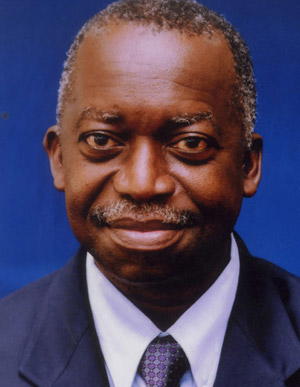
Prof Sofoluwe, VC, UNILAG
By Douglas Anele
TWO weeks ago, the second annual memorial lecture in honour of the 10th Vice-Chancellor of the University of Lagos, late Prof. Adetokumbo Babatunde Sofoluwe (fondly called ABS by some of his admirers), was held at Afe Babalola auditorium in the main campus of the university.

Late Prof. Adetokunbo Sofoluwe
From all accounts, it was a well-attended lecture. Unfortunately, I was absent because I mistakenly thought that May 12 was a Tuesday, whereas it was actually a Monday.
Therefore, a few hours after the lecture, when Prof. H.O.D. Longe, my egbon and a very close friend of the late VC, asked whether I attended the lecture, I told him the truth, that I took my vehicle to the mechanic workshop on Monday morning, thinking that the event would hold the following day, Tuesday.
Prof. Longe informed me that some other colleagues made the same mistake, whereupon I decided to write this essay as my own modest way of celebrating and honouring the memory of Prof. Sofoluwe, who I consider to be the most humble and amiable VC of UNILAG since it was established in 1962.
Before discussing my encounters with late Prof. Sofoluwe and his character traits that endeared him to me, it is useful to say a few things about the phenomenon of death.
Now, of all living beings on earth, humans are the only ones with an acute consciousness of death, for it constitutes one of the basic conditions of human existence characterised by minimal instinctive determination of behaviour and maximal development of the brain, especially the neo-cortex.
According to Erich Fromm, the noted psychoanalyst and philosopher, the human species is the only class of living creatures that has self-consciousness, imagination, and rationality. The capacity for self-consciousness means that a human being is aware that he is separate, and yet part of, nature and other human beings.
Imagination allows him to envision and picture possibilities in his mind, while rationality enables him conceive and understand the world, and ascertain the best means of attaining his goals and desires.
The mental and spiritual qualities of humans reveal the existential dichotomies at the core of their being. Nevertheless, the most fundamental of them all is the dichotomy between life and death. Each human being must die at a particular point in time.
This sobering unalterable fact, and the centrality of death in religion and philosophical thought worldwide throughout the ages, might be the reason why John Hick, in his book, Death and Eternal Life, describes the phenomenon as an “impossibly vast and tantalisingly mysterious subject.”
Preoccupation with death will continue as long as people are preoccupied with life, because life and death are inseparable. Religion is one of the ways through which human beings try to cope with the inescapability of death by postulating an immortal soul.
In my view, the attempt to obliterate the tragic sense of death, and, by implication the uniqueness of individual human life on earth, through religion is wrong and futile. To begin with, it leads to the false belief that injustices in this world will be remedied at an indefinite future in the afterlife when God, the purported creator of the universe, will pass judgment on humankind, a belief that has failed to deter evil people from committing atrocities worldwide.
Again, mentally deranged religious fundamentalists deliberately commit suicide due to unshakable misguided expectation of reward with eternal bliss in paradise for grotesque martyrdom. Belief in immortality tends to discourage individuals from fully exploring possibilities for happiness in this life.
By postulating taboo morality as a precondition for heaven, for instance, religions tend to put unnecessary chains on human capacity for wholesome enjoyment here on earth by tendentiously labelling otherwise harmless activities as “sin” punishable in hell.
Courageous acceptance of death for what it is, that is, as complete annihilation of the possibilities of an individual, is very useful for developing certain attitudes conducive for productive life. It makes one aware of the necessity and imperative of doing whatever one has to do to the best of one’s ability, in the full knowledge that death may strike at anytime without notice totally removing the possibility of a second opportunity.
Realistic attitude to death also protects a person from the illusory comforts and anxiety of religious superstition encapsulated in the concepts of heaven and hell respectively. It reduces proneness to some of the anguish and pain associated with the death of those that we love and cherish, and permits a greater appreciation of life as a unique gift from our parents.
I have pleasant memories of my interactions with late Prof. Sofoluwe. Indeed, his demise was a personal loss to me. I cannot remember exactly how we met. However, it was clear to me that the late VC was keenly interested in my person and academic work. Perhaps, he considered me a brilliant young academic who requires encouragement to succeed.
Hence, he always encouraged me to be more serious with my research. I vividly remember the day he said to me that he would not rest until I reach the peak of my academic career. Unfortunately, he would not be around to witness the fulfilment of his wish.
Although Prof. Sofoluwe was in Computer Science, he was also interested in the Philosophy of Science, which is my area of specialisation. Occasionally, he would send me photocopied materials on different aspects of science to improve my knowledge. Prof. Sofoluwe was a kind and humane person.
One day I was in his office, and there was discussion about a certain Professor whose records showed conflicting dates of birth. It was obvious that the woman in question ought to have retired three years earlier. Rather than apply the stipulated sanctions, the late VC opted to give her a “soft landing.”
To his credit, Prof. Sofoluwe demystified the office of Vice-Chancellor. He was accessible to both staff and students, unlike some of his colleagues elsewhere who behaved like tin gods that must be feared and worshipped by everyone.
Prof. Sofoluwe demonstrated that occupying an elevated office is an opportunity to serve, not to be served, At the Senior Staff Club, the late VC usually went round to greet people, irrespective of the person’s status in the university. Severally, I enjoyed his generosity at the club, although sometimes he would in a very friendly manner request that I should buy one thing or another for him.
Disclaimer
Comments expressed here do not reflect the opinions of Vanguard newspapers or any employee thereof.