
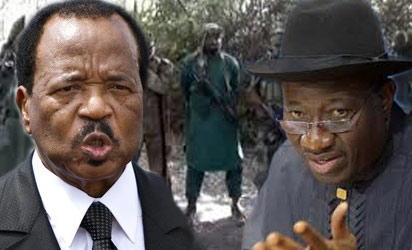
President Goodluck Jonathan and President Paul Biya, Cameroon
By Douglas Anele
Therefore, it is largely a frustrating and futile exercise to recommend solutions to a group of bulimic politicians preoccupied with acquisition and retention of power at all costs, and sustenance of official avenues for primitive accumulation.
That said, since the negative repercussions of misgovernance affect mostly the poor, the powerless and the downtrodden, it is imperative that one should continuously draw attention to them and from time to time proffer ideas about how they can be eliminated or reduced to the barest minimum.
Now, Nigeria is in deep crises. In virtually all the important parameters for assessing quality of life, the country is experiencing the paradox of “motion without movement.” Boko Haram sponsored violence and destruction in different parts of Northern Nigeria has become more frightening since Goodluck Jonathan became President in 2011.
Of course, there are security concerns in the South as well: kidnapping, armed robbery, ritual murders and other hideous crimes are committed daily across the country. Nevertheless, the security challenges posed by the rampaging Islamic fundamentalist sect seem to have an international terrorist dimension, and bring out in bold relief gaping faultlines in intergroup configurations of the Nigerian state.
Unfortunately, reactions to the Boko Haram phenomenon by some prominent Nigerians representing powerful interests calibrated along geo-ethnic and religious lines indicate that lessons of the Biafran war have not been internalised by President Jonathan’s supporters and his traducers alike.
Some prominent indigenes of South-South see Boko Haram as a calculated attempt by disgruntled members of the Northern establishment to destabilise Goodliuck Jonathan’s government and portray him as a weak and ineffective leader, whereas a few hardcore Northern feudalists consider the sect a legitimate pressure group representing Northern interests.
Whatever may be the case, one thing is certain: the method employed by Boko Haram in pursuing its agenda is counterproductive because it brings pain and death to innocent Nigerians.
The odious and inciting letter to governors of Northern states by Murtala Nyako, governor of Adamawa state, accusing the federal government of genocide against Northerners in the pretext of fighting Boko Haram contradicts the concept of “One Nigeria” enshrined in the 1999 Constitution.
It’s tone and content is anti-Nigeria, and establishes that Nyako is totally against Jonathan’s presidency, presumably because the latter hails from the South, and political power at the federal level belongs to Northerners, according to Maitama Sule’s ridiculous theory that Allah endowed Northerners with leadership qualities.
It is gratifying to note that the governors to whom the letter was addressed did not take Nyako’s hysterical Fulani irredentism seriously, and rightly so: only an individual thoroughly hateful and spiteful of Mr. President and the concept of “One Nigeria” can entertain the gospel of raw hatred in it.
Even if we accept that President Jonathan has performed below expectation with regard to security, comparing him to Adolf Hitler and alleging genocide against Northerners without solid evidence is, to say the least, irresponsible and highly reprehensible.
Anyway, with the letter, Nyako has unwittingly demonstrated the intellectual hollowness of the ruling class in contemporary Nigeria, which is a far cry from what obtained when Dr. Nnamdi Azikiwe, Chief Obafemi Awolowo, and other prominent politicians of the First Republic were at the forefront of Nigerian politics. Dr. Azikiwe and others made mistakes; but they were not as corrupt, greedy and myopic as the politicians we have now.
Moreover, considering the healthy economic growth of the 1960s, it can be plausibly argued that Nigerian politicians before the civil war were better managers of resources than the spendthrift politicians strutting around today as tin gods.
Although there is some progress in few areas of our national life since 1999, the fact that about sixty percent of Nigerians are poor is a serious indictment of our leaders. The present administration was clever by half when it released statistics purportedly demonstrating that Nigeria’s economy is growing.
The reality, however, is different: more and more Nigerians are sinking into poverty, because of increasing deindustrialisation and shambolic economic planning. It is a painful irony that while members of the ruling elite are enjoying the best things of life comparable to the jarring ostentatious lifestyles of a Saudi prince, an increasing number of Nigerians are trapped in the black hole of want, hopelessness and despair – an unmistakable sign of a society in decline.
Absence of social justice in Nigeria is blocking the emergence of resilient psychological foundation or mindset necessary for nation building. The problem lies primarily with the predominant egoistic mentality of Nigerians, particularly the leaders, because the leadership sets the moral tone in every society.
Nigerian political leaders make fine speeches all the time, promising that government will do all in its power to improve their welfare. But from experience, Nigerians know that politicians, collectively, are untrustworthy people fond of making promises they do not really intend to keep.
It will be interesting to carry out a scientific research to ascertain the extent to which President Jonathan and governors of the thirty-six states have fulfilled their campaign promises during the last elections. The result would show, I believe, that virtually none of them has achieved up to fifty percent performance.
Keep in mind that most governors employ vuvuzela-sounding propaganda in the media claiming phantom achievements to create the illusion of good governance. Of course, you can deceive some of the people some of the time or all the time, but you cannot deceive all the people all the time. Nigerians are gradually coming to terms with the chameleonic character of their politicians.
In my view, our leaders do not take us seriously. In their warped consciousness, leadership is about self-indulgent materialism, not about service to the people. When President was asking Nigerians to vote for him before the last presidential elections in 2011, he spoke eloquently about his transformation agenda, about how he would deploy the country’s resources to fight those forces hindering our national development.
However, his scorecard does not match his fine rhetoric. The President’s supporters and sycophants can praise him from now until “kingdom come” – after all, they are benefiting from the system. That would not change the fact that Mr. President is yet to deliver on his promise to transform the country, and there is no strong indication that he would do so even if he were re-elected in 2015.
Positive social transformation is not about speech making; it is not about praise-singers insulting those critical of the President’s inability to transform his good intensions into concrete achievement. Real transformation starts from within and spreads outwards – it is a thing of the mind.
Therefore, the question is, has the President been able, through self-discovery and self-discipline, to mobilise his intellectual, emotional and spiritual (not religious) potentials to transform himself so that he can work effectively on his transformation agenda for the country? Judging by his decisions and actions, it is obvious that President Jonathan is yet to undergo the kind of psycho-spiritual epiphany which transformed Mahatma Gandhi, Nelson Mandela and Lee Kuan Yew from ordinary citizens into iconic leaders in their respective countries.
To be continued
Disclaimer
Comments expressed here do not reflect the opinions of Vanguard newspapers or any employee thereof.