
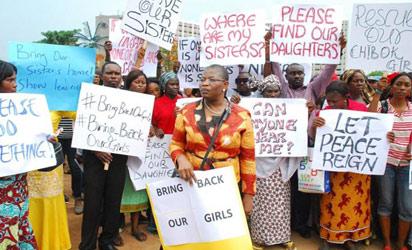
Some women, led by Mrs Oby Ezekwesili, protesting the abduction of 230 school girls in Chibok, Borno State.
By Is’haq Modibbo Kawu
NOT since the OCCUPY NIGERIA demonstrations of January 2012, against the Jonathan administration’s hike of petroleum products prices, has an event shocked and united Nigerians like the on-going #BRING BACK OUR GIRLS manifestation.
Like wild fire in the veld, a nationwide movement has triggered an international momentum. Nigerians are joining hands across fault lines political actors opportunistically exploit to access power. The abduction of the Chibok School girls in Borno state has troubled the conscience of all of humanity.
Those who profit from the disunity, docility and acquiescence of Nigerians in their oppression are shocked to the marrows by Nigerians’ united response: man-woman; old-young; North-South; Muslim-Christian! This national mobilisation has also swept the world. And for the first time since the emergence of the Boko Haram insurgency, the Chibok abduction has interrogated the dominant narrative and exposed the inadequacy of governance.

Some women, led by Mrs Oby Ezekwesili, protesting the abduction of 230 school girls in Chibok, Borno State.
The girls were abducted on April 14th and President Jonathan responded only in the past one week. Goodluck Jonathan couldn’t find the time to visit Chibok to commiserate with the families, nor reassure the Borno people of government’s determination to bring home the girls. On the contrary, they have attempted a cruel, irresponsible and cynical attempt to spin the story and cast doubt in the minds of Nigerians.
When PDP Women’s Leader Kema Chikwe expressed doubt that the girls were abducted, it was the first shot in a campaign to shift blame; set up straw men and find scapegoats. It was this cynically manipulative politicking that incensed Nigerians. The narratives were hitherto simple and effective: Boko Haram was a Northern conspiracy against Jonathan; the other line presented an elaborate Northern Muslim scheme to wipe out Christians.
They were divisive enough; and Jonathan can conveniently sit on his hands and do nothing, beyond the perfunctory. Boko Haram’s excesses have occasioned very hollow governmental responses. It is a scandalous, Trillion Naira annual defense budget that has not dented the ferocity of the insurgency.
But above all, Nigerians have become frustrated with the serial inability or outright refusal of President Jonathan to be presidential: dormitories killings in BuniYadi, Yobe State, and neither president, vice president nor education minister showed up at the scene; the same with the Chibok abductions. In the USA, President Obama was always one of the first callers whenever children are caught up in tragedies.
That is a genuine show of leadership. Its absence in Nigeria, under President Jonathan was so cruelly expressed and exposed in his response to the Chibok girls’ abduction. Nigerians’ anger triggered the #BRING BACK OUR GIRLS movement! Nigerians are expressing themselves as owners of the country, putting the administration on notice: BRING BACK OUR GIRLS! There is no other way! The belated fact finding committee three weeks after the abduction underlines Jonathan’s handling of the situation.
The belated effort was clearly in response to the international dimension of the mass movement for the girls’ return. The neocolonial Jonathan administration fears the wrath of the Western powers!
Scapegoats
It is looking like Mrs. Patience Jonathan, President Goodluck Jonathan’s wife, is leading the effort to find scapegoats. She has consequently gone beyond her remit to summon Federal and state government officials to a meeting at State House.
They have attempted to twist the story by launching an offensive, in response to the worldwide movement. Patience Jonathan railed against the Borno Governor’s wife, who didn’t attend the belated meeting of Sunday 3rd May.
When Patience Jonathan “directed” women to stop demonstrating because the Borno governor’s wife did not attend the meeting, I wonder where she got the power to summon state and federal officials to such a meeting. She is overstepping her remit and deploying powers that have absolutely no recognition under Nigeria’s constitution. As a matter of fact, in law she will be described as a busybody! But here we are; she even had the temerity to order a democratically elected Borno state governor to secure the girls’ release or risk a march on the Government House in Maiduguri, led by her!
Beyond the empty bravado, it would have made comical relief to see Patience Jonathan leading such a demonstration; but the Chibok girls’ abduction is not a joke! Mrs. Patience Jonathan is apparently incensed because the pressures from around the world are getting to President Goodluck. She must be reminded that presidency is more than the lucre that they seem so enamoured of; Noblesse Oblige! Privilege entails responsibility and the first duty of government is the security of lives of the citizenry.
It is the failure in that job by the Jonathan administration that the abduction of the Chibok Girls has underlined. That is why Nigerians have built up the #BRING BACK OUR GIRLS movement; that movement has struck the conscience of the world. Scapegoating the leaders of Borno state will not win Mrs. Patience Jonathan and her husband’s administration a respite, until they #BRING BACK OUR GIRLS!
Alhaji Adamu Attah: Decency from a different era
I RETURNED to Nigeria on Sunday, May 3rd, to discover from my pack of newspapers of the previous week, that Alhaji Adamu Attah, the first civilian governor of the old Kwara state, had died on May 1st, 2014. So many thoughts have raced through my mind about the politics of the Second Republic, 1979-1983.
Radio Kwara had prepared an elaborate series of programmes as part of the transition programme to Civil Rule, under the broad title of ELECTIONS 79. I was the voice of those programmes and the very exciting electioneering process brought me into close proximity to the politicians of the period: J.S Olawoyin; Abubakar Olusola Saraki; AGF Abdulrazaq; Akanbi Oniyangi and Adamu Attah, to mention just a few.
Adamu Attah’s very strong Ghanaian accent, ease of manner and a general decency stood him out; a prince and scion of the legendary Attah family of Ebirraland, which was arguably, the most educated in Northern Nigeria, Adamu Attah was not as well-known as his gubernatorial opponents like JS Olawoyin of the Unity Party of Nigeria (UPN) and AGF Abdulrazaq of the Great Nigeria Peoples Party (GNPP).
He nevertheless had the formidable machinery of the National Party of Nigeria (NPN) to ride to power; and like the proverbial rider of a tiger’s back, it was the schisms within that behemoth of the Second Republic, that ended his political career. But that was to be in the elections of 1983.
As governor, Adamu Attah ruled with all the decency of his origins and education. He was an incredible stickler for time; and unlike the generation of clowns and crooks in power in many of our states today, you could literally set your wristwatch with Adamu Attah’s arrival at public events. He always arrived on time! Looking back now, he left some noteworthy legacies in Kwara state that we must continue to appreciate. Attah had a cabinet of very formidable individuals who helped to define his era.
The late Babatunde Kassum was commissioner for education and under him, Attah’s administration opened up very well equipped schools all over Kwara state and that was a major turning point in education that was not equaled by subsequent administrations. Poignantly, under Bukola Saraki in eight years, he managed to rehabilitate four secondary schools!
Attah built the Danish Overseas assisted Specialist Hospitals in Sobi, Ilorin; Offa; Jebba and Obangede. He also constructed the second phase of Kwara Hotels, in Ilorin, which Bukola Saraki transferred to an obscure group in a controversial half-house to privatization and has become a machinery of bleeding funds out of Kwara. Attah also introduced the Sunday edition of the NIGERIAN HERALD newspaper; built the Governor’s Office in the GRA; and his administration was the last to organize the Patigi International Boats Regatta. He built the Kabba-Okene road.
In the years of his administration, salaries were never owed even for a month; I worked at Radio Kwara at the time and do remember. Many years later, I wrote a Master’s degree thesis on the reportage of labour issues by the Herald newspaper titles during the Second Republic and it was remarkable to discover that many states owed up to six months in those years and one even owed nine months salaries arrears!
Lost chance
As I indicated earlier, Adamu Attah was to lose a chance to be re-elected in the 1983 election because of the serious crisis that had opened up between him and Abubakar Olusola Saraki, the Senate Leader, who doubled as party chieftain in Kwara state. Early in the administration, Attah deferred completely to Saraki, including even the abandonment of state activities to await Olusola Saraki at the Ilorin airport. The prince in Attah began to reject the apparent humiliation of such waits and other acts in the hands of the powerful party leader that was nevertheless a commoner.
Efforts by the national leadership to broker peace repeatedly failed. The national NPN leadership supported the governor, but Olusola Saraki was at his wily best, and had mobilised the Ilorin people to oppose a demonised Attah (the same tactic was exploited by Olusola Saraki against the late Governor MuhammedLawal in 2003), this was inspite of the support that Adamu Attah enjoyed from the late Emir of Ilorin, Alhaji Zulkarnaini Gambari (father of the present emir).
Saraki went into an alliance with the opposition UPN, and convinced the community to back its candidate, C.O.Adebayo. Adamu Attah lost the election and disappeared from the political scene. He spent the next thirty years in relative obscurity, hardship and ill health.
But with his death, we must acknowledge his contributions to the making of our state and the building of our country. He was a very decent man, who clearly belonged to a more decent era. He did not work out a dubious pension package for himself, the type that Bukola Saraki did, at the end of his controversial governorship of Kwara.
Bukola Saraki allegedly receives N100Million monthly pension from Kwara today and he also got the state to build him a house that occupies half of a street in the GRA. Kwara pays for his convoy of cars and security men; we pick the bill of his hired private jets and we foot his and family’s medical and holiday expenses, annually. All that for the misfortune we had that he governed us for eight years.
That was not what Adamu Attah did. The Second Republic politicians, the generation that Adamu Attah belonged to, suffered a lot of opprobrium, especially after their overthrow in December 1983. But they were much more committed to our communities than the present generation of barefaced looters of our states. Adamu Attah left power quietly and died on May 1st, 2014. May Allah forgive his sins. Allah yajikansa.
Disclaimer
Comments expressed here do not reflect the opinions of Vanguard newspapers or any employee thereof.