
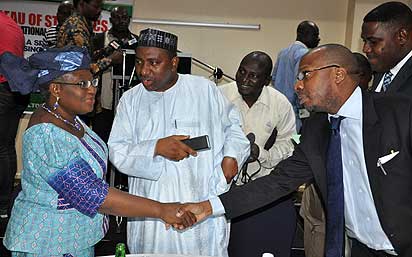
*Briefing on Result of GDP in Nigeria: Minister of Finance and Coordinating Minister of Economy, Dr. Ngozi Okonjo –Iweala chatting with Minister of National Planning Amb. Bashiru Yuguda and Statistician –General of the Federation and CEO of National Bureau of Statistics Dr. Yemi Kale during presentation of Preliminary Results of the Rebased Nominal Gross Domestic Product ( GDP) Estimates from Nigeria 2010 to 2013 held in Abuja. Photo by Gbemiga Olamikan.
BY Dele Sobowale
“One must show the truth to posterity with boldness and to his contemporaries with circumspection. It is very hard to reconcile those two duties.” Voltaire, 1694-1778. ( BOOK OF QUOTATIONS p 255.)
The great Albert Einstein, 1879-1955, reputed to be the most intelligent person to have walked the earth, was the father of one quaint formula, E= MC2, which had been driving physicists and mathematicians crazy ever since it was published. Only God knows how many Ph.Ds have awarded to scholars conducting research into several aspects of the formula. And the end is not in sight yet.
Like all Americans, Einstein tried his hands at other subjects, including music and economics. He gave up both for different reasons. Music he found “too simple and economics, too difficult”. I gave up Medicine because it was too difficult and took up economics because it was simple enough to enable me go through a university with the minimum of effort – while leaving me with a lot of time to read wide. What has that got to do with rebasing? Wait a few minutes and you will soon understand it.
What did Einstein find so difficult to grasp in economics? He told us; his problem was reconciling the paradoxes which are so thickly embedded in economics. They simply drove the Professor of professors up the walls. To me, an economist, if he/she is any good, must have a mind made out of soft rubber – capable of taking any shape in order to reconcile the paradoxes inherent in our ‘science’.
The public debate, on rebasing the Nigerian GDP, is being conducted, mostly, by people whose minds are set in concrete. They simply don’t know how to deal with the new information – which contradicts everything they have been told, learnt and experienced. That the governments of Nigeria, generally, lack credibility has not helped matters. And, this statement applies to all governments – not just Jonathan’s.
The fact that we are already caught up in 2015 elections and the tricks politicians play had further made objective considerations of the result of rebasing almost impossible. The inanities the spokesman for APC – a lawyer – reportedly announced in response constitute the worst form of ignorance on the subject. Similarly, the attempt by some PDP members to claim credit on behalf of Jonathan for the ‘achievement’ represents dishonesty of the highest order.
The adjustments started from 1991, when Jonathan was nowhere near government, and they will be reflected in our annual GDP figures henceforth – long after GEJ would have departed office; either in 2015 or 2019. So, this thing has absolutely, nothing to do with Jonathan’s performance in office.
Permit me to quickly repeat a statement, about Dr Kale, the Statistician-General, from last week’s column, which documented the skeptics complaints about “positive” data supplied by governments whose credibility is in doubt. The statement said, “…………..”. The message I intended to get across then was clear to me. Dr Kale is a victim of “guilt by association”.
Most Nigerians don’t know him; and, certainly, many more don’t even know what are the mandates of the nation’s Chief Statistician. As far as they are concerned, he is part of government and, as such, cannot be trusted. It is in that respect that he still continues to earn my sympathies. The man had undertaken a gargantuan exercise, which others before him had avoided, like the plague, and instead of, first of all, being commended for the great effort, he had been condemned all around for the results.
I will come to the end result later. But, it is important we first of all separate the process, the exercise, the result and the person responsible for all three from the rest of government. That way, we can critically examine the work objectively and derive from it all the innumerable lessons it can teach us as a nation.
Believe me; rebasing had revealed several important truths about our economy, such as should we engage hundreds of Nigerians studying economics to look into for their Ph.D. However, this is not the forum to list some of them.
Having spent last week paying tribute to the pessimists and skeptics, without whom governments would have turned all of us into praise singers, let me now demonstrate what I mean by the mind of soft rubber needed to understand the paradoxes of economics. Dr Adeleke, recently retired Commissioner of Police, for Health Services, and a worthy old boy of Igbobi College, used to tease me that I am the only economist who does not say “on the other hand”. I wish him a well-deserved and happy retirement; but, I will disappoint him this time.
On the other hand, REBASING IS NOT ONLY A LEGITIMATE EXERCISE BUT ONE WHICH SHOULD HAVE BEEN CONDUCTED SEVERAL TIMES IN THE PAST — irrespective of what we think of the motives for undertaking it. Dr Kale deserves at least that credit and, perhaps more. Meanwhile, Dr Okonjo-Iweala, who was Federal Finance Minister, when one was due in 2004/2005, but failed to order one exercise to be conducted, should spare us her comments about this one. Politeness to ladies is still important.
Does that mean I accept the $510b GDP figure? The answer is NO. But, before the critics and the supporters of the Federal Government start to react, let me state the reasons for my disagreement. To me the rebasing exercise, just concluded, despite being a step in the right direction, has not gone far enough. Don’t forget, I talked to Dr Kale last year and I got a feel for what was being done.
Because, the exact GDP of any country would never be known, mostly, on account of invisible trade, it is my strong belief that the Nigerian GDP is actually bigger than $510b. To be quite candid, I think Dr Kale recoiled from going all the way to demonstrate how large the potentials of our economy really are. I can’t blame him.
If he received the sort of reactions we read in the papers or listen to on electronic media, for declaring $510b, someone would probably have asked that he be put in a straight jacket if he declared $700b. I don’t have Dr Kale’s constraints; perhaps, because one needs to be a bit crazy to write columns in Nigeria these days. To me the Nigerian GDP, which by the way is an annual figure and not static, is larger than $510b. Let me quickly start to explain – before the straight jacket is ordered for me.
TO BE CONTINUED
Visit: www.delesobowale.com or Visit: www.facebook.com/biolasobowale
Disclaimer
Comments expressed here do not reflect the opinions of Vanguard newspapers or any employee thereof.