
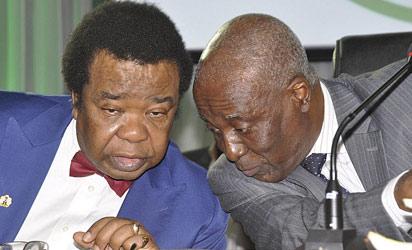
Professor Bolaji Akinyemi and Justice Idris Kutigi
By Is’haq Modibbo Kawu
It was GG Darah who first pointed it out to me graphically, just before the commencement of plenary on Monday this week. Nigerians have always known how to move away from the brink.
And while many people despair almost to the point of total rejection of their country, Darah read lines from his column for THE GUARDIAN this week, about the role Nigeria has played in peace making in several parts of the African continent, dating back to the Congo crisis of the early 1960s.

Professor Bolaji Akinyemi and Justice Idris Kutigi
The mood inside the hall was rather friendlier at the beginning of the week, because of the deal that was cobbled together by a group of 50 delegates who Chairman Justice Kutigi interestingly chose to describe as ‘friends of the Conference’. We had gathered to hear the details, but not a single delegate was unaware of the horse-trading which finally broke the impasse that forced the adjournment of sitting last week. We arrived more sober about the realities of the conference and the fact that things were never going to be straight forward in terms of expectations. Yet, it was intrinsic to the National Conference that too much hostile passion was going to seep to the surface sooner rather than later.
And it came so early with the debate about voting percentages. I have already written about that on this page last week.
Different delegations
I have watched comings and goings of members of the different delegations over these past couple of weeks, and it became even clearer to me that as we moved forward with the process, even more hostile emotions will be expressed.
There is a real difference of perception, attitude and expectation from one group to the other, mirroring the historical fault lines that have always dogged the elite rivalries of Nigeria, from the commencement of politics, as a means of securing power, dating back to the 1950s.
The fact that some of the old men of those early years of Nigerian nationhood are also part of this National Conference merely brings home the monsters that, for all these decades, have dogged Nigeria. It was therefore completely predictable that we would run into heavy weather and frightening turbulence.
The issue was how we weather the storm. The ‘friends of the Conference’ dammed the anger from the two sides of the heated debate and in an expression of that Nigerian ability to walk away from the brink, when it becomes imperative.
That was where GG Darah’s reminder became very relevant. I saw in Darah, my old comrade from his years as a lecturer from the old University of Ife. Darah used to be one of the most committed of Nigerian Marxists; a genuine comrade with an infectious sense of humour and that incredible ability to make you welcome.
He is a folklorist whose research into the folk traditions of the various peoples of Nigeria, starting from his own Urhobo people, is one of the major contributions to Nigerian and African scholarship. But then the years rolled by and the changes in the international system, with the collapse of the world socialist system, changed the perspectives of many socialists in all parts of the world.
Nigeria was not spared of the same troubling responses to those earth-shaking changes. Imperialist triumphalism was expressed in Francis Fukuyama’s arrogant thesis about the end of history. Chasms developed between and amongst Nigerian socialists too.
The politics of identity overthrew allegiance to a class-based worldview. GG Darah became a passionate ideologue of the new and strident agitations which centred on the conditions of existence of the people in the Niger Delta region of our country. The new situation also seemed to have alienated comrades from themselves across the country.
It has taken the 2014 National Conference for us to meet again. And somehow, the bonds of old were still attractive and they were the basis of the insight that GG Darah brought to his explanations early this week. The encounter with Darah was one of many other encounters; but I think the most significant development is the effort being made by civil society organisations to help build a coalition that will bring in the labour movement, media, youth and progressive intellectuals in order to build a pan-Nigerian platform.
The idea behind this initiative is to help sweep the carpet off the feet of the regionalist and sectional agendas that have proven divisive and are always going to continue to heat up the process as we move forward. These, in the main, have been the lifelong agendas of old men, many of them in their eighties and late seventies.
They are stuck in a time warp and in my view are far removed from the real issues which Nigerians can unite around. If we succeed with the coalition building effort, then the idea is to try and unite Nigerians, especially the younger generation, to fight for those ideas that can assist in fighting underdevelopment and building an economic system which creates jobs and works for the mass of Nigerian people.
Political battles
As I never tire to remind here, the majority of Nigerians today are under the age of 35. As a matter of fact, the old people who bring the mindset of the political battles of the 1950s to this National Conference are merely 3.5% of Nigeria’s population today. It is incredible that it is this group that is frantically trying to determine how Nigeria must look like into the future; but in truth, these are people of the past!
But if we return to my thought about how Nigerians will skillfully move away from the brink, we will have to be honest to say that the work done by the ‘friends of the Conference’ took in all segments of the Conference.
It was the inclusive nature of the team and the realisation that no group can hold the entire Conference to ransom that we all need each other to find success, that finally allowed people to return to their conciliatory best. It allowed us to break the logjam of the previous week, without removing, completely, that underlining suspiciousness that is wired into every gathering of Nigerians.
As we commenced responses to President Jonathan’s address at the opening ceremony of the National Conference, the underlining bitterness, suspicions and venom are rising to the fore once again.
Intrepid media cameramen
But on a lighter note, not a few of my friends have been caught sleeping by the intrepid media cameramen covering the Conference.
Those pictures of sleeping delegates are the first items of hilarious discussions every morning before the commencement of plenary. Some of my friends have mischievously warned me not to be caught sleeping; they probably forgot that I am the quintessential insomniac!
There is something that the reader has also noticed; I am a delegate and participant in the National Conference, but I am also trying to find the detachment to be able to continue my professional existence as a journalist and commentator.
I will try to balance the dialectic as creatively as possible through this three-month assignment. Let’s see how things pan out!
Do they really think in the PDP?
Last weekend, the PDP was in Bauchi to hold a North East regional rally. It was a roll call of the biggest names in the party, all led by President Goodluck Jonathan. As usual, Jonathan bungled his rally by playing politics instead of being Nigeria’s president.
He accused the governors from the region of creating the condition which allowed the insurgency in that region of Nigeria to fester. And betraying his inability to rise to presidential heights, he still compared what was happening in the North East to militancy in his own state. But do these PDP people think at all? Do they honestly have a sense of honour or a sense of shame?
It is incredible that they could hold a rally in Bauchi, yet the same president could not spare time to visit Yobe to commiserate with the people on the tragic massacre of Nigerian children a few weeks ago.
Jonathan refused to visit; he could not send his vice, Namadi Sambo; and the Minister of Education never saw a need to also visit. Those children are not theirs, obviously, and the region could have been in Sudan, or wherever, as far as they are concerned.
Presidential responsibilities
A caring president who sees every part of his country, his own, would have also visited Borno in the wake of the attack on Maiduguri and the Giwa barracks in the city a couple of weeks ago.
Jonathan has continued to allow petty politicking to becloud his presidential responsibilities in respect of his relationships with Borno and Yobe. It is instructive that the same president allocated merely N2 billion as fund for the reconstruction of the entire North East part of Nigeria. Yet he found $1 billion to fight oil theft in the Niger Delta.
If the past is our guide, it won’t surprise if the $1 billion end up in the pockets of Niger Delta militants, allies of President Jonathan. The PDP cannot expect people of a region that the president has not shown any modicum of empathy to also vote for them and its president, Goodluck Jonathan.
We must collectively remind President Jonathan that he has not acted presidential in the way that he has responded to the continuing suffering in that segment of our country. There is a long list of indecencies in the way the PDP denizens have related to the feelings of Nigerians.
That is the way the party increasingly became, having become addicted to power without responsibility since 1999. But President Jonathan and his PDP sunk much lower into absurdity over the last weekend by flying into Bauchi to hold a rally.
It was a most unfortunate display of insensitivity by a president who swore to an oath to do justice to all sections of Nigeria, without exception! Those in the ruling party as well as those who rule us just don’t appreciate the weight of the responsibility they willingly chose to carry.
Disclaimer
Comments expressed here do not reflect the opinions of Vanguard newspapers or any employee thereof.