
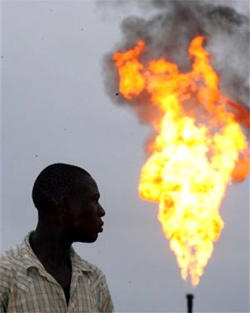
Gas flaring
THE history of crude oil production in Nigeria informs us that the Shell Oil Company was the first to discover oil in commercial quantity in Nigeria.

*Gas flare
The location was Oloibriri (now in Bayelsa State), and the year was 1956. Two years later, Nigeria’s first consignment of crude oil was exported from the Oloibiri oil fields. But what is not well advertised is the fact that gas flaring has been taking place in Nigeria since 1958. The ecological disaster and associated consequences of gas flaring in Nigeria have been well-documented, and do not constitute the main objective in this dispatch from America.
As a Vanguard newspaper reporter, I once joined the Nigerian Navy on an exercise in Escravos. As we flew in their helicopter above the off-shore oil rigs at night, we could see what looked like a festival of a million tongues of fire in the ocean.
Our Navy flight crew explained to us that what we were looking at were the gas-flaring activities of the oil companies that operated in that area. It was a remarkable sight with an equally remarkable environmental danger.
A few weeks ago, I was listening to the National Public Radio, which you can say is the U.S. equivalent of the British Broadcasting Corporation, BBC. The station was airing a news-feature programme on how people in North Dakota State in the U.S.were reacting to the phenomenon of oil companies flaring gas. I immediately remembered the trip to Escravos.
What you are about to read is the entirety of an official press release in Bismarck, North Dakota, dated October 16, 2013. Perhaps, there is a lesson for the Nigerian government in this North Dakota response to the flaring of gas by oil companies operating on its territory.What is good for the people of North Dakota on this matter, I suppose, should be good for Nigerians.
Ongoing litigation
This is an on-going litigation. “Today North Dakota mineral owners filed ten class action lawsuits in North Dakota State district court against oil companies operating in North Dakota’s Bakken oilfield, seeking damages for natural gas flared – or burnt off into the atmosphere – from oil wells in violation of state flaring laws. Copies of the complaints filed are available at www.ndgasflaringlitigation.com
“The named plaintiffs and the class members they seek to represent in each case are western North Dakota mineral rights owners who potentially have lost millions of dollars in royalties due to producers’ practice of burning off large quantities of gas rather than selling it.
The lawsuits seek to force operators to comply with state law and pay royalties to mineral owners on the value of flared gas, and by so doing create a compelling economic incentive for producers to reduce and eliminate the wasteful practice of flaring. Bakken natural gas is some of the most valuable gas in the country due to its density of natural gas liquids (NGLs).
“Flaring of natural gas from North Dakota oil wells is a controversial practice that has more than doubled in volume in the last two years, according to recent reports. NASA photos of flaring in North Dakota oilfields taken from space resemble a large urban area rivaling Minneapolis-St. Paul and Chicago in size.
The North Dakota Industrial Commission, which regulates the state’s oil and gas industry, is working hard to regulate the recent Bakken shale oil and gas boom and with public support is looking for ways to reduce wasteful wholesale flaring of valuable gas.
“Gas flaring in North Dakota has risen meteorically over the past few years, triggering growing public concern on a local and national scale. In 1999, North Dakota flared only three per cent of its gas production.
The North Dakota Department of Mineral Resources announced recently that operators flared off 30 per cent of the gas produced in July 2013. An estimated $100 million worth of gas is flared in North Dakota each month.
In March 2012, a group of investors representing $500 billion in assets sent a public letter to twenty-one of the largest U.S. shale oil producers, asking them to reduce flaring because it might ultimately “threaten the industry’s license to operate.” On August 25, 2013, the Bismarck Tribune editorialized on the need for “a harder line” by the state on flaring.
“North Dakota law allows limited flaring during the first year after an oil well enters production if certain oil production limits are followed; then after a year, a producer must apply for a written exemption for any future flaring.
If it fails to do so it must pay royalties and state taxes on the “flared gas”. In the lawsuits, the plaintiffs allege that operators are flaring in excess of production limits during the first year, and flaring beyond a year without exemptions, and without paying royalties on flared gas, which violates North Dakota law.
Presently around 1500 wells are flaring gas in North Dakota without connections to pipeline and processing plant infrastructure. Other wells supposedly have pipeline connections in place but producers continue to flare the gas anyway.
“Counsel for the royalty owners are five law firms from North Dakota, Colorado, Texas, Montana and Wyoming with oil and gas and class action experience.”
Source:http://www.ndgasflaringlitigation.com/ In short, this press release is about oil companies paying for the loss of revenue resulting from wasted income that might have accrued from the gas being burnt into the atmosphere. Of course, the ecological damage precipitated by flaring gas is another matter altogether. Nigeria’s oil and gas administrators need to study what is being done in North Dakota.
Disclaimer
Comments expressed here do not reflect the opinions of Vanguard newspapers or any employee thereof.