
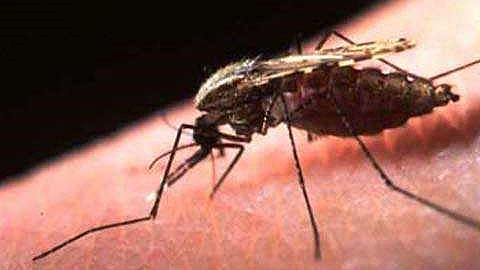
mosquito
By CHIOMA OBINNA
FOr over a decade, Emmanuel and Ruth Odigie and their four children reside in a rented two-room apartment in Ajegunle area of Lagos. Year in, year out, the poverty-striken family have had their share of tales of woe. Come rain, come shine, they are forced to cope with challenges of living in an unhealthy environment.

Worse still, the residents hardly observe any clean up. Everyone claims to be too busy. No one cares about the situation. One of the common diseases among the residents is malaria.
“In a year, almost everybody in my house suffers four or five episodes of severe malaria. On the average we spend N7,500 monthly to treat malaria for the whole family. We have insecticide treated nets, but we do not use the nets because of the heat. There is no electricity around here for months,” Emmanuel recounted.”
He and his family are among the 15.03 million Nigerians at the risk of malaria annually. Data from the World Health Organisation, WHO, shows that malaria infected around 219 million people in 2010, killing around 660,000 of them – the vast majority in sub-Saharan Africa. But some global health experts say the annual malaria death toll could be higher.
Nigeria malaria burden
Minister of Health Professor Onyebuchi Chukwu describes malaria as a major public problem in the country. “Nigeria contributes a quarter of malaria burden in Africa. Over 90 per cent of the country’s 167 million people are at risk. It contributes 30 per cent to childhood mortality in the country and contributes 11 per cent of maternal mortality. I must add that it reduces Nigeria’s Gross Domestic Product by one per cent annually. It is estimated that malaria-related illnesses and mortality cost Africa’s economy about $12 billion annually.”
The Demographic and Health Survey, DHS of 2008 reported an infant mortality of 75 per 1000 live births and an under-five mortality of 157 per 1000.
Unarguably, there have been concerted efforts to control malaria in Nigeria and Africa as a whole. These efforts appear to be yielding dividend as there is evidence in reduction of childhood deaths for some years now. However, this success has encouraged the world into pushing for total eradication of malaria.
Although, evidence suggests this is a feasible goal using new interventions and tools such as vaccines, which are in development,health watchers stress that the environment remains a stumbling block in winning this war against malaria, particularly in countries like Nigeria.
Mosquito-borne disease
Country Director, “Malaria No More”, Mrs. Dayo Oluwole, says malaria is a mosquito-borne disease caused by a blood parasite called Plasmodium.
“Patients with malaria typically are very sick with high fevers, shaking chills and flu-like illness. According to Oluwole, although malaria can be a fatal disease, illness and death from malaria are largely preventable.
Today, it is no longer news that in most rural areas of Nigeria people are living below poverty line and where poor housing and horrible living conditions are the order of the day. It is also common place to find poor drainage systems which experts say promote mosquito breeding.
Leakages, obstructions and small pools or puddles of residual water in drainage ditches often afford suitable breeding sites for mosquitoes. The planning and construction of some drainage systems in the country today are poorly constructed. Most of the gutters are not flowing.
Future global warming burden: New studies say future global warming could lead to a significant increase in malaria cases in densely populated regions of Africa and South America unless disease monitoring and control efforts are increased. In the study of the mosquito-borne disease that infects around 220 million people a year, the researchers found what they described as the first hard evidence that malaria creeps to higher elevations during warmer years and back down to lower altitudes when temperatures cool.
This in turn “suggests that with progressive global warming,malaria will creep up the mountains and spread to new high-altitude area.
International effort to reduce malaria burden are laudable, but there may be need to pay more attention to the environment. Just by cleaning and modifying the environment it can be hard for the mosquitoes to complete their life cycle and transmit malaria.
Individual perception about malaria: President of the Malaria Society of Nigeria, Dr. John Babajide Puddicombe, says clean and simple environment is a major factor in the war against mosquitoes which transmits malaria.
“Individuals should changed their perception about malaria and maintain clean and simple environment as a deterrent to mosquitoes breeding and a change of attitude.”
Government and stakeholders: “If government and other stakeholders come together to fight malaria holistically, in no distance time, the burden of malaria in Nigeria and Africa at large may not get to zero level but can be reduced to an insignificant level” Issues of drain systems and prevention of stagnated water and use of mosquito nets should be emphasized, says Dr. Sunday Luro, Paediatrician at the Gbagada General Hospital, Lagos, Luro urged the public to keep drains clean and avoid stagnated water around their houses and should also use mosquito nets.
The fight against malaria should not be limited to the distribution of mosquito treated bed nets and making the treatment of malaria free to children below five years. While these moves are laudable, their sustainability is in doubt as this could be fairly compared to problem reduction rather than problem solving.
Need to pay attention: There is need to pay more attention to the environment and avoid all those behaviours which are favourable conditions for the establishment and proliferation of mosquitoes.
Disclaimer
Comments expressed here do not reflect the opinions of Vanguard newspapers or any employee thereof.