
By Our Reporter
Municipal solid waste (MSW) management is an essential component for sustainable development and public health. In Equatorial Guinea, there has been a remarkable demographic and urban growth in recent decades which has equally been matched with the challenge of waste management that requires attention.
According to data from the World Bank, the population of Equatorial Guinea increased from approximately 350,000 inhabitants in 1990 to about 1.4 million in 2020.
Likewise, INEGE reports a constant upward trend from 1983 to 2015. The inadequate accumulation and poor management of solid waste represent not only an environmental problem, but also a social and economic one, directly affecting the quality of life of its inhabitants and the conservation of the natural environment. Despite the efforts made by local and national authorities, integrated solid waste management in many urban and peri-urban areas still faces multiple obstacles, such as insufficient adequate infrastructure, lack of clear policies and limited community participation.
An in-depth diagnosis of the problems faced by communities in relation to the generation, collection, treatment and final disposal of their solid waste shows deficiencies of the current system and lack of active participation of the population, considered key agents in the implementation of sustainable solutions.
To get Equatorial Guinea out of the doldrum, experts recommend a need to strengthen institutional capacities, promote environmental education, optimize collection systems and encourage responsible practices by citizens, thus contributing to a more efficient, inclusive and ecologically viable management of solid waste in the country.
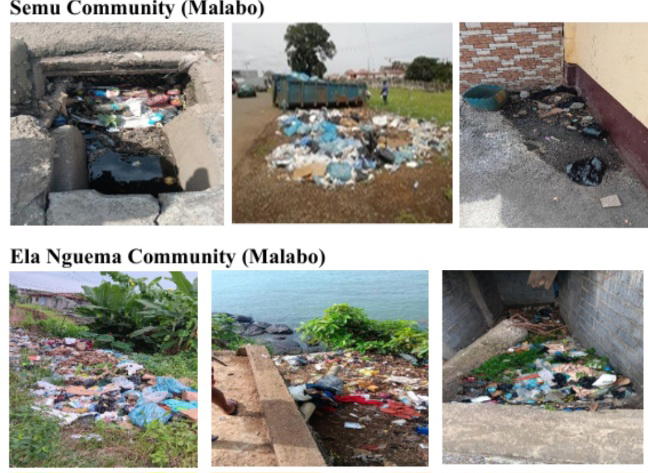
A visit to Semu, Lampert and Elá Nguema – three districts of Malabo with high population density exposes diverse waste disposal practices consistent with the urban environment of the capital, and the different socioeconomic strata and domestic consumption habits.
THE PROBLEM
Equatorial Guinea’s economic growth, driven by the oil sector, has fostered an increase in consumption and, consequently, in the generation of solid waste in Malabo and Bata. However, economic development has not been accompanied by adequate waste management infrastructure. The lack of efficient systems for collection, treatment and final disposal has led to public health problems, accumulation of waste, water pollution and the proliferation of disease vectors. Likewise, the absence of comprehensive policies limits the adoption of circular economy practices such as recycling.
Currently, the system is limited to collection, transport and dumping in peripheral areas.
Waste Disposal Method
About 60 percent of residents use municipal containers, while about 30 percent dispose of their waste in ravines, rivers or the sea. The remaining opts for open burning. This happens because nearly half of the population does not have access to official final disposal systems.
Most also live distances to the containers. A sizeable number said they must walk up to 15 minutes to find one, which shows that poor waste disposal is not exclusively due to cultural habits, but to a real gap in basic infrastructure.
It is estimated that, if the container is more than 5 minutes away, the probability that the waste will end up on public roads significantly increases.
Consequences on the Environment
Those who volunteered to speak on the subject said that canals and ravines are obstructed by garbage. Many perceive unpleasant odors near their homes and there are also plastic wastes on beaches and rivers. They also mentioned the prevalence of burning of garbage in their environment.
The poor urban solid waste management in Malabo are categorized into:
➢ Visual pollution, due to the poor disposal of waste in the streets
➢ Atmospheric pollution/global warming, caused by the burning of waste in the
open field.
➢ Pollution of water bodies, caused by the dumping of waste into rivers and seas.
Consequences on Human Health
Some of the health problems associated with the solid waste management issue includes diarrhoea and stomach ailments, breathing problems and cough among affected families, dermatological problems and insect bites. These issues are prevalent among most of the population due to the accumulation of waste
Economic consequences
The undue accumulation of waste also affects the landscape, the value of houses or land and businesses and shops.
On the wastes dumped in the rivers, Rita Lopez who has lived in the city since 1960 said that she remembers that, at that time, the river was completely clean; there was no trash and there was even a specific place where you could drink water directly from it.
The channel was straight and you could fish with peace of mind, managing to fill up to four or five baskets of fish without any problem. However, the environment changed drastically due to construction, which diverted the natural course of the river. Currently, between the works and the accumulation of garbage, water runs anywhere, causing serious flooding in low-lying areas. When it rains heavily, water enters the houses and, when the storm ends, the rooms are full of waste and dirt.
SITUATION IN THE CITY OF BATA
Urban waste management in the city of Bata and its social and environmental impact is also of grave concern. Here there is blame game among the government and companies and the citizens on which sector generates more waste.
There is however unanimity among nearly half of the citizens that poor urban waste management generates water pollution and soil pollution.
The findings show that the most prominent practice is the dumping of waste in open spaces among those who live in urban areas, use of community containers for waste disposal and waste burning as a method of waste disposal.
The investigation however shows critical deficiencies in collection logistics. The inefficient location of the collection points, coupled with the scarcity of infrastructure, prevents proper waste management. This logistical disconnect forces residents to resort to unsanitary disposal practices, as moving waste to landfills is unfeasible under current conditions.
There is a normalization of bad practices and the generation gap. One of the most alarming findings is the social normalization of poor waste management. There is a lack of internalization about the environmental consequences: the incorrect disposal of waste has become a common practice that crosses different social groups, from students who discard wrappers on public roads, to adults who incinerate household waste, ignoring the toxicity of emissions.
The degradation of the urban environment and health risk, the visual and olfactory impact is evident in both cities. The accumulation of waste in ravines and peri-urban areas has created permanent sources of infection.
It was observed that these spots have become breeding niches for (rats, flies, mosquitoes), aggravating the respiratory and skin health problems mentioned by residents. Likewise, the constant presence of plastics, water currents during the rainy season, the risk of flooding due to clogging of canals is threatening, which would further complicate the health situation.
In the perception of the citizens regarding the public service, despite the poor conditions, there is a willingness among citizens to improve the situation. Many residents express frustration at the lack of a robust system, but also a willingness to collaborate if they perceive concrete changes in the frequency of collection or accessibility to drop-off points.
The general perception is one of institutional helplessness; Citizens feel that, although they want to do things right, the system does not provide them with the necessary tools to comply with responsible waste management.
Joaquin Esono who has lived in that town since he was 10 years old is of the view that the city has grown and there are more people, that has been good, but many people generate more garbage. Before, when there were few people, there was not much garbage in the streets, however, garbage is registered everywhere you go in the city.
“People throw garbage anywhere, in yards, rivers, fields, highways even behind their houses. Children play surrounded by garbage, people live surrounded by garbage, and the situation is getting worse and worse. The government must do something, but so do we, the government will not tell you how to clean your house or yard, the government is not going to monitor each person so that they do not throw garbage anywhere. it is necessary to strictly prohibit these discharges and raise awareness among the population; The problem is not the river itself, but the carelessness of the people”.
It could be summarized that the waste management crisis in Malabo and Bata is a multifactorial phenomenon where insufficient infrastructure acts as a catalyst for inappropriate behavior.
The persistence of this “collect and dump” model is not only unsustainable, but it is eroding the quality of urban life, public health, and the economic image of the country’s most important urban centers.
The current management of urban solid waste in Malabo and Bata represents a structural vulnerability. The convergence between accelerated urbanization and the lack of adequate infrastructure has led to a health and environmental crisis that compromises the quality of life of citizens and the integrity of local ecosystems.
The findings underline that the current model, characterized by informal burning and indiscriminate dumping, is unsustainable in the long term. The mitigation of these impacts requires an imperative transition towards a comprehensive management model, based on three strategic pillars: the technological modernization of the final disposal infrastructure, the implementation of a rigorous regulatory framework that regulates the environmental responsibility of the public and private sectors, and the establishment of citizen education policies that promote the circular economy.
Ultimately, the success of any intervention will depend on coordinated governance, which integrates investment in installed capacity with a culture of social co-responsibility, thus ensuring healthy, resilient urban environments aligned with national objectives of well being and development.
To balance economic growth with sustainability, it is proposed that the government invest in infrastructure, especially the construction of adequate treatment plants and sanitary landfills.
It must also carry out environmental education programs focused on reduction and recycling, implement comprehensive policies that promote the circular economy and community participation., and establish clear regulatory frameworks along with an improvement in accessibility to the collection service
The challenge for Equatorial Guinea is to balance its economic growth with proper and sustainable management of urban solid waste, which protects the environment and improves the quality of life of its population.
Disclaimer
Comments expressed here do not reflect the opinions of Vanguard newspapers or any employee thereof.