
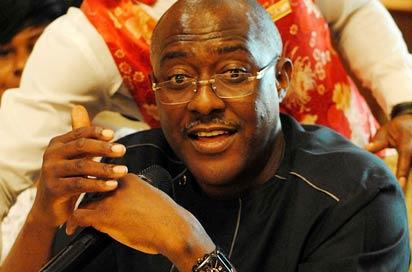
Chief Olisa Metuh
By Is’haq Modibbo Kawu
Last week, Olisa Metuh, the ruling PDP’s Publicity Secretary, said the insurgency in the country was sponsored by unpatriotic elements to discredit President Goodluck Jonathan’s administration. According to him, Jonathan is being persecuted for no other reason than being a Nigerian from a minority ethnic group, adding further that no leader in the history of the country faced the height of persecution the President has been subjected to since he assumed office.
Well, just in case Nigerians had forgotten, and with eyes firmly fixed on the needs of the 2015 elections, Metuh “recall[ed] statements by some politicians vowing to make the country ungovernable for President Jonathan on the eve of the 2011 general elections”.

Olisa Metuh
And in order to awaken [Christian] religious consciousness (manipulating the religious fault line has become grand strategy of the Jonathan campaign project for 2015 just like it was in 2011!), he described the action of the ‘unpatriotic’, but apparently faceless elements (it is always politically profitable to set up straw men, that can be repeatedly flogged!), as “the climax of wickedness only heard by Lucifer in the distant bosom of hell fire”.
A few days later, Metu went even further when he said that his PDP had “verifiable evidence” that the opposition All Progressives Congress, APC, was involved in insurgency in the country. According to him, his accusation was “not in vain”, just as he had summarized the manifesto of the APC as “a product of Janjaweed ideology”.
Unprecedented violence
And to remind us that the dirty politicking for 2015 was already underway, Metuh added that “it was not a coincidence that after General Muhammadu Buharinhad beckoned on his supporters to go on a lynching spree should he lose the 2011 presidential election, an unprecedented violence broke out, which claimed the lives of hundreds of innocent Nigerians”.
Not done, Metuh, then returned to Buhari’s “allegory” of bloody monkey and baboon in respect of the 2015 election as well as Nasir El-Rufai’s warning that there might be violence if the 2015 elections were not free. Metuh said El-Rufai’s admonition amounted to “prophecy of violent deaths and destruction”.
There are many interesting matters arising from Metuh’s desperate attempt to play Joseph Goebbels’ card. In the first place, the fact that his statements have not been denied by the PDP, make them official party position. Similarly, it is incredible that the Jonathan PDP administration knows the “unpatriotic elements” sponsoring insurgency but has chosen not to arrest and prosecute them since 2011. It also refused to arrest and prosecute General Buhari and Nasir El-Rufai, despite Metuh’s “verifiable evidence”. It means that something is wrong with the PDP and its administration, because by refusing to so act, they violate Section 14 (2) (b) of the 1999 Constitution, which says: “The security and welfare of the people shall be the primary purpose of government”. Hundreds of Nigerians have been killed in the Boko Haram insurgency and yet in spite of the PDP having “verifiable evidence” of those responsible, President Goodluck Jonathan has flatly refused to act upon the evidence, allowing Nigerians to continue to die! No wonder that he has refused to visit Yobe where over 50 young Nigerian students were recently slaughtered or Borno, where hundreds have been and are being killed!
Metuh is a bad salesman for PDP’s political wares. His consistent effort to manipulate Nigerians’ emotions by reference to the 2011 post-election violence is part of the grand strategy for the 2015 elections. He hopes to herd Nigerians into the larger of religion for effective divisiveness in 2015. It is also part of that grand design that there is the propaganda that the opposition APC is a Muslim party, dominated by Muslims. They are apparently or implicitly saying the PDP is also a Christian party! The exploitation of religion for political advantage is very dangerous politics but is clearly important for circles around President Jonathan, and party spokesperson Metuh for the 2015 elections. It served Jonathan well in 2011; he has returned to visiting various churches around the country, to strengthen the narrative that he is the Christian candidate.
Metuh’s demonisation of his APC opponents from that same platform fits a pattern of manipulative use of religion for political ends. It is the reason that I describe Metuh as suffering a Goebbels Complex: repeat a lie as often as possible and a significant segment of the population might believe a reasonable amount of the lies.
It is instructive that on the same day that Metuh was expressing his Goebbels Complex, the National Security Adviser, Sambo Dasuki, was unfurling a new counter-insurgency strategy for the country. Dasuki’s plan recognises that there must be a de-radicalisation process along with a well-laid out socio-economic project that seeks to empower the young and vulnerable in those areas of the country where the insurgency has laid communities to waste and has been responsible for the recruitment of young people as well as the killings of many of these young people. In all that Dasuki laid before Nigeria, there was no hint of Metuh’s “verifiable evidence”.
It was a proffessional, well thought out document, which offers a different narrative as well as providing a responsible platform to end the insurgency; de-radicalise the youth, working with people in the various communities where the insurgency took hold and hopefully, opening up the vistas of an inclusive, democratic society, with a modicum of social justice.
It is unfortunate that Metuh was making his wild statement on the day that the NSA was assisting President Jonathan with a serious, well thought out and patriotic programme. A Goebbels Complex is an expression of the irresponsible side of politicking; unfortunately it is the complex that Metuh thrives upon as PDP’s spokesperson. With individuals like Metuh, it should not surprise us that the PDP has moved so far away from the patriotic idealism of its founding fathers; like the much lamented Chief Sunday Awoniyi.
National Conference 2014: Of sparks, hot air and entrenched positions
One of my resolves as a delegate to the 2014 National Conference is to keep a running diary of events of each day. I have not been able to do so just yet. But I have observed as keenly as possible as the heat of the battle of the entrenched positions of the various delegations has risen like the thermometer in the two days of meeting this week.
Because of the alphabetical arrangement of seats, I have sitting almost directly behind me, Col. Anthony Nyiam, whose name connotes controversy at various levels of our national life. It is very safe to describe Nyiam as a very emotional man. He responds to arguments with a passionate abandon and I have tried to engage him in discussion about his views of the Nigerian situation.
Of course his position has been severally canvassed in the media and they reflect the general argument that many elite circles in Southern Nigeria canvass: restructuring the country into regions so that they can not only control their resources, but also “healthily” compete with each other, as they decide how they govern themselves.
It is clear to me that the fundamental contradictions located in the nation’s political economy choices completely escapes Nyiam as it does a lot of those who share that broad perspective. I say that not as critique of the individual, but merely to point out that the posturing that heat the Nigerian polity are located squarely within the inter-elite rivalry that has been fought from ethno-religious and regional trenches since the beginning of Nigeria. It was also clear to me that the demographic reality of Nigeria does not play into the focus of disputation, either within the National Conference or out of it, with the various groups of the nation’s elite.
Passionate debate
That is why the underlining current of the passionate debate which commenced this week has been about the positions of the so-called regions and so fiercely insistent are they going to be canvassed, that one of the elite groups, the Yoruba elite, actually said that any Yoruba person that refuses to support that agenda must not return to Yorubaland! Phew! And before you could spell conference, the outlines of the battles of the next three months are already out in bold relief.
The debate about consensus or whether 75% of delegates voting as the Procedure Rules book said, or the 2/3 of delegates voting as a section of the delegates canvassed on Tuesday this week. Those who did the numbers crunching noticed that there were deliberate imbalances worked into the composition of the delegates to the National Conference from the beginning. Of the 492 delegates, only 191 come from Northern Nigeria; that could not have been an accident!
Those who want the voting pattern changed are mainly the delegates from the South who sensed that the numbers momentum is with them and the Northern delegates will not allow any deviation from what Procedure Rules book said, especially again because President Jonathan canvassed the option of consensus building during the National Conference.
I don’t have any delusions about the depth of distrust between elite groups in Nigeria. That has been one of the greatest problems militating against building a genuinely great country. It has never stopped amazing me that the default position for elite groups in Nigeria, whenever they are locked in rivalry, has always been to question the right of their country to continue to exist: secession and disintegration seem to be some of the most beloved concepts amongst Nigerian elite groups and as we move ever closer to 2015, they seem determined to make that end of Nigeria become a self-fulfilling prophesy. This week at the National Conference, the sparks, heat and entrenched positions are becoming the frighteningly dominant currents of the discourse.
They are portents for the monster on the horizon. Nigeria is dangerously divided; elite groups have built emotions close to hate for the “other” and these emotions becloud judgement and condition the thrust of argument and debate. If we cannot build the consensus to break these emotive logjams, then things will get even worse as we move forward. That is very clear in my mind.
But I am very interested in how these elite forces will play their hands and meet the admonition from President Jonathan that “we must seize the opportunity to cement the cleavages and fault lines that separate us”. From what has happened this week, it appears that those cleavages and fault lines have become dangerously wider between us!
Disclaimer
Comments expressed here do not reflect the opinions of Vanguard newspapers or any employee thereof.