
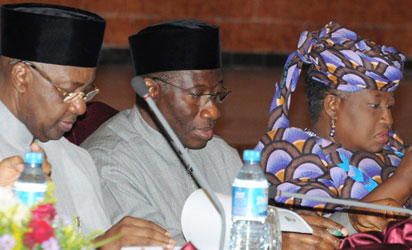
President Goodluck Jonathan (middle); Vice President Namadi Sambo (left) and Finance Minister, Dr. Ngozi Okonjo-Iweala during the opening of the Presidential Retreat on Maritime Security at the Banquet Hall, State House, Abuja, yesterday. Photo: Abayomi Adeshida.

As last week was closing with the news of the sorrowful departure of the Peoples‘ Democratic Party‘s (PDP) Chairman, Bamanga Tukur, the new week has brought the pleasing news of a new Chairman, Adamu M‘uazu, a former Governor of Bauchi State. This is a credit to PDP Party for saving Nigerians the horror of witnessing a long drawn battle with the dire consequences of a fractured political party.
After digesting the economic blueprint of President Jonathan as enunciated by that brilliant, confident and outspoken Minister of Finance and Economic Coordination, Dr. Okonjo-Iweala in the reply to the Honorable Members of House of Representatives, it could be concluded that Nigeria is on the sure step towards economic development (judging by the arrays of statistical figures).
It only remains to be verified by media tours of those beautiful roads constructed and under construction and those fast moving modern railway coaches from Lagos to Kano.
It is clear that a rejuvenated railway system would relieve greatly movement of goods and people on the present and poorly maintained roads.It could be assumed that the Transformation Agenda of the present government had worked wonders in the country as to make life more abundant.
If this is so, then President Goodluck Jonathan should have no “Enemies” as being suggested in certain enlightened quarters. I don`t believe that there are “Enemies” lurking somewhere to pounce on our amiable President, but I must admit the existence of political Opponents, powerful, organized and co-ordinated.
In my view, the party named All Progressives Congress (APC) is a collection of colorful politicians who see in Dr. Jonathan, a leader, visionless and effete.
Economic orientation
Members of the APC, to some Nigerians, are not different in political philosophy and economic orientation from their counterparts in the PDP – their leaders harbor no known welfare instincts but look like preying birds with peaks dyed in red (colour of oppression). Their acquisitive instincts for power, prestige and money are prodigious and frightening.
If it is agreed for the purpose of argument that the President‘s political opponents are not his “Enemies” as such, but there is the real danger represented by that curious but Vicious Triangle. It has an economic undertone. The greater part of the year 2013 witnessed the intensification of the economic reform programme of the present government of the Federation.
The reforms are anchored on the familiar cliché of “Economic Stability and Poverty Alleviation” There is no doubt that these reforms are necessary for the political stability and prosperity of Nigeria.
It is surprising, if not painful, that many attempts by previous governments – whether military or civilian – have not yielded many dividends. The goal of economic stability in the real sense has become elusive and ever receding.
What are the factors that have militated against the previous attempts and beclouding the present efforts? Some sharp financial minds decidedly point to the “Vicious Triangle” of Bank Lending Rate, Foreign Exchange Rate and Rate of Inflation. Instability in the bank lending rate, unstable foreign exchange situation and restless domestic price level are enough potent forces that could undermine any policy, even if it is economically sound.
The main problem of the previous governments, including the present one, is the inability to reconcile the policy of cheap lending (cheap money), with those of rising prices (inflation) and falling value of the national currency (depreciation). The conflicts in major policies have resulted in distortions and instability within the economy. The results have been assumed economic stability, but with rising unemployment.
There is little doubt that a policy of low lending rate by the banks would tend to encourage domestic production which needs faster domestic demand to sustain it. A lively domestic demand relies on higher purchasing power of consumers in form of higher wages for workers and enhanced pensions for retirees.
In the past, increase in the quantity of money had led to uncontrolled rises in price because supply could not meet demand for goods. Unless inflation could be controlled, the advantages of cheap money policy would be lost.
The foreign exchange mechanism is an intriguing one for the Nigerian economy which relies on foreign inputs (raw materials, equipment, spare parts and food) for survival. A depreciated currency leads to increasing cost of locally produced goods and rising cost of those goods in both the domestic and foreign markets. A strong Naira could encourage flood of imports which could affect the balance of trade and later, the balance of payments, as many would assume.
What then is the solution? It is suggested that a policy of cheap lending should be reconciled with those of controlling the quantity of money and the prices of domestic products.
It does not mean that the wages and prices would not rise, but such rise should not be more than the rise in productivity and adequate supply of goods.
The Foreign Exchange policy should be designed to encourage domestic production and steady growth rate. Such a ‘multiple rates‘ system should be designed to ensure cheap necessary inputs for domestic industry and to penalize luxuries, while also favoring the export of agricultural products.
It is advisable for President Jonathan not to be frightened by perceived enemies but should concentrate more on taming the forces of inflation, high exchange rate and growing unemployment which tend to threaten the security of the nation.
The happy news of the week is that the end of Boko Haram insurgency may be around the corner, according to the new Chief of Defense Staff.
Disclaimer
Comments expressed here do not reflect the opinions of Vanguard newspapers or any employee thereof.