
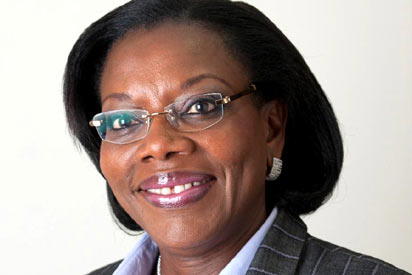
*Dame Aleruchi Cookey- Gams
Administrator of Greater Port Harcourt City Development Authority, Dame Aleruchi Cookey-Gams, in this interview, dismisses the claim that the agency is stagnated on its quest to restore and consolidate on the lost beauty of Rivers State capital city…
How long have you been in the saddle as Administrator of Greater Port Harcourt City Development Authority?
It’s been four years.
The Greater Port Harcourt project is widely viewed as one of the strongest pillars of development of the Governor Amaechi’s ‘Rivers of Possibilities’ dream. How far have you gone with projecting the Greater Port Harcourt Master plan?
The Master Plan for the Greater Port Harcourt area covers Port Harcourt metropolis and environs and projections for future expansion. In specifics, we are looking at the whole of Port Harcourt and parts of Obio/Akpor, Ikwerre, Etchie, Oyigbo, Eleme, Okrika, and Ogu-Bolo.

*Dame Aleruchi Cookey- Gams
The city is expanding to these adjoining localities. What we have decided to do is identify these extending frontiers and plan for future expansion. In carrying out implementation, the Master Plan is domiciled in every Ministry, Department and Agency. We do not for any reason see implementation as the sole responsibility of Greater Port Harcourt Authority, such that if the Ministry of Works is planning a road construction, for instance, it goes to the Master Plan where we have the relevant subsectors –roads, water, power, where each new facility should be now and maybe ten years ahead. So you now revise it onwards in terms of the realities on ground.
Implementing is two pronged.
There is urban renewal of the old city where government has invested extensively in providing better infrastructures in most area. We have done a lot infrastructure expansion, particularly road expansion on Trans-Amadi, Rumuola, Ada-George, Elekahia, Rumuomasi, and all of that. For the new City Area, we have identified our Phase I development for 30,000 housing units. We started with Phase IA for 3000 housing units.
Our responsibility is to provide infrastructures. We are providing roads, streets, paved walkways, electricity supply because it is green field for the new city and we are providing storm water because Port Harcourt is flat and there is lot of flooding. So we have to manage the storm water and not forgetting sewage management.
We are dealing with a central sewage treatment that would not require individual developers not to cast septic tanks all over the place. We are providing water and underground electricity. That is where we are now. Contracts have been awarded. The three anchors of the Greater Port Harcourt area are the airport area, the old city itself and the seaports. We have planned that we link that triangle. Phase I of the roads contracts takes the new freeway that runs from the airport area to Aba Road, to Port Harcourt-Owerri Road and comes through Brookstone. That is the first phase.
It is that elaborate?
Phase II brings it out on the Aba Expressway; Phase III will take it, from Aba Express on to the new Federal Government Road that is going into Onne. That is Eleme axis. We have awarded that contract aside contractors providing all the infrastructures for the Phase 1A development.
In terms of tying our power plan with the overall Master Plan, we are also dealing with that. In the Master Plan, you know where the Sports Complex is. That has been done by the Ministry of Sports. We also have area allocated to Ministry of Health for hospital. Rivers State University of Science and Technology also has its permanent site there as our agency interfaces with respective ministries.
We also have an educational area to allow for private establishment of educational and allied institutions. Currently we have within that boundary the Jesuit Memorial College established by the Society of Jesuit in memory of the 60 children that lost their lives. They have just started a session as the first tenant to develop in our education area. We also have a school that the Federal Ministry of Education is building and the State School for the Physically Challenged is also going to be there.
The idea is to regulate how all of these developments would take place. We have been canvassing for developers and investors to come to the authority to chart their lands to be guided on their development interest, where and how it can be developed and obtain standard plan on what to develop, so we do not have a situation where right next to a residential house you have heavy duty industry and people selling gas.
Our land use management system defines areas for specific interests, like residential, from industrial. Government responsibility is to provide infrastructures, but we cannot do it all alone. Currently people are building. There is a lot of social dislocation to ask people to vacate places after erecting in the wrong locations. Ministry of Urban Development also has its own regulatory boundaries as we enforce within the Greater Port Harcourt Area.
How do you deal with likely conflict with other arms or agencies of government?
It is one government. With proper communications we are not encountering much challenge here. There is an understanding that approvals at this point of development should not be the responsibility of the local governments, but that of the state and communicated to the local government affected.
It is believed that your agency started with so much urgency. The pace in the estimation of many has slowed so much. What is the limitation?
I don’t know when last you went there. The bridges pillars are all up. The first phase of our M10 Road has three interchanges. One of the critical things we must do as government is plan for the future rather than allow development to catch up with us in an unplanned manner. The first interchange is the airport. It will have a flyover.
The interchange at Rumuokurushi was only built after we started spending six hours waiting to cross the interchanges. In the Greater Port Harcourt, we are not waiting for development and population to explode before struggling to solve the challenges. That is what happens in developed climes. Nothing has slowed at all.
What we can say is that for, some time, the engineers were not in the field because they were carrying out detailed engineering drawings and procurement processes with the Bureau for Public Procurement for necessary approvals. Now we are better positioned to start delivering several of these projects. Some of our contracts were awarded in the first half of 2011, so I do not understand where the perception of slow down is coming from.
What about issues of compensation for land acquired?
We did compensation for lands acquired for infrastructures development. People may say things. First, government does not buy land, but we paid compensation. And it is a very expensive exercise. I don’t think there is any state that is paying our kind of compensation.
What has been your motivation in exercising this towering responsibility delegated by a governor known for big dreams and excellence of delivery?
The driving force would be first that it is a call to service. We must commit to public service of our state, our nation. And it is a privilege and you realise that it is a decision between you and God in terms of how well you serve. And nobody is perfect. If you put ten different people on this same seat, they will come up with ten different results. But I think there should be that sincerity of purpose. There must be commitment and satisfaction derived at the end of the day. I may not be the most knowledgeable, but I am satisfied that I have done my best and more so that I can defend my actions.
Six years into the Supreme Court judgment that brought in the government of Amaechi under which you now have the opportunity to serve at such high level, how do you feel about the journey of the ‘Rivers of Possibilities’ so far?
If I were the governor, I would feel a deep sense of self fulfilment. In all his policies and programmes, he has made a lot of giant strides. You would see he has gone out of his way to do things that will benefit the future. He has done things that he would not even get the glory because that is the thing about leadership.
Sometimes people just concentrate on those small things to get immediate ovation. But it is more difficult for a leader to look at the larger picture that puts lasting things in place even long after he is gone. That is the kind of person he has been. Is it in health sector? Is it in education, roads? Name them. They were not easy decisions to take, but he had to take them.
There is the apprehension that the Greater Port Harcourt has no room for the poor. How true is that?
I have told you that the Greater Port Harcourt is the totality of the old and the new cities. And in the Master Plan, you have provisions for different land uses for different areas. There is no way we will alienate anyone. Within the bargain, we are already discussing with civil servants to come and develop. They have asked us to allocate for them, and we will look for land, acquire and be in position to allocate. There are all kinds of allocations for different strata of society, low cost and high cost. Government responsibility is to accommodate everybody.
Disclaimer
Comments expressed here do not reflect the opinions of Vanguard newspapers or any employee thereof.