
By Douglas Anele
The title of our discourse today is cloned from Walter Rodney’s incisive critique of the brazen exploitation of Africa by European powers entitled How Europe Underdeveloped Africa. But despite huge differences in the content of Rodney’s work and our analysis, there is a fundamental intersection: just as the developmental trajectory of Africa was adversely affected by contact with Europe, quality education in Nigeria’s public universities is steadily being eroded as a result of unwholesome attitude to work by an increasing numbers of university teachers.
Before we analyse some of the ways in which academics have contributed to the decay in the university system, I must express sincere condolences to the family of Festus Iyayi, a Professor of Business Administration at the University of Benin and former President, Academic Staff Union of Universities (ASUU).
Prof. Iyayi died last Tuesday in a car accident on his way to the National Executive Committee (NEC) meeting of ASUU in Kano. Dr. Ngozi Ilo, National Welfare Officer of the union and Dr. Anthony Monye Emina, Chairman, ASUU UNIBEN branch, sustained injuries; they are now being treated in a hospital. Of course, the death of any human being is tragic, because it means the permanent extinction of the possibilities latent in that person.
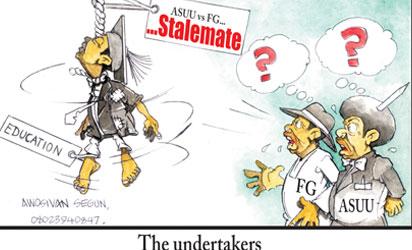
Prof. Iyayi’s premature death is both tragic and ironic: it occurred at a time when the current strike in which he played an important role for ASUU was nearing its end, thereby denying him the opportunity to benefit from the financial concessions President Goodluck Jonathan made to the union recently. Moreover, it is a very powerful message for ASUU to re-examine some of its antiquated strategies for dispute resolution with government and mechanics of decision-making by the union.
Some relevant questions in this regard include, why must representatives of all local chapters of ASUU travel by road to venues of meetings no matter the distance? What is wrong with each branch chairperson sending its decision on any matter, including strike, through fax, email and other forms of electronic communication to the national headquarters for final ratification by NEC?
In addition, why did ASUU not consider the option of teleconferencing, which conveniently removes the necessity of travelling either by road or by air, thereby making the possibility of accident almost zero? Perhaps, Prof. Iyayi’s death would compel ASUU leadership to reassess critically its modus operandi to eliminate frequent travels and reduce unnecessary stress in decision-making processes to the barest minimum. Having said that, we commiserate with the immediate family of Prof. Iyayi, and wish Dr. Ilo and others quick recovery. Certainly, for most lecturers, expression of grief by President Jonathan and former Vice President Atiku Abubakar on the death of Prof. Iyayi is insincere.
Atiku Abubakar, when he was in power, did not support ASUU, whereas President Jonathan has continued the unserious attitude of his predecessors to FGN-ASUU agreements. Indeed, if Mr. President had implemented the memorandum of understanding reached with ASUU last year, the current strike would be unnecessary and Iyayi would not have embarked on the journey that claimed his life.
The Kogi state government should compensate Iyayi’s family and families of those injured by the accident immediately. In addition, we strongly suggest that the Federal Road Safety Commission must be alive to its responsibilities by enforcing approved speed limits on the convoys of top government officials. The tacit assumption that Mr. President, governors and other “sacred cows” are above the law contradicts the very essence of democratic governance predicated on the legal axiom that no one is above the law.
If so, why are we still witnessing government-approved reckless driving in a civilian dispensation, as if the roads belong to the President, governors, legislators, etc? Top government officials are yet to appreciate the fact that Nigeria is under a democratic government now, albeit a flawed one. Hence, they easily forget that ordinary Nigerians have the right to move freely on our roads without fear of intimidation by siren-blaring vehicles driven by lunatics.
In this connection, we recommend that the driver responsible for the accident should face justice whenever he is discharged from hospital to serve as a deterrent to other power-intoxicated drivers working for public officials. Concerning the indefinite postponement of its planned NEC meeting, everyone understands the emotional turbulence and dislocation in ASUU leadership right now.
However, since nothing in this world can bring Prof. Iyayi back, the national President, Dr. Nasir Fagge, in concert with members of his executive, should have declared a five-day mourning period as a mark of respect for our departed colleague and reschedule the meeting for 18 November, 2013. The strike has gone on for too long, and delaying it further is not in the interest of anyone. In fact, prolonged or indefinite suspension of the meeting would merely worsen the exasperation of students, parents, lecturers, university management and other stakeholders whose livelihoods depend on the functioning of universities.
On a personal note, as a human being and member of ASUU, I feel the pain of losing a colleague. But life must go on since, according to William Shakespeare speaking through Julius Caesar, “death, a necessary end, will come when it will come.” Having paid our dues to late Prof. Iyayi, we now return to the main theme of our discussion, namely, the culpability of lecturers in the decay in teaching and learning in our universities.
When ASUU embarked on strike in 2009, I wrote an essay calling on the union to embark on critical self-examination. Having taught continuously for eighteen and half years and served in different capacities in the university system, I know that although inadequate funding is one of the biggest problems of our universities, poor attitude to work by an increasing number of lecturers is equally devastating.
Moreover, I felt that, rather than fixation with organising indefinite strikes ASUU should begin to lay emphasis on helping inexperienced academics to acquire appropriate skills for effective teaching, research and service to the university community. Till now, I am convinced that even if government disburses all the money in our Central Bank to the universities alone, without dedicated teachers and prudent creative managers of human and material resources at various levels of authority in these institutions, the situation would merely improve marginally.
Hence, I argued for a paradigm-shift by ASUU from indefinite strikes to pragmatic measures aimed at helping academics develop skills for best practices in every aspect of their work. Expectedly, while some colleagues railed against me for condemning frequent strikes and criticising lecturers publicly, others agreed that many lecturers are misbehaving and underperforming both in the classroom and at the management level.
Since ASUU leaders consistently ignore the voice of moderation with respect to malignant indefinite strikes, I will continue to state my candid opinion on the issue, because speaking one’s mind in spite of what the majority might think is one of the linchpins of intellectual honesty. ASUU leaders and activists should know that a sizeable number of lecturers are not happy with the union’s growing notoriety as a “strike machine” and that self-criticism is one of the best indices of mature intellectualism.
To be continued
Disclaimer
Comments expressed here do not reflect the opinions of Vanguard newspapers or any employee thereof.