
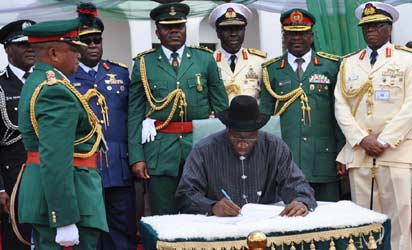
INDEPENDENCE—President Goodluck Jonathan (6th right) flanked by Vice-President Namadi Sambo (7th right); former Head of State, General Yakubu Gowon (5th right); Senate President David Mark (9th right); former Head of Interim National Government, Chief Ernest Shonekan (8th right) and service chiefs, cutting the 53rd Independence Anniversary Cake at the Presidential Villa, Abuja
BY AWA KALU
On Tuesday this week, Nigeria as a country probably had a low key celebration to mark the 53rd anniversary of political independence from our colonial masters. Perhaps, the anniversary was celebrated without fanfare or pomp and pageantry in acknowledgment of the increasing global unrest that is on top of the agenda of most developed, developing and less developed nations occasioned by unexpected security incidents.
It is also possible that the avoidance of any form of gloating in our celebrations is a clear acceptance of the argument of the majority that we are yet to arrive at our destination 53 years after our journey began. Does any nation ever arrive at its destination or is the life of a nation a continuous journey punctuated by events whether remarkable or not? Yet again, one may ask, when did the life of this country begin? Some would say it began in 1914 when the amalgamation of the Northern Protectorate and its counterpart, the Southern Protectorate was achieved. At this juncture, it may simply be noted that what is presently known as the Federal Republic of Nigeria was not a country, at least prior to the amalgamation of 1914.
The indigenous and heterogeneous groups, often derogatorily referred to as ‘tribes’, which make up this country existed independently of each other with different cultural and political systems. However, the colonial masters, largely for economic and administrative reasons, felt that there was a need to merge the Northern and Southern Protectorates into a single colony. The fusion was achieved by Lord Frederick Lugard, the then Governor General.
It has often been wondered in several quarters whether the amalgamation was a political master stroke or an unmitigated error. As has been acknowledged, every journey has a beginning and it will be left to the discerning reader to determine whether our journey as a country truly began in 1914.
Snippets from our colonial history show that Lord Lugard made way for Sir Hugh Clifford in 1919 or thereabouts. It was indeed Sir Clifford that laid the foundations of democracy in the colony in that the first Nigerian constitution of 1922 was appropriately called the Clifford Constitution. That constitution introduced a Legislative Council and for the first time, enlightened Nigerians were afforded the opportunity of a say in the political affairs of their country.
No matter how tenuous their emergence in government was, what cannot be contradicted is that it was that constitution that sowed the first seeds of nationalist movements in that time. The early Nationalists were the principal actors in the struggle against colonialism. Late Herbert Macaulay, for instance, is often referred to as the father of Nigerian nationalism. He was later joined in the struggle by the likes of Dr. Nnamdi Azikiwe, the late Sardauna of Sokoto and other patriotic leaders.
It is believed that women were not left out of the agitations that eventually led to the ouster of the Colonialists. What is popularly known as ‘the Aba Women Riots of 1929’ was a revolt against the involvement of women in the payment of tax. Of course, the effort of women in the achievement of political independence cannot be ignored and this has been touted as one of the reasons the Central Bank of Nigeria presented the Amazons of yester-years to be printed on the face of the proposed N5,000 note. Even though now suspended, it cannot be doubted that in the nearest future, an opportunity for acknowledging the efforts of women in nation building will present itself. What needs to be repeated is that the combined pressure from men and women culminated in democratic self rule, first for the Western and Eastern Regions and later for the Northern Region as a prelude to the independence of the nation from Great Britain.
However, in light of the fact that what calls for celebration is the 53rd anniversary of our independence from Great Britain, it would then seem incontestable that Nigeria was born on the 1st of October, 1960 and that it was on that date that its journey as a nation began.

INDEPENDENCE—President Goodluck Jonathan (6th right) flanked by Vice-President Namadi Sambo (7th right); former Head of State, General Yakubu Gowon (5th right); Senate President David Mark (9th right); former Head of Interim National Government, Chief Ernest Shonekan (8th right) and service chiefs, cutting the 53rd Independence Anniversary Cake at the Presidential Villa, Abuja
Providing instruction
A nation is akin to a human being, born naked and unable to do things for itself, assisted for many years, weaned and let loose to cater for itself. For the human being, it is those who bring the child into the world that are responsible for its upbringing including providing instruction as to how to survive in a competitive environment. In the words of Hillary Clinton, former First Lady and Secretary of State of the United States of America, ‘it takes a village’. If it takes a village to bring up a child, you may wonder, how many persons or villages would it take to ‘bring up’ a nation? All that can be said is that: for a nation, the burden is often cast on the proverbial ‘founding fathers’ whose dreams, wisdom and foresight propel the nation to greatness.
According to that belief, it was the founding fathers of the United States who dreamt of a strong nation propelled by the ideas of equality of all human beings, that government itself is instituted for the welfare of the governed and that every person is entitled to the pursuit of happiness. The dream of America’s founding fathers has been vigorously pursued by their successors in the course of several decades or even centuries of democratic governance. In our own case, it appears that the dreams of our founding fathers were encapsulated in that first National Anthem which my generation recited effortlessly.
We hailed Nigeria, our own dear native land, and we pledged that though tribe and tongue may differ, in our brotherhood we stand. We then agreed that we were proud to serve our sovereign motherland. For reasons that have not been completely satisfactory, that National Anthem which acknowledged our diversity and affirmed our unity was hastily jettisoned. In its place, we are beckoned as compatriots to arise and to obey Nigeria’s call. That call is to serve our fatherland with love, strength and faith. We then resonate in the belief that the labour of our heroes past shall never be in vain.
In unison, we confirm our preparedness to serve our fatherland with all our might and to produce only one nation bound in freedom, peace and unity. Whichever of the two anthems you choose or prefer, there is no iota of doubt that the ingredients of a national ideology are inherent in both. The question at this time, at our 53rd independence anniversary, is whether we have struck the chord embedded in both anthems- the task of building a great Nigeria? In addition, can the successors to the founding fathers of this nation claim to have fulfilled the promise of the anthems recited by our youth?
The answer is not hard to find and we do not need any rocket scientist to grant us any illumination into our current travails in the build up to our independence anniversary.
A careful examination of our recent history and social condition will leave no one in any doubt that following an incremental deterioration in our security situation there has been a downgrading of our individual and collective well being. Were we statistically-minded, for instance, it would have been easy to quantify the havoc wrought by unmitigated armed robbery, car snatching and allied offences. How do you quantify the economic danger posed by the rise in kidnapping in many states in the Niger Delta and South East Regions? Where is the barometer with which we can measure the economic mayhem arising from sustained militancy in the Niger Delta which, fortunately, was ameliorated by the amnesty programme initiated by the Federal Government? What about the confusion now generated by the random deployment of Improvised Explosive Devices (IEDs) in different parts of the country leading to the dislocation of social and economic life? What about the degeneration of public safety in the North East typified by the killing of sleeping youths in Damaturu last week? What about the understated impact of strikes such as the one occasioning a disruption of the studies of students in various Federal tertiary institutions across the country?
What about the notable consequences of natural disasters such as the repeated flooding in Lagos and more recently other parts of the country? Can we be oblivious to the declaration of a state of emergency in parts of the Northern States? In the aggregate, it cannot be in doubt that the security of the state is the only guarantee for order, peace and good government.
Founding fathers
This was obvious to our founding fathers for which reason our extant constitution, in section 14(2)(b) declared that ‘the security and welfare of the people shall be the primary purpose of government’. National security is inseparable from the welfare of the people for which reason it is accorded the status of a fundamental objective and directive principle of state policy. Can a nation celebrate without security?
In further answer, we may borrow a few words from a book (Foundations of a New Nigeria) edited by two great and celebrated scholars, Sam Oyovbaire and Tunji Olagunju. In their introduction, they argue that ‘History is a succession of events in the life of nations, of peoples or of communities. Historical events are social cumulations.
Fundamentally, one set of identifiable events in time and space is as much rooted in a preceding set of events as it is the root of succeeding events’. ‘Similarly’ they contend, ‘historical events in one place could become the genesis of events in other places depending of course on the critical nature of the former.
Disclaimer
Comments expressed here do not reflect the opinions of Vanguard newspapers or any employee thereof.