
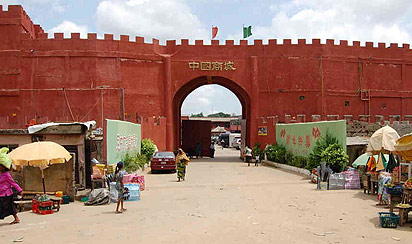
Entrance of the bustling China Town in Lagos.
By Is’haq Modibbo Kawu
It was inside the Dubai Mall, that the idea to write this piece began to gestate in my mind. We had done a flight from Ho Chi Minh City, Vietnam to Dubai on the last leg of our trip to China and Indo-China. Dubai was supposed to be a wind down, on the way back home.
Naturally, I had planned to write about the experiences of the near-two week trip, to draw lessons about the Asian experience of the development process. Asia is much more relevant to us, because of shared colonial experiences; the long battle against underdevelopment and the incredible developments we all see today.
It is remarkable that our ruling elite is still so dependent on the imperialist powers and their prescriptions, that they would rather the diktats of Washington, London and Paris than learn from those Asian developments; not to talk of the full latitude given to intellectuals trained in the ways of imperialism like Ngozi Okonjo-Iweala to mess with our country’s development agenda, while forcing down our throats the bitter pills of imperialism.
As I looked around us last Thursday, and the multitudes from all walks of life, shopping in this city, I also noted the huge number of Nigerians that we have also met here. Nigerians enjoy their shopping and Dubai has become a favoured destination to purchase all kinds of luxury and it is also a much-coveted destination to launder stolen public money by members of Nigeria’s thieving bourgeoisie.
But it is not just a shopping destination, because in recent years, Nigerians have also arrived in droves for the medical facilities here, while children of the rich attend many of the universities located all over the United Arab Emirates. And that has become one of the main points of worry here.
A lot of these young boys and girls live here unsupervised by their parents and in the circumstance, have become drug addicts. This is a problem that has become so endemic with many of the ruling class families, especially in Northern Nigeria, and as with many of the social problems confronting our society today, it is not sufficiently interrogated. People play the proverbial ostrich and lament amongst themselves, as the cream of their youth is damaged by indulgence.
Last week in Dubai, we met a young Nigerian, son of a prominent Northern Nigerian family who was supposedly training to become a pilot. But he has not been attending classes because of a serious problem with drugs! It was a very scary scenario when we gave him a ride in the car taking us back to the hotel and he was laughing deliriously and talking to himself.
He had obviously gone round the bend! It was not the first time I was encountering such a scene. Four years ago, I had gone on a reporting assignment in Eritrea and had transited through Cairo. As I checked out of my hotel early that morning, I saw a young Nigerian girl who told me she was 20; she was a student of one of the highbrow universities in the Egyptian capital. She was drunk and was chain-smoking.
She greeted me, because from my dressing, she knew I was Nigerian. When I asked her name, she insisted that I looked at her face very carefully to hazard a guess, because, she assured me, she was a carbon copy of her father’s! I couldn’t correctly guess but soon as she mentioned her surname, it clicked immediately; she was indeed the exact replica of a famous father.
The old man visited the week before for a few days before returning to the cloak-and-dagger world of Nigerian politics. Unbeknownst to him, the young girl lives a life of drugs, alcohol, cigarettes and much besides in Cairo. The leading member of our ruling class deluded himself that he had secured the future of the daughter, away from the crisis-ridden Nigerian educational system.
If only they had kept the system alive, they would not have sent those children away from their cultures into the alienation which opens them to a life of drugs! Parents that attended public schools a few decades ago, now superintend over the complete collapse of our public space.There have appeared online videos of children of our rich holding wild parties and orgies, and spending lavishly abroad, monies their parents stole from our country.
These thoughts from Dubai could not have taken away from the days of travel in China and Vietnam. It was pure serendipity really! I had been holding a discussion with Kashim Shettima, the Borno state governor about two months ago in Abuja, when he told me of his plan to travel to China and Vietnam. He then requested that I joined the delegation to be a witness to the various activities earmarked for the trip. The Borno delegation attended the 114th Canton Trade Fair in Guangzhou.
It was interested in procurement of equipment for agriculture and agro-allied industries, water resources development and such equipment that can assist the poverty alleviation project of the government as well as women and youth empowerment activities.
We also visited a bus manufacturing company that is in the process of constructing inter and intra-city buses as well as school buses for Borno State. The idea is that Borno is preparing for a post-Boko Haram insurgency life of people-centered development. It was pursuant to the theme that took us to Vietnam, which has become one of the largest rice producers in the world. We travelled in the Mekong Delta region, where there are impressive rice and fish production facilities.
The Borno government has an ambitious plan for the production of wheat, rice, vegetables and fish. Thousands of households are being brought into a modernised agricultural process which necessitated the procurements of machinery done at the Canton Fair as well as the agreements reached over rice production and fisheries training in Vietnam.
We had arrived in Ho Chi Minh City and Can Tho, a couple of days after the burial of national hero, General Vo Nguyen Giap. A copy of the glossy SAIGON TIMES, a weekly magazine, had carried a cover on “The General Who Makes History”. The overwhelming majority of Vietnamese today was born after the war ended in victory and the commencement of the rebuilding of their country.
Everywhere there are indications that the economy has begun to grow, and nowhere more so, than in the towns and villages in the Mekong Delta, with the rice paddies; the wide array of fish species and the huge number of mopeds on the streets.
The Vietnamese are very friendly and polite people and we were made welcome everywhere we went. I think the most incredible piece of that welcome must be the Vietnamese version of “Point and Kill” joint that we experienced in Can Tho. Here in Abuja, we relish our ‘Point and Kill” and I recall that Jibo Ibrahim once took us out to one in Wuse, a few years back, when Mahmood Mamdani came visiting. But in Abuja you were always sure of three species of fish: tilapia, cat and croaker.
Right? Well in Can Tho, we had more than 50 species of fish and other riverine species to choose from! Trust Nigerians to tuck into the delight! The passion to travel is at the heart of our humanity; and the more I have seen of the world, the greater my appreciation of our shared humanity. The two weeks in China, Vietnam and Dubai just reinforced that reality for me. But it is always good to be back home!
Tony Nyiam, Adams Oshiomhole and national conversation
One of the main talking points of the week was the attitude of a member of the Presidential Advisory Committee on National Dialogue, Tony Nyiam, to Governor Adams Oshiomhole at the Benin public hearing organised by the committee.
Nyiam was said to have been forced to resign from the committee by other members, after he “had shouted down the Governor while making his contribution”, according to VANGUARD of Tuesday, October 29, 2013. The paper said further that: “While the Governor was still making his speech…
Nyiam stood up and shouted him down…He was restrained by other members who were taken aback by his action”. Oshiomhole’s ‘crime’ with Nyiam at the event, was not to have riden piggy-backed, on his delusions about the proposed conference. A generation of Southern Nigerian activists, expired old men and sundry rabble rousers have lived on and swore by SNC as the panacea to all problems bedeviling Nigeria.
The failed coup plotter also made an effort to link the anarchic, failed coup he participated in, which announced the excision of some states from Nigeria, as part of the wider issues of the National Question. He was given celebrity status amongst media, intellectual and activist circles of the South.
It came as no surprise therefore, that he was named member of Goodluck Jonathan’s national conversation committee. That he would heckle Governor Oshiomhole did not also surprise me.
These gentlemen pretend to represent an alternative vision for Nigerian development, yet they are puny tyrants and undemocratic demagogues, stripped of subterfuge! Oshiomhole ticked the right boxes by interrogating the perpetual fascination with conferences, when they have not been substantially productive in the past.
He wondered why 100 years after amalgamation and over 50 years after independence, old men in their eighties, who took every privilege from Nigeria while young, now turn round to attempt to delegitimize our country! Adams puts it most brilliantly: “I think Nigeria needs to address very serious issues.
When I see eminent Nigerians discussing this issue, I am sure they know that Nigeria’s problem is not the politics of sharing which the national dialogue is all about, who is getting what, who has this natural endowment, who should do this or not do this. For me this is the act of perfecting poverty. The real challenge is getting Nigeria back to production. The real challenge is creating industrial base…”.
Oshiomhole’s perspective fits the frame of the Nigerian working people and the overwhelming population of Nigeria which is under the age of 35. They need education, skills and jobs. They are all over Nigeria, whether in the creeks of the Niger Delta or the semi-arid regions of Northern Nigeria. There are no ethnic (or tribal) contradictions between these young, and often desperately poor, citizens. They are not represented by the ethnic/tribal fixations of eighty-something year old Professor Nwabueze or the outbursts of Tony Nyiam!
Disclaimer
Comments expressed here do not reflect the opinions of Vanguard newspapers or any employee thereof.