
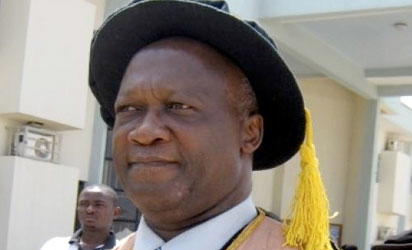
Prof. Boniface Egboka, Unizik V.C
By Ebele Orakpo
On June 3, 2009, Professor Boniface Egboka emerged the 4th substantive vice-chancellor of the Nnamdi Azikiwe University, NAU Awka, for a five-year term which ends in June next year. In this chat with Vanguard Learning in Awka, Egboka speaks on the journey so far, how the university has maintained a steady academic calendar and raised funds for capital projects. Excerpts:
“We have been working hard at Nnamdi Azikiwe University (NAU) Awka, to make it a highly sought-after academic institution. NAU has 14 faculties with many professors, lecturers and students actively involved in teaching, learning, research and community services,” said Egboka, professor of Hydrogeology.
Infrastructure:
On how the university has been able to achieve much in the area of infrastructure development despite the fact that it did not get a take-off grant from government when it transited from a state to a federal university, Egboka said Public-Private Partnerships (PPPs) and Internally-Generated Revenue (IGR) were the secret.
“To supplement the normal funds from the Federal Government (FG), NAU leadership practises public-private partnership where we (NAU, FG and its agencies) are the public component while communities, towns, corporate bodies, NGOs, individuals, national and international organisations etc., make up the private sector component and we have got very good responses. Parents of students over the years approved and accepted to pay some development levy. Unfortunately, tuition is free in federal universities and that is a problem. People should pay for the educational food they receive. So with that money and from the takings from our post-graduate and part-time students, we are able to support capital development.
“In the PPP programme, while some stakeholders provide the entire funding for the projects, in some others, we pay some percentage, like 40% and the donor pays about 60%. So with the IGR, PPP, FG, State government led byMr. Peter Obi, companies like Emzor Pharmaceuticals, JUHEL Pharmaceuticals, Chisco Transport, GUO Motors, Elmada Company of Canada, Prince Arthur Eze, Ibeto Group etc., we have been able to build infrastructure like labs, lecture rooms, auditoria, hostels and also provide water. Sometimes these donors provide books, computers, cash etc. We usually enter into an MoU that will establish confidence between us and the donor. With these, we try to remain afloat academically and administratively,” he said.

Prof. Boniface Egboka, Unizik V.C
Stable academic calendar:
“We have maintained a stable academic calendar for over 12 years thanks to the discipline and understanding of our lecturers and students. It has not been easy but people are very conscious of it. Here, we believe in the force of argument, not argument of force. We allow free discussions, exchange opinions and try to work very closely with our trade unions and over the years, that system has been maintained. We also run a student first philosophy. Our students are the centre of gravity of our administrative and academic excellence. They are the future hope of their families and the country. They come here as adolescents to be fashioned into adults who will take charge of our country so we take special care of them.
“We stand in as their parents and look very closely at their needs and try to explain to them issues when they arise. We monitor them closely, allow them to organise their elections without interference and prevent some carnivorous individuals from coming to poach them either for political gerrymandering or for immoral escapades. In terms of security, we have very strong security for them; we ensure they attend lectures and lecturers teach and examine them accordingly, mark the scripts and release results as early as one month. When students mess up, we try to correct them, use minimal force with a lot of guidance and counseling except in extreme cases where we invite the parents to come and see things for themselves.
“In many cases, we have had successes in changing such students. It is not easy but it’s worth it because if the students are happy, they will develop properly and become good nationalists who will stand tall for this country. We also take care of the staff within the limit of our resources and everybody tries to go along. This is why we have always had stable calendar. Three years ago, NAU was third in university preference for students next to UNILAG and UI; two years ago, we came 2nd next to UNILAG and this year, we came third next to UNIBEN and UNILORIN.
We also have international collaboration exercises. We have linkage programmes with China’s Xiamen University and collaborative ventures with other Asian, European, American and Canadian universities.”
NAU’s forte:
When asked the strong points of NAU in terms of courses, Egboka said the university has so many strong points. “Our excellence is multidimensional and multisectoral. In an academic community, you have what we call academic freedom – staff teaching and researching on what they think will benefit the environment. All our faculties are doing well. In each of them, the staff and students are of right very aggressive in academic research.
“A lot of breakthroughs have happened in the faculties. For example, a team from Geological Sciences took part in a national, continental and global competition on oil and gas virgin evaluation and prospecting organised by American Association of Petroleum Geologists and Imperial College, London. We emerged winners in Africa out of 11 universities and 5th in the world out of 12 universities. One of our History and International Relations students took part in a diploma in French Language programme at Alliance Française and came first out of 25 others.
“He was given an award by the French Government to tour France and Belgium. Someone in Pharmaceutical Sciences got a $10,000 award for a global competition, a lecturer in Music Dept got $18,000 award and so on. We have the best Confucius Institute in Africa. We have Chike Okoli Centre for Entrepreneurial Studies and recently, the NUC approved a BSc. programme in Entrepreneurship for NAU.”
Egboka said he will like to be remembered “as someone who humbly worked as a vice-chancellor at NAU and who wanted to make staff and students happy as they do their work.”
Disclaimer
Comments expressed here do not reflect the opinions of Vanguard newspapers or any employee thereof.