
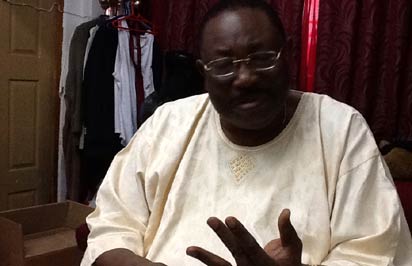
*Major General Sam Momah
By Soni Daniel, Regional Editor, North
Major General Sam Momah served as the Minister of Science and Technology during the administrations of Generals Sani Abacha and Abdulsalami Abubakar, and carved a niche for himself by creating what has come to be known as “Technology Incubation Centres” to help Nigeria in her drive for technological advancement and industrialisation.
He stands out as one of Nigeria’s intellectual soldiers and outstanding engineers, having also qualified as a certified civil engineer and a Fellow of the Nigerian Society of Engineers. He has just published a book, “Nigeria Beyond Divorce”, in which he argues against the break-up of the country and pleads with Nigerians to seek peace and pursue it in the interest of the nation.
Excerpts from an interview with him:
Let me start with the book itself. What informed the choice of the title: Nigeria Beyond Divorce?
Essentially, of late, Nigerians have become very despondent about the country to the extent that many feel we should just go our separate ways. They feel that the country should disintegrate and I get surprised with the calibre of people who hold this view. They are not just people on the street but very responsible Nigerians.
I feel bad too because when you see the way the country is going you tend to wonder what is left. I did my own little research and I felt that if you look at all the unstable countries in Africa over the years – Somalia, Sudan, Ethiopia, etc – you find that the crises that destabilised them started like what we are seeing in Nigeria.
It is these little things that nobody is checking that gave rise to the big crises that are currently rocking the African countries. I felt like raising the alarm to warn my fellow countrymen and women that it’s not just a matter of just saying go your separate ways, but the aftermath of such an action because Nigeria is a country of 170million people.

*Major General Sam Momah
If we decide to go our separate ways, it is not going to be that smooth because the boundaries are not known between one tribe and the other, one region and the other, one town and the other and the refugee problem that 170 million people would throw up could overwhelm West Africa. So even if 10million or 20million refugees spread to West Africa, they are going to destabilise the region and Africa. So, we have to realise the enormity of the problem that the split of Nigeria could cause for the country and people as well as our neighbours.
I want to use this book to drum it into the consciousness of all well-meaning Nigerians that there is no alternative to peace and unity and that we cannot afford to go our separate ways after living together for 100 years. Let us sing it as a song that Nigeria is beyond divorce. I want to call on Nigerians to realise that we fought a civil war and lost 3million souls. I want Nigerians to note that no nation fights two civil wars and survives. Nigeria cannot survive another war and we have to find a way to live together. That is all I am saying in my book.
You lamented the issue of corruption, indiscipline, wastage, underdevelopment and all that but you left everything hanging without putting the blame on anyone. Are you afraid of hitting the nail on the head?
I am not afraid of anybody, but it is just my own way of remaining very objective in all matters and at all times until I get the real picture of what I am talking about. In the case of Nigeria, I am not an auditor, I am not an accountant, I am not a lawyer; I am just a soldier, who has no access to all the facts and figures. So I didn’t want to accuse anyone wrongly without the facts and figures. As you know, it takes time to really prove a point in this country, but the sad thing is that Nigerians are fond of jumping into conclusion without the facts and I don’t want to be caught in that web.
In chapter five of the book, you attributed Nigeria’s problem to over bloated bureaucracy caused by ‘undue creation of states’. What do you mean by that? Are you opposed to more states being created in Nigeria?
Of course, I am trying to say I am against the creation of states per se because the states are not viable. Today, only Lagos State has proven to be viable – that is, it can generate the resources to run on its own without waiting for federal allocations. In fact, I can say that only Lagos State has continued to prove that it is a state that can stand on its own and render services to its citizens.
I want to believe that if we had remained with the 12 states that were originally created, things would have been better. Going by what is happening now and the recent discovery of Shale gas in the West, it is doubtful if Nigeria will continue to get the kind of oil revenue it is getting and be able to carry along all the states in the country. My fear is that we may soon get to a stage where the Federal Government may not be able to sell enough oil and raise money to distribute to the states. That is why people should not dismiss the issue of Federal Government not being able to pay salary as Okonjo Iweala stated.
It is possible, given the way things are going in this country. We have to tell ourselves the home truth and not to have states that we cannot fund. Rather than continue to create new states, we should be talking about provinces so as to bring the number of development centres closer to the people and significantly trim the large bureaucracy for the benefit of Nigerians.
If we have Provincial Councils in the six geo-political zones, it will eliminate the need for the large number of ministers, commissioners, special advisers and all other categories of people who are drawing entitlements from government on daily basis, but adding nothing to the system at the end of the day. The establishment of Provincial Councils will give room for technocrats drawn from various fields of human endeavours to man the various sectors of the economy and eliminate the role of politicians who are currently being paid jumbo salaries by government at all levels.
You once served as a minister and most of these things you are talking about in the book were not done. Do you have the moral right to complain about them today?
What you should know is that the military has its own way of doing things. They had a limited period to stay in power and many of their leaders did not want to do anything beyond the period they elected to stay in office. Take the case of Abdulsalami Abubakar, who had all the opportunity to stay in power for as long as he wanted but he decided to quit sooner than most Nigerians expected.
When Abubakar came, he asked me how long I thought we could stay as a government and I said, ‘Well, sir, you could stay for a year plus’, and he quickly replied that he wanted to leave as soon as possible and he left the scene before a year. That being the case, there was nothing much that administration could do. If we had stayed beyond a year, one could have planned a programme of activity and implemented same.
You also talked about poor productivity as part of the problem facing Nigeria under what you called poor productivity aggravated by wrong application of the federal character principle. What do you mean by that?
I personally feel that federal character principle has contributed to over 50% of the problems facing Nigeria today. Although the initiators of the principle meant well for the country, the implementation over the years has left much to be desired. It has destroyed merit and enthroned mediocrity and indolence in the land. Nigerians no longer work hard to achieve promotion and get appointed into key government positions but depend on primordial considerations. It is even worse when it comes to admission into Unity Schools.
Whereas some Nigerians from certain parts of the country are given a set of cut off marks as a condition for admission, some other Nigerians from different parts, are also expected to score some points in order to be admitted into the same Unity Colleges. This is indeed the country’s dilemma. No country can operate like that and expect to excel.
Young students from the southern part of Nigeria cannot just understand why they cannot gain admission into the Federal Government colleges in spite of their high scores in common entrance examination, while others from the other part of the country who score lower marks in the same examination are given express admission all in the name of federal character.
Federal character is encourages cheating rather than promote national development and sense of cohesion. This principle should be redefined and made more productive so that it does not continue to sacrifice merit on the altar of mediocrity. Federal character as is presently practised in Nigeria tends to inculcate cheating culture rather than emphasise hard work, selflessness and nation-building, the core values, which our founding fathers lived by. Nigerians should be given equal opportunities to go to school and access to jobs based on merit.
The Federal Government should ensure that all Nigerians have access to basic and tertiary education through scholarship and grants but the standards of education should not be lowered for anyone no matter where the person comes from. That is the only way to make federal character serve the collective interest of Nigerians.
Federal character can be solely applied to political appointments to give a sense of belonging to all but it should not be used to determine admission into public schools, appointments or promotion into the civil or public service. Using this principle to administer the schools or public service has the potential of destroying the core values of the public service and the interest of Nigeria. The transformation agenda of the government may not work effectively with the principle still in place.
What did you achieve as the Minister of Science and Technology under the late Gen Sani Abacha?
Well, like I have said, the military has its peculiar method of doing things. You are an officer and you are merely commanded by your superior officer to come and carry out some tasks already outlined for you. Under the military, you may not be able to exercise the kind of freedom that is obtainable under a civilian administration such as we have today. There is no room for politicking and in our time there was nothing like an individual programme for implementation. You can whisper your own idea but you don’t go against the position of the military leader.
But I understand that you established some Incubation Centres across the country. What were they meant to achieve?
Yes, within my ministry, I did a lot of innovation and General Abacha himself was very happy with me. The Incubation Centres, which I started in 26 states, were meant to provide a platform for Nigerians to learn skills and trades that could make them to be self-reliant and take Nigeria’s technological drive to the next level.
It was meant to enable Nigerian school leavers to have a place to learn any technical trade of their choice and be able to stand on their own. All the centres were equipped with vital tools and were to be replicated in all the 776 Local Government Areas of the country. The idea was to provide a training programme that could last about six months for each trainee. It is the same thing that applies in China, where we got the idea from.
But unfortunately since I left, maintaining the centres has not been easy. There was even a time when they wanted to scrap it. I had to appeal to them to retain it. That is the main problem in the third world: they don’t ensure continuity of projects and programmes thereby truncating many lofty dreams.
Why did you join the army of all the professions? Was it by accident, family choice or passion?
It was by accident. We are a family of eight, three boys and five girls. I am the second boy, my senior brother was in secondary school when I was about to finish primary school and you know in those days it was not easy to pay school fees. My father was a reverend, but in those days, all you could get from church members was one chicken, yams or egg as the case may be.
There was no money. So when my brother was in secondary school, my father said I had to wait for my brother to finish before I could go in. I didn’t find it comfortable. Given the situation, I had to go and live with my senior brother in the South-west. There was this teacher who used to be friendly with my cousin and he got the army recruitment form for me and spoke to my father to allow me to enroll. As God would have it, I took the military entrance and passed in flying colours. I seized the opportunity and went into the army as soon as I finished secondary school instead of going to wait at home for my senior brother to finish from the university because of lack of money.
That is why I say that I joined the army by accident because my original plan was to go the university and read an engineering course and become an engineer, which was a more respectable course of study at the time. The army was not a popular choice in those days.
In fact my father still objected to my joining the army even after I had been successful at the interview, which was very rigorous and based strictly on merit. It was conducted by white men who were mostly British and Indians. My father said I was not going to anywhere. He asked himself, “How can I allow my son to become a soldier?” He told me to perish the thought and begin to look for something else to do until he had enough money to send me to the university to go and read engineering. Despite my pleas to him, he refused to budge and it was my mother, who gave me the money to go for the interview in Lagos.
My father only relented after my success at the interview. The white men, who interviewed me and the other Nigerians, later handed me a sealed envelope containing some money, which I promptly handed over to my father on reaching home and he was happy with me. It was the money the army had given to me to use and prepare for my trip for overseas training that they put in the sealed envelope. While abroad for my training, I used the little allowances I was being paid to train my siblings back home and that really helped the family.
So I think the army has treated me well. Not only did they train my very well they also exposed me to so many opportunities in life. That is why I feel I should pay back with this book that I have written so as to leave it as a legacy for the younger ones to know about Nigeria, how we started the journey and where we are heading so as to be able to also help our leaders on how we can improve on our situation.
In all your 36 years in the army, you were not involved in any of the numerous coups. How did you do it?
Actually it is my own fate that kept me through all the years without being linked with any incident in the army. God has always been with me because my hands were clean and I thank God that I was never part of any coup because it runs against my professional training. I was professionally trained in military academies in many parts of the world, particularly the Indian Defence Academy, which is very unique and thorough.
In fact, the environment alone is training itself because it is in the middle of nowhere. You just go there to do training and nothing more. They have a distinctive predicated on the principle of the country that they have to work and succeed no matter the condition of their land. They abhor greed and work to lift their country from obscurity to sufficiency whereas we in Nigeria want to reap where we did not sow
Cast you mind back to the army when you entered and when you left the army. Would you say you are happy with what you achieved?
Yes, I am very happy, even though it could have been better. But I thank God that I made the rank of a Major General in the army. It is not a mean feat because it is only when you reach the rank that you thank God. I am a two-star General and that is something to thank God for because it is not a mean thing. Some hardly get one star but I hit two. I am very happy with what God used the army to do for me.
So, what would you have been if you had not enrolled in the army?
I had always wanted to be an engineer and that was when they advertised and said they would train, I opted to train as an army engineer so as to meet my age long desire. Today, apart from being a retired General of the army; I am also a certified civil engineer, a Fellow of the Nigerian Society of Engineers, NSE, and a writer. I have a burning desire to write given my background as a researcher when I trained and in many army institutions around the globe.
I was challenged to begin to read wide and research into contemporary issues, when in one of my training programs in the British War College, a Major was made to lead the rest of the trainees some of whom, including myself, was already a Lt Colonel, but he seemed to know more than the rest of us. It was a big challenge that made me to begin to read wide and make notes. By the time I looked at my notes, it was already more than enough to write my first book. From that time, the interest to read and write has become part of my life. It is my passion in life.
But would you encourage any of your children to go into the army?
No. I don’t want any of my children to join the army for the fear that anything can happen and consume your life. Your best friend can decide to backstab or betray you and so on. I was lucky to stay off trouble throughout my years in the army. Others were not so lucky.
Is that why you are apolitical?
Yes, that is who I am. I don’t want to join any political fray because I have not seen people of like- minds. Until I see people who are ready to serve, to offer service without getting paid, I would remain as I am. This is because Nigeria needs to be salvaged from the bread-and- butter politicians, who are merely running all over the place for what they can get from the system for themselves and their acolytes and not really to serve national interest.
Singapore that moved from third world to first world today has enough for all because people are investing and working for the overall interest of the nation unlike what we are doing in Nigeria, trying to carve empires for ourselves at the expense of the nation and the people.
Those who steal are not also being punished to serve as a deterrent while those who are in leadership positions act with impunity, and throwing national ideas overboard for selfish interests.
For instance, today in Nigeria, special persons are tampering with national assets like oil pipelines and those who should punish them claim it is their turn to loot national treasures; nobody has been jailed for life for breaking and stealing national assets. If a nation does not punish offenders, why would the people stop stealing and treating national wealth with disdain?
Disclaimer
Comments expressed here do not reflect the opinions of Vanguard newspapers or any employee thereof.