
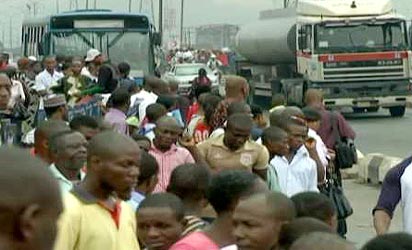
File photo
By Obi Nwakanma
The quality of civic life in Nigeria is the most critical gap in the development of a free society and a robust democratic culture. Nigeria’s transition to democratic culture after over thirty-five years of military rule, out of its slightly over fifty years of political independence from colonialism, feels like the slow ride of the tortoise.
Much of the population is disengaged from the true civic process that gives life and clarity to the political development of the nation. I had an interesting conversation with Patrick, the chauffeur of a great friend of mine, who had driven me from my friend’s home to the Presidential Hotel on Port-Harcourt’s Aba road. Patrick seemed like a smart man. Thoughtful, eloquent and, ‘it seemed quite self-possessed. I engaged him on the subject of the politics of Rivers State. “I do not pay attention to them!” he said dismissively.
“But why?”
“Well, I’m not from this state.”
“But you live here. Here in Port-Harcourt” I said to him.
“Yes. Not a long time. Just fifteen years”
“Just fifteen years?”
“Just fifteen years.”
“That’s a long time to live anywhere. You have a stake in the political life of this city and this state”
“Ah Oga” he said, with a little shake of his head, “This country’s ways are not the same as abroad…”
“But the constitution says…”
“Which constitution? They write one thing and do another.”
“That’s why you have to be part of a citizen’s pressure group for the enforcement of the constitution.”
“Oga, the government who should lead the way does not even know what constitution is.”
“You are part of the government” I said to him. “You are a citizen…”
“How can?”
“But you are! Government is an aggregation of interests collectively held.”
“That is not how we do it here?” Patrick said. “Here in Nigeria, there is government people and there are ordinary people. I be ordinary man. I no have voice to talk.”
“That’s why you have the legislature and someone who represents your interests and views in the Houses o Assembly!”
“But even sef, where I go see him? Oga, everything you talk is how it is supposed to be. But Nigeria is different. It is upside-down-country… .”
I thought at that moment, “Here! A title for my next column: “Nigeria: an Upside-down-country.” But it quickly struck me also that this would sound familiar, clichéd and trite. Nigeria is everyman’s punching bag. The most severe affliction this country suffers is cynicism.
Public or citizenship cynicism is the high measure of our public imagination, from its literary output; its journalism; its various forms of imaginative expression, to the very stories we tell at the domestic hearths. It is the result of a profoundly disenchanted population. Our greatest enemy in Nigeria is “government.” Government is this. Government has not done that. Government should have known that.
Government is not doing squirt. We have, in all our cynicism, failed to focus a necessary attention on the collapse of citizenship and citizens behavior. We cede every civic responsibility on the great lie that the greatest problem of Nigerians is the government.
It is a great lie because the greatest problem of Nigeria is to be found in Nigerian citizens. Governments might build roads. But it is up to the citizens to keep it clean and uncluttered. To drive in a safe and responsible way on those roads. To demonstrate polite and thoughtful consideration to other users of the road.
We cannot expect political leadership, those we generally, and serially refer to as “government” to help the elderly or the children cross the roads, or even to force people to use designated public places for their exact purpose. When a city builds a bus-stop, it does not expect that it should soon be converted to an Akara stall, or Mall for all kinds of crazy desires.
Corrupt governments flow from corrupt and ignorant societies and corruption at the highest places starts from the corruption at the lowest levels of social organization: the family. Nigerians cannot expect a great government led by astute people when they do not express themselves as great citizens of a great nation.
That is where the trouble lies: the gaps in our civic lives and in our notions of public responsibility. There are Nigerians, many highly educated, who have never read a copy of the Nigerian constitution, and this includes even purveyors of serious public opinions.
There are those who argue that Nigeria is an “artificial society” and until everything is set “constitutionally right,” there would be no grounds for a true, well-ordered society. No, a truly, well ordered society does not come, fully made and served in a tin can.
It is the product of the highest civic push, by the most able, and most determined people, who organize at all levels to seek the highest public good. Nigerians expect great public schools, great roads, well-built bridges, well-lit streets, and security, but they do not pay tax. Ask why? And they say, “but government has enough money from oil!” Nigerians do not verify public facts.
They rely on rumours and hear-say, and the kind of yellow journalism, which sadly, have kept the mode and even perverted the style of journalism we reserved for military era politics that required that the journalist be both a guerilla activist, and advocate of constitutional rule, and a propagandist for the civil society.
It is about time that journalism begins the proper work of change; as citizens we must re-engage, and take back our society; otherwise, we will continue to produce a lackluster leadership and a society in persistent and active despair, and a citizenship known more for the lachrymal life. Nigeria is not the problem. Government is not the problem. The problem, it seems to me, is the unhealed wound of history that has created the great sore in civic life.
Disclaimer
Comments expressed here do not reflect the opinions of Vanguard newspapers or any employee thereof.