
By Douglas Anele
Corruption in Nigeria is not restricted to the executive branch alone; its destructive tentacles reach all institutions of government. For instance, the legislature is a very important arm of democratic governance saddled with the responsibilities of making good laws for national development and oversight on the executive.
Our shamelessly parasitic National Assembly is a Mecca of legislative rascality and corruption, to the extent that Nigerians no longer expect it to function as an effective check against abuse of power by the President and his cabinet. In fact, both the executive and the legislature are working together to despoil Nigerians. The judiciary is also part of the decay in the system: the number of cash-and-carry magistrates and judges has risen tremendously in recent years.
One does not need to be a lawyer to know that Nigerian laws and their judicial interpretation unabashedly favour the rich and powerful. From the foregoing, it is fair to conclude that Nigeria’s democracy is standing on a rickety institutional tripod that will not stand the test of time. To repeat, Nigeria has not made meaningful progress since the restoration of civilian rule in 1999. We have already alluded to the recurrent problems of epileptic electricity and senseless corruption. One of the basic functions of government is to provide security for the citizens and foreigners within its borders. The security situation in Nigeria has deteriorated especially since 2010.
Boko Haram insurgency is the greatest security challenge facing the federal government right now. In addition, armed robbery, kidnapping and other violent crimes are on the rise – some pessimists liken the situation to the hypothetical Hobbesian state of nature. As already indicated, Jonathan inherited most of these problems, but Nigerians are concerned whether his government has effective strategies to neutralise Boko Haram and reduce violent crime in all its ramifications to the barest minimum. I believe that the renewed onslaught against Boko Haram is commendable and should be supported by everyone, for it will be a gross act of irresponsibility for government to appear weak while a group of fanatics unleash violence on the people. 
Northern leaders critical of Jonathan for confronting the terrorists more decisively this time around are enemies not just of the President but also of peace-loving Nigerians generally. How can any reasonable person criticise President Jonathan for working to liquidate an organisation that has caused death and destruction for no good reason? However, beyond stepping up measures to end the Boko Haram terrorism, government must provide enabling environment for job creation and broaden opportunities for both academic and vocational training. The major causes of insanity disguised as devotion to a noble cause, aside from religious fundamentalism, are ignorance, poverty, and unemployment.
Poverty and ignorance are two of the greatest handicaps confronting ordinary Nigerians, particularly in the north. It is disheartening that, although northerners have dominated the highest political office in the country the north remains relatively poorer and vastly more educationally underdeveloped than the south. Therefore, collectively northern leaders are a complete disgrace to the people there, because they used their privileged positions for self-enrichment, leaving the vast majority in the slough of despond, so to speak. It is now time for the youths from northern Nigeria to make their voices heard by taking measures to end the continued oppression and marginalisation of the underprivileged.
Sections 39 and 40 of the 1999 Constitution, when interpreted holistically, guarantees all Nigerian citizens the right to protest. Educated northern youths should lead the fight for the intellectual and economic emancipation of the masses. Going back to our appraisal of Jonathan’s administration, it is ironic that the President and his lieutenants gave themselves high marks for their handling of the country.
This is hardly surprising, considering that, as the Igbo would say, no one would say that the soup prepared by his mother is not delicious. We have already noted that the situation is actually worsening in the areas of electricity supply, corruption and insecurity. Moreover, the fundamentals of the country’s economy, namely, the petroleum and manufacturing sectors, infrastructure, and agriculture are shambolic. Yet magicians in government conjured figures purporting to show that our economy is growing. It is easy to manipulate to prove almost anything.
Still, how can anyone sincerely believe that our economy is in good standing when electricity supply has plummeted, when the real sector is contracting due to very harsh operating environment, and when unemployment and inflation are increasing rapidly? It is bad enough that the government is underperforming; it is wicked to cook up fictitious figures to deceive people that “it is well with our economy”.
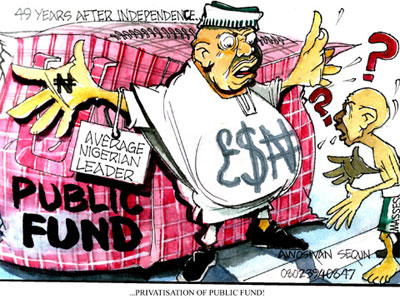
Millions of Nigerians, including myself, are working so hard to earn legitimate income. Unfortunately, it is hard to make ends meet because of persistent hyperinflation. Of course, for highly placed politicians, business tycoons, top traditional rulers and extremely wealthy benefactors of Jonathan and others, the economy is doing well. Millions, and in some cases billions in both local and foreign currencies, are rolling into their bank accounts: they are also acquiring expensive properties in different parts of Nigeria and abroad.
Hence, President Jonathan and his cohorts are right, the government has done well because rich people are actually benefiting from our democracy of the rich, by the rich, and for the rich. What we have said thus far about the federal government is equally applicable in the states and local governments. Even in comparatively rich states where there is a semblance of infrastructural development, such as Akwa Ibom and Delta, the governors and legislators would have achieved more by eliminating unnecessary extravagant and frivolous spending. Judging by the financial recklessness of our leaders, it is fair to conclude that they are genetically incapable of financial discipline and prudent management of public funds.
Any venture managed the way Nigeria has been governed since 1999 would collapse quickly. Similarly, most countries would have experienced serious social upheaval given the depressing state of affairs in our country. We have managed to avoid bankruptcy because of increases in the price of crude oil, and complete breakdown of social order due to the amazing capacity of Nigerians to endure suffering with stoic equanimity.
Nonetheless, it would be foolish for Jonathan and other members of the ruling elite to remain complacent and pachydermatous to the anguish of suffering Nigerians, especially those who cannot afford the basic necessities of life such as food, shelter, clothes and jobs. Democracy, like the Jewish Sabbath, is for people, not people for democracy, as has been the case in our experiment with democracy. Thus, Nigerians must begin speak out more vigorously and engage in non-violent activism to force government to take their welfare seriously.
We must wake up from the theological delusion of believing there is a big brother somewhere in fictitious heaven that will miraculously solve our manmade problems. The way I see it, government does not really care about us. Life is damn too short for any sensible person to wait for supernatural or divine intervention. Together we have what it takes to force a positive change in the way people in power handle our affairs. CONCLUDED.
Disclaimer
Comments expressed here do not reflect the opinions of Vanguard newspapers or any employee thereof.