
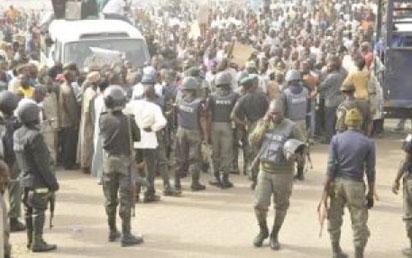
*File photo: Policemen
By Muyiwa Adetiba
A retired senior police officer had this car sticker which read: ‘If you think the Police are not your friend, when next you are in trouble, call an armed robber’.
The message crudely summarises our love-hate relationship with the Police. We decry their incompetence and corruption, yet theirs is our first port of call when our houses are under siege or someone (or something) is generally threatening our sense of security. As bad as we think they are, the Police at the airports, at the banks, or on the streets, give us a sense of security and well being.
Imagine then, the panic that would grip us if we woke up to find that a powerful government had decided to scrap the Police because it found (or suspected) the Inspector General to be corrupt.
Imagine therefore, a city without Police, where the boundaries of law and order are left to the inhabitants to determine; where the limit to the freedom of your hand as it relates to my nose is not determined by law.
This is the same way we feel about our health security. We have learnt to live with the incessant strikes of doctors and health workers.
We complain about the unprofessional attitudes in our teaching hospitals; yet we would all panic if, as a result of a government policy, the supervising body in charge of health was to be denied funds because of its boss. It would mean, among other things, that quacks would have a field day .People could even advertise coconut water as a wonder drug knowing that nobody would check.
Can we imagine how it would be if we could not distinguish the difference between a fake cheque and a real one? If wonder banks could spring up on a Monday and disappear at the end of the week? ; if the health of the banks was not monitored because the governor of CBN had offended the powers that be?; or if insurance companies collected your premium but refused to pay claims?; and no regulating body to call them to order?
Can we imagine the riots that would engulf the nation if the supply of fuel was not properly monitored?; ditto for all the things that must be constantly monitored and regulated if we must have a semblance of security and well being.
I have used these slightly outlandish examples to show that our world is run by orderliness and controls. The more efficient the arms that ensure these controls, the safer and more civilised the society becomes.
Now the financial market is the heart beat of any nation’s economy and where the financial institutions congregate is usually called the ‘City’. This body, the City, has its rules and those who monitor those rules. It is widely believed that the world economy crashed because some key financial institutions were not properly monitored or that certain controls were not enforced.
In other words, the City’s police did not do their work properly. Because the City is so important as a result of what happened to the world’s economy, every country has strengthened the capabilities of those whose job it is to police that financial body.
These policemen are usually highly skilled, highly motivated, and largely autonomous. They are not supposed to be subject to the egos of anybody.
This why we must be wary of the ego clash between the House of Representatives and the Presidency over Otteh who is the head of our Security and Exchange Commission (SEC) because it is a clash that could damage the economy.
What was the House thinking when it approved a zero budget for SEC? That the Presidency would blink? What if the Presidency did not as it is now the case? What next? Should the country’s investment climate be made cloudy because of one person? Should the careers of many be put on the line because of one person? More importantly, should an institution as vital as SEC be made ineffectual because some people don’t like its boss?
I have absolutely nothing against the oversight functions of the Federal House of Representative because every arm of government should be held accountable one way or another (including the House itself).
But rules and regulations must be clear and unambiguous. Nothing that affects our national interest must be made personal. And to deny an important agency like SEC of funds because of the perceived offences of its leader is taking political brinksmanship to a reckless, irresponsible and unacceptable level.
It is also worrisome that the House is seeking the power to hire and fire through the back door. Its victims are usually those who disagree with its ambiguous and amorphous standards. Institutions should be strengthened and allowed to do their work according to laid down rules; not brow beaten and victimised.
Every body suffers in the end when financial operators get away with sharp practises because the monitoring agency is starved of funds. The effect might not be seen now. Maybe not even until Otteh and some members of the House have left their respective offices.
But whenever this vital institution begins to malfunction and under perform, we should remember the genesis of the problem and put the blame squarely at the floor of the House of Representatives; at the very people we elected to protect and strengthen such institutions
Disclaimer
Comments expressed here do not reflect the opinions of Vanguard newspapers or any employee thereof.