
By Rotimi Fasan
ALL Progressive Congress, the political party that was cobbled together from at least four other major parties, is the opposition answer to the Peoples Democratic Party, PDP, behemoth in a Nigeria where the idea of independent candidacy is yet to gain sound footing however desirable.
These parties are considered regional in their power base but the PDP at the best of times reflects the ethnic origin/biases of its most senior/vocal members from the president down to party leaders and governors.
It is therefore no less regional than the CPC, ACN, ANPP or APGA. Most times what unites the various units of power in the PDP as the other parties is class interest more than ethnic solidarity which comes into play only when members of the close-knit caucuses lose out in the power game.
But is anything the matter with a party with national aspirations drawing most of its members from a particular region? Once the manifesto of that party speaks to the needs of the vast majority of the people of the country and is not aimed at promoting sectional interest such party should, in my view, be able and ought to be allowed to function.
It goes without saying that a party that emerges from such background must of necessity open up its ranks at all levels to people from other regions/backgrounds if it is to survive.
The kind of human needs and aspirations political parties promise to uphold and pursue bear no regional, ethnic or religious labels. The necessity for solid education, affordable housing, proper health care, sufficient provision of food and employment all backed with appropriate infrastructure, among other requirements, are universal enough to command national allegiance for any party.
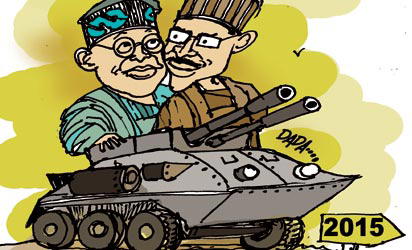
Without disrespect to other partners in the APC, the ‘coalition’ is held together mainly by the ACN and the CPC. This much is obvious in the visibility of the respective leaders of these two parties, Bola Tinubu and Muhammadu Buhari.
It is a reflection of the elitist nature of our politics that we are not told when these parties sought and got the permission of their ‘congresses’ to proceed into this merger that should in practical terms spell the end of each of the former parties as they were known. (This may be overlooked where leaders can be trusted to work in the interest of the people and also given the ‘emergency’ circumstances under which the parties are working).
Otherwise, the likelihood is that some of them might want to declare their independence once things don’t go their way. But if this partnership is to go anywhere the imperative of equitable respect for all partners, irrespective of their individual strengths before coming together, must be stressed and adhered to as failure to observe this is often grounds for mumbled discontent growing into open disagreement and revolt. In this wise, both the APGA and ANPP ought to and should expect to be treated with equitable respect.
Equitable here because both responsibility and power and, of course, sharing of office would also follow the path of what each has brought to the table. That said, what are the motivations for the coming together of the parties?
If the inaugural address by Tom Ikimi announcing the birth of the APC is anything to go by, the party’s goals are no different from the usual goals political parties put in their shopping list and they are as basic as I have mentioned above. Ikimi did not elaborate on these.
But should Nigerians take the APC on the strength of their claim? The claim needs to be tested and one way to go about this is to look at the pedigree of the leading members of the party. At least until they win at the polls if things work out for them. Let’s not forget though that both Buhari and Tinubu have been here before and nothing came out of their planned agenda.
Personal aspirations, too strong to resolve before the election, proved the undoing of their understanding. The ACN all but disowned their presidential candidate who has since joined the government of his opponent at the polls, President Goodluck Jonathan. The CPC would have none but Buhari leading it to the polls and when it lost it took it too badly, more or less inciting violence by its members. The CPC’s arrangement with ANPP fell through with nothing to salvage. What are the assurances that things would work out this time?
Buhari has a lot going for him by way of integrity. But has the last ten years in active politics weaned him of his more autocratic tendencies? Could his readiness to work with a Christian leader like Tunde Bakare be sign that he would not seek to promote his religion at the expense of other religions?
And how ready would he be to step down for another member of the coalition who might be more acceptable to the party than him? The last question also applies to Tinubu whose campaign during the governorship election in OndoState was like the outing of a bad-tempered school master out to beat an offending pupil into line. He fumed, cursed and bragged at the opposition LP and its candidate.
This is saying nothing of the manner he breathed down the neck of Fashola, almost pushing him out of office at a point. Is he more amenable to a more democratic way of doing things now?
There can be no doubt of his activist temper/credentials but how prepared is he, if the claim is true, to cut down on his tendency for primitive acquisition? We are told there are no permanent friends or enemies in politics- but how does this play out with a one time power monger like Ikimi? For a man with an obese ego who tended to pretend he was a soldier in the arrogant manner he talked and carried himself as Abacha’s minister, can he be trusted to work for the new party?
What forced him from the PDP in which he served as returning officer during the convention that brought Obasanjo into office? Was it the loss of patronage and power in the PDP that led him into the APC? What assurances are there that he has weaned himself of his autocratic side?
The PDP is not going to and should not be expected to remain impervious to what the APC represents. It would bring in both fair and foul means to fight and in this it would be looking for the weakest links in the APC chain which are the uncommitted members, people easily blown aside by material wants. In the end, we might by default be closer to a two-party state than we care to know. A little to the right, a little to the left?
Disclaimer
Comments expressed here do not reflect the opinions of Vanguard newspapers or any employee thereof.