
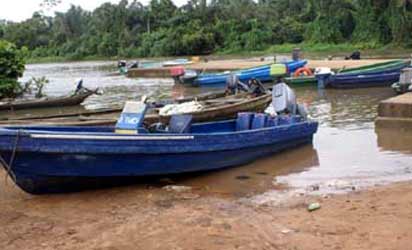
Speed boats at Gelegele port
By Victor Omoregie
Omoregie argues that Gelegele and other oil producing communities have symbolically become ‘sores in our democracy,’ due to the neglect of the welfare and development of inhabitants of these communities
ON enquiry, one of the women, Madam Tejuraboh, who volunteered information, said they sent their wares through the port to places like Bayelsa State, Port Harcourt, Calabar, Warri, Lagos and even the riverine areas of Egun in Ondo State. She said it was cheaper and safer, adding that it eliminates the hassles from security personnel, who they usually met if they went by road.
It was noticed that the water at the port was very turbulent, indicating that it was very close to the ocean. Another pointer to this was that nobody was seen swimming in it. While we were there, members of the Hausa community were looking for the services of local divers to help search for the body of one of their members who had mistakenly fallen into the lagoon.
According to Musa Garba, the Head of the Hausa Community in Gelegele, Ibrahim (the deceased) had gone to answer nature’s call at the seaport and mistakenly lost grip of the edge of the concrete bay and fell into the lagoon.

Speed boats at Gelegele port
On the concrete floor of the bay was a mixture of crude oil and droppings from aquatic animals caught, which made the floor very slippery.
Next to the docking bay was the Dubril Oil Company’s loading terminal, where crude oil was being filled into one of the barges. As would be expected there were signs of illegal bunkering, with drums littering the entire port area. As we turned to leave the seaport, I shook my head in disbelief that the ‘famous’ Gelegele seaport had been reduced to mere waterside jetty.
Total neglect
At the Health Clinic it was another story of total neglect. The windows and doors needed repairs. There were no signs of people, whether patient or medical staff. The young lady who called herself Nina, who sold telephone recharge cards in front of the clinic, said the clinic staff only came twice a month. At these times it was just to dispense local analgesic drugs to persons who needed it. Members of the community that needed proper medical attention usually went to Benin City, emergency cases inclusive.
At the community secondary and primary schools the state of disrepair was mild, as parents reportedly assisted the institutions with finance to meet some their needs.
Although the schools were on holidays, Vanguard met some students who said, all the school needed was more staff. As if to compliment this statement, Mrs. Stella Mumea, a teacher at the primary school said “most of us are over-burdened with subjects and classes to teach. We are only managing to cope”.
At the secondary school, the student population was said to be decreasing every year. The reason being that most of the students usually head for the urban towns, either to continue their education there or to learn a trade. All this to escape the boredom of village life which is over bearing in Gelegele. There is nothing appealing to keep them back.
At the Dubril Oil Company flow station at Gelegele, it was case of continuous flaring of gas and its effect was noticeable. There was an unusual high temperature within the community. The zinc roofs of most of the houses were rusty. According to some members of the community, in the dry season, the intensity of the heat would be very high, causing third-degree burns at times. During the rainy season, the community experiences what is referred to as “acid rain”, which kills off crops and accelerates the rusting of most of the zinc roofs. The security guard was the only personnel that Vanguard met on site. He refused us access into the premises except with the permission of his supervisor. Asked when that would be, he said he could not say.
However, Vanguard gathered from some members of the community, that the Dubril supervising staff came to Gelegele once a week, accompanied by a retinue of security operatives which included the JTF, Navy and Mobile Police. Asked why, one of our guides said that it was just to intimidate and put fear into the minds of members of the community.
According to the youth, the management of Dubril Oil Company is anticipating opposition to their continued stay in Gelegele because aside from the exploration of crude oil, the company has done nothing for the community.
It was with disbelief that Vanguard discovered that in the entire Gelegele community, there was no sign of drinkable pipe borne water. To survive, the community makes do with sachet water brought from Benin City. For this, the community pays N20 per sachet. As to what they resort to as an alternative to clean water for cooking and having their bathe. One of the youths said they fetch water from streams in the bush. And this is over a journey of 12 kilometres as most of the streams in the area have been contaminated by the gradual leaking of crude oil and oil-spillage of varying degrees into most of them. The water-bed is also not spared as the oil seeps into the soil and then into the under-ground water bed.
To cap Vanguard’s visit to Gelegele, we decided to get to the proposed site where the federal government intends to build a new seaport. Sometime last year President Goodluck Jonathan and the Federal Executive Council approved the design of the Gelegele Seaport in the 2010/2011 federal budget. The contract for the Consultancy Services for the design of the Seaport development at Gelegele was given to Messrs. Chris Epas Konsult Limited. The contract sum was N224, 989,864. The duration was for six months. The contract was awarded through the Ministry of Niger Delta Affairs.
Federal representatives
All this came through efforts of the elected Edo State federal representatives, in the persons of Honourable Ehiogie West-Idahosa, Samson Osagie (both of the Federal House of Representatives) and Senator Ehigie Uzamere, who worked tirelessly to ensure the incorporation of the Gelegele Seaport in the budgets of the federal government and that of the Niger Delta Ministry.
The only way to get to the proposed seaport is by foot. There is no passable road that a vehicle of any make can drive through. After walking over a distance that took us about 20 minutes, we arrived at a wide expanse of clearing that still had some form of vegetation. Our guides then pointed to the area indicating that we were at the proposed site of the new seaport. From the look of what we saw, even the original surveyors would find it difficult locating the site. The different construction layout-points and beacons to indicate the exact site of the port have all been overtaken by grass and vegetative undergrowth. From the current state of the proposed seaport, the likelihood of the project taking off is very doubtful. There was nothing to indicate that work might start there in the nearest future. As there was nothing more to record and coupled with the fact that the rush of the lagoon was heard close by, we decided to return to the community. We were advised by our guides that any mis-step on our part, could find us being pulled into the lagoon. The entire place was covered by green vegetation, half of which was water hyacinth that had the lagoon flowing under them.
With the sun gradually setting and members of the community already retiring into their homes, one could predict that the nights at Gelegele were lonely and harsh. One of our guides said that for night life, it was just sitting around and singing songs to while away the time. Ironically, the inside of the homes were cooler and more comfortable than the outside, no thanks to the flaring of gas that is continually going on within the community.
The arrival of the bus in the evening indicated that it was time to go back to Benin. If you miss the bus, the possibility of getting back to Benin is very slim as taxis are rare in the area. The only way you can get back to Benin is to board one of the motorcycles, ridden by some bare-chested young men, who dare the odds to ride to Benin.
As we boarded the bus, I remembered the words of Pa Daniel Okotete, one of the elders in the Gelegele community, who summed up the plight of his community thus: “ Gelegele like other oil-producing communities have become like sores on the legs of the rich man, who is always gaily dressed to cover his legs.” One is wont to agree with Pa Okotete, as these communities have symbolically become ‘sores in our democracy, due to the neglect about the welfare and development of these communities. In sober reflection, one wonders when Nigeria would learn to pay attention to its rural areas, especially those that are laying the “golden eggs” for now.
Gov. Oshiomole should visit us – General Obei
It would seem that the reoccurring decimals in every oil-producing community are a devastated environment, lack of infrastructure and lastly a teeming army of restive youths. It was this same scenario that Vanguard met when it went to Gelegele community located in Ovia North-east local Government area of Edo State.
During the visit, Vanguard talked to the leader of the youths in the community, who was referred to as “General” Richard Obei. According to General Obei, he played his part in the agitation that engulfed the Niger Delta, when the youths took up arms to fight for their rights and those of their communities. But at the moment, he says himself and his ‘army’ have laid down their arms and embraced peace. According to him, they still expect to be integrated into the Federal government’s Amnesty programme.
Below are excerpts of Vanguard interaction with ‘General Obei’
How has life been treating you since you laid down your arms
It has been hardship all the way. I believe this is the price we all have to pay for peace to reign. My lieutenants and I heeded the call of the Federal government to drop our arms, which we did, but sadly nothing concrete has been heard from the government.
Government’s amnesty programme
I am still wondering why we have not been included in the government’s amnesty programme. I am forced to believe at times that it might be because we are not from the core Niger Delta area. Government just concentrated on youths from Delta and Bayelsa States. It is even evident in the award of contracts to former militants to protect oil pipeline. You don’t have to be a magician to know that a majority of these militants involved in the protection of the pipelines are from the states earlier mentioned.
What then are you proposing to government to help alleviate this suffering and hardship that you are talking about?
The development of the seaport would have been a sure way to bring a lease of new life within the community. It would create jobs for the youths. When you entered into the community, did you see any of the youths doing anything tangible? An idle mind they say is the devil’s workshop. The youths should be empowered to take their minds off mischief. Youths the world over contribute immensely to the development of any nation. Our case should not be different.
What would you want the government to urgently do for your community?
Although the NNDC sometime ago laid the foundation stone for a proposed Skills Acquisition Centre, nothing concrete has been about it since then. With a Skills Acquisition Centre, a majority of the youths would be fully engaged. If government cannot integrate us into the Amnesty programme, it should complete the Skills Acquisition Centre for us.
Disclaimer
Comments expressed here do not reflect the opinions of Vanguard newspapers or any employee thereof.