
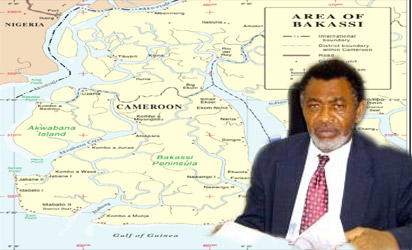
Prof. Walter Ofonagoro…Bakassi is in Nigeria
Prof Walter Ofonagoro in this segment insists that the international boundary between southern Cameroun and southern Nigeria started from cape Bakassi on the Atlantic coast and moving inland along the western bank of the Rio del Rey river in the 1922-39 reports to the League of Nations
PROFESSOR J.C. Anene confirms in his book, International Boundaries of Nigeria, that this portion of the boundary from the sea, at Bakassi, to the Cross River “Rapids”, had been settled by 1913, and were not nullified by the 1913 Agreements: “In the final settlement, the “rapids” of the provisional boundary became the thalweg of the Cross River at the bend of the river about two and a half miles upstream from Obokun.
The boundary southwards followed the thalweg of the Cross River down to its junction with the Akwa River. The thalweg of the latter River continued the boundary, and thence to a number of hill tops, demarcated with pillars.
From these hill-tops, the boundary followed the thalweg of the Akwa Yafe River down to the coast. Here, the boundary was coincident with the Western Bank of the Rio Del Rey estuary.”

Prof. Walter Ofonagoro…Bakassi is in Nigeria
President Shehu Shagari who had served as a Federal Minister in Nigeria, since 1954, also states that the boundary between Nigeria and Cameroons had long been settled down the Rio del Rey, and the territorial waters of the two countries finally defined and settled between the British and the Germans up to the three-mile limit since 1913, and demarcated on a colonial map which both Britain and Germany signed. He further maintained that it was the discovery of oil in large quantities under the sea in the Bakassi region that aggravated the problem of maritime international boundaries.
Cameroon then took advantage of Nigeria’s preoccupation with the Civil War in the late sixties, to start drilling for off-shore oil, in a disputed area in the sea along the Nigerian border. Finally, he stressed that the existing Nigerian border at the sea coast of Rio Del Rey was protected by the OAU Resolution of 1964, respecting the inviolability of inherited colonial boundaries.
Every student of modern European history is familiar with the aggressive posture of the German government in foreign affairs at the time, which eventually led to the First World War. In 1913, European powers were seeking shelter in a frenzy of alliance negotiations, as Germany bullied the other powers for concessions in their colonial possessions.
Germany bullied France into surrendering substantial territory to German Cameroons as a settlement in the Moroccan Question of 1911 and 1912 when Germany tried to seize Morocco from France.
Britain, likewise was pressured to surrender Bakassi Peninsula to Germany, but never did, and never allowed the mutual border from Rio Del Rey to be moved to the Calabar/Cross River Estuary even in the March 11, 1913 Agreement.
Great Britain insisted in Article 21 of that Agreement, that the boundary from Thalweg of Akwa Yafe River, “shall lie wholly to the East of the navigable channels of the Cross and Calabar Rivers”, that is, towards the Rio del Rey boundary. All the documents mentioned above, are a matter of public record, and can be found in the following publications:
1. Walter I. Ofonagoro, Trade and Imperialism in Southern Nigeria, 1885-1929. (New York, Nok Publishers, 1979)
2. J.C. Anene, Southern Nigeria in Transition, 1885-1906, (Cambridge, 1966)
3. International Boundaries of Nigeria (New York, The Humanities Press, 1970).
4. Clive Perry, LLD. The Consolidated Treaty Series, (New York: Oceana Publications, 1978)
5. The treaties are also published in Sir E. Hertslet, the Map of Africa by Treaty, Vol. III (London: Frank Cass and Co. 1967).
Cameroons and the League of Nations: There is additional information about concealment of material evidence and misinformation that have a bearing on this case.
I would like to draw the attention of the reader to papers presented at the Yale University Conference on Imperial and Colonial History, held at Yale University, New Haven, Connecticut in Spring, 1965. In that Conference, which paraded the world’s most acclaimed experts in British and German Imperial and Colonial History, papers relevant to Germany’s brief 22 year rule in Cameroons (1884-1916) were presented. Particularly apt is the paper presented by Professor David E. Gardinier of Yale University, entitled “The British in Cameroons, 1919-1939”.
He was able to demonstrate that Britain and France invaded German Cameroons at the outbreak of the war in 1914, and by February 18, 1916, the last German outpost at Mora, was routed.
Sharing of German Camerouns
Thereafter, the British and French allies set about sharing German Cameroons. Britain already had an Empire in which the sun never set and so, she was not interested in acquiring more colonies.
She however took enough territory from defeated German Cameroons to re-unite territories and peoples who had been divided by previous Anglo-German boundary lines. In German Borno in North-West Cameroons, Britain took enough territory to unify the Nigerian Emirate of Borno; and in German Adamawa in Cameroons, she took enough territory to reconstitute the Nigerian Emirate of Adamawa.
France also recovered all the territories she had ceded to German Cameroons in the Moroccan Crisis of 1911 and 1912. Both Britain and France set up their respective administrations in their partitioned spheres of Cameroon in March, 1916.
On March 4, 1916, Britain and France agreed to a provisional partition of German Cameroons, and by June 29, 1919, Article 119 of the Treaty of Versailles recognized the renunciation by Germany of all her colonies in favour of the Allies. Who were the Allies? They were Britain, France, Italy, Russia, and the United States who joined the war in 1917.
Before the signing of the League Treaty on June 29, 1919, the Supreme Council of the League of Nations decided that all German colonies with the exception of Togo and Cameroons should be placed under mandate. France was sure that she was entitled to sovereignty over her portion of the conquered German colonies. Britain just wanted enough territory to fill out the edges of her existing colonies of Nigeria and Ghana.
On May 7, 1919, the two powers were asked to advise the League on what to do with Cameroons and Togo. Eventually, they took their time to consolidate their hold on German Cameroon.
They also wrote their own terms of the conditions stated in the League Mandates which they signed on July 20, 1922, three years after the League of Nations had been set up. They had controlled their conquered colonies for four years before the League of Nations was born.
Their mandate allowed them to integrate their colonies with their new conquests, so long as they maintained “law, order and good government” and “improved the moral character” of their charges.
These were, after all, “B” Mandates which were, at the time, not deemed capable of self-determination. By 1922, Great Britain had already dispensed with the cession of Bakassi to Germany, and quietly re-integrated that peninsula with Nigeria.
The terms of the Mandate Treaty required Britain to send Annual Reports to the League Headquarters in Geneva, on the administration of the Mandates. I have read those reports sent to London by the British Government of Southern Cameroons, between 1922 and 1939. Most of them have maps and other statistical data. None of those maps show Bakassi as a German Territory.
Rather, all the maps that accompanied these Annual Reports on Southern Cameroon, between 1922 and 1939, showed the international boundary between southern Cameroon and Southern Nigeria, starting from Cape Bakassi on the Atlantic coast of the Bakassi Peninsula, and moving inland along the Western bank of the Rio del Rey which was the Eastern end of the Bakassi Peninsula.
Thence at the headwaters of the Rio del Rey, the boundary turned west along the north shore of Bakassi Peninsula and then north into the Akwa Yafe River thalweg, and thence into the interior. Furthermore, the Annual Reports dealt only with the four administrative Divisions of Southern Cameroons, namely Mamfe, Victoria, Kumba and Bamenda. Britain never sent any report on Bakassi to the League between 1922 and 1946.
Disclaimer
Comments expressed here do not reflect the opinions of Vanguard newspapers or any employee thereof.