
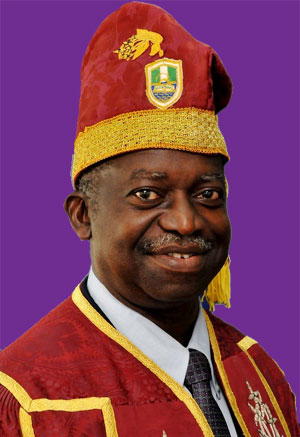
Late Prof. Adetokunbo Sofoluwe
By Douglas Anele
On a cool Saturday morning of May 12, as I was jogging along the Health Centre road, University of Lagos, Mr. Adebule, a senior administrative staff of the university parked by my side and beckoned me to come. When I got to him, he requested in a very solemn voice that I should enter his car. I asked him why, and he told me that my friend, the Vice-Chancellor, Prof. Adetokumbo Sofoluwe, died around 12 midnight.
Immediately I sat down in a state of suspended animation, unable yet to absorb fully the devastating impact of the terrible news I just received. According to Adebule someone called him to break the sad news, and he was on his way to the Vice-Chancellor’s Lodge.
Despite my sweaty and dishevelled appearance, I accompanied him to the Lodge. On our way I was (unrealistically) hoping that somehow the news would be false, that perhaps Prof. Sofoluwe had defied cardiac arrest and was still alive. However my hopes were dashed, because on getting to our destination I saw a number of people gathered in small groups discussing in mournful voices.
Forty minutes later, after condoling with few members of the Sofoluwe family present, I went home. I broke the sad news to my spouse, Ijeoma, and she was overwhelmed with sadness.
Now that my amiable mentor has gone, she wondered, who would fill the vacuum he left? Ijeoma had met the late VC a few times; on each occasion she was impressed by his humility, kindness and infectious sense of humour. Prof. Sofoluwe’s sudden death is one of the most painful experiences I have had in recent years – sometimes I still have to remind myself that my oga is really dead.
Indeed, some hours before his death, I, Prof. H.O.D. Longe and others siting nearby enjoyed some banter with him at the Senior Staff Club.As usual, I reminded Prof. that as a graduate of Edinburgh University where the great atheistic philosopher and sceptic, David Hume, studied, he should not be so passionate about Christianity.
I drew his attention to the book I gave him in February entitled The God Delusion, written by Prof. Richard Dawkins. The late VC replied that the ideas I was supporting are “very dangerous.” One day, he said, I, Douglas Anele, would repent and “accept Jesus as my lord and personal saviour.”
After a few more pleasant exchanges Prof. asked me to see him the following Wednesday. Sadly, he died before the appointed time. I personally miss Professor Sofoluwe for several reasons. I will certainly miss his kindness and consistent encouragement.
Prof.usually sent me interesting materials on the philosophy of science and the history of computer. He persistently reminded me that I have the intellectual resources to be a Professor:he encouraged me to publish myresearch papers in international journals. Prof. Sofoluwe related to me like a caring elder brother, and I am profoundly grateful for his concern for my career upliftment.
He was the most humble, down-to-earth and compassionate of the six VCs I have encountered at UNILAG since 1984. The late VC was so nice that, even if he refuses your request, especially if granting it would be detrimental to his reputation and integrity of the system, he would do so in a very gracious and sympathetic manner. Prof. Sofoluwe was a man of peace and a team player, amiable but serious-minded as well.
He loved UNILAG so much. In his statement of vision and mission for the university entitled Sustaining UNILAG as a University of First Choice, (also known as the Blue Book) Prof. Sofoluwe outlined his game plan for consolidating the position of UNILAG as a primus inter pares among universities in Nigeria.
He was making steady progress, but unfortunately death did not allow him to complete the noble mission he formulated in the Blue Book. The entire university community is already missing his bonhomie, his good sense and indefatigable commitment to service. Now, the death of my dear egbon provides a wonderful opportunity for me to say one or two things about belief in life after death without the illusory consolation of religious superstition.
To start with, Prof. Sofoluwe was a sincere Christian. However, despite his imperfections as a human being, I believe that his humane qualities qualify him for heaven, if there is any such thing and if there is life after death. Christians assume without question that the righteous (such as the late VC, I suppose) will enjoy eternal life with Jesus in paradise, whereas unbelievers like myself will be perpetually roasted in the sulphur and brimstone fires of hell.
Well, apart from the fact that belief in heaven and hell does not have any scientific foundation whatsoever, evidence from the relevant biological sciences tends towards rejection of belief in immortality. The literature on death and what happens afterwards is intimidatingly huge. But none contains incontrovertible evidence pointing to immortality of the soul – in fact the idea of ‘soul’ as a disembodied spiritual entity is irritatingly unclear.
Moreover, belief in immortality is based on the fear of death and uncertainties about post-mortem existence. Clearly, each multicellular organism, including man, must die at a certain point in time, sometimes after producing offsprings.
Therefore, the phenomenon of death and the need for survival necessitate evolution, which means that evolution contradicts belief in immortality – for why would any organism evolve, reproduce and adapt to the environment if it has a component which lasts forever?
Given the incredible continuity in evolutionary progression from amoeba to Homo sapiens, at what point did biological systems acquire an immortal soul? Belief in immortality and religion stem from the same psychological source, namely, fear of death, fear of the unknown and obstinate refusal to accept the fundamental precariousness and transitoriness of human existence.
But the earlier we understand death as theabsolute and ultimate termination of an individual human life the better for us, because it is on the basis of that understanding that we can truly appreciate the inescapable uniqueness and preciousness of the gift of life from our parents by giving our existence authenticity and meaning in the context of man’s ontological finitude and temporality.
Disclaimer
Comments expressed here do not reflect the opinions of Vanguard newspapers or any employee thereof.