
By Rotimi Fasan
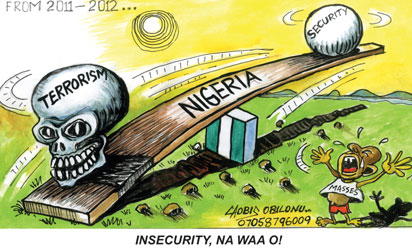
A comprehensive resolution of Nigeria’s security issues may not be possible until we have, as a country, resolved the question of nationhood. For as long as every society is made up of human beings, to that extent could it be expected that there would be issues of a criminal kind, whether deliberate or otherwise.
But issues of criminality and curbing the criminal tendencies of people are seriously compounded in a country where criminals enjoy the protection of certain sections of the society or where they know that they can always count on primordial considerations to escape societal sanction.
Nigeria is today faced with a lot of security challenges and not a few of these challenges are tied to the question of our inability to think and act as a nation. Although Nigerians loosely speak of the country and its people as a nation but it is clear that the people or, better yet, the peoples lack a common outlook to life that is important to the forging of a common sense of societal vision important to the making of a nation.
There is yet no sense of a national outlook to how society could address many of the challenges facing it. Most times when Nigerians comment on matters of a national kind, they tend to do so from a less nationalistic, say clannish standpoint that many call tribalism.
For this reason, the idea of showing respect and concern for one’s ethnic background is demonised and those who do so are made to feel that they have committed some unpardonable crime. Yet deep down, this is unavoidable for many Nigerians. In a multi-ethnic society like ours, people should be free to identify with their individual ethnic groups without disregard for other groups.
Pride in one’s immediate family is the basis of pride in one’s ethnic community and ultimately pride in one’s nation and the human race. To be proudly Igbo or Kanuri is not and should not be mutually exclusive to being proudly Nigerian. One is the basis of the other and where people have a sense of justice, of what is right and proper, there should be no fear of these two emotions conflicting.
It may, in my view, be very difficult for someone who feels no pride in being or is, in fact, ashamed to be called Ijaw or Yoruba to be proud of being called a Nigerian. But one should not be so proudly Efik that to think and act like a Nigerian becomes impossible. The failure to do this is at the root of the many crises facing Nigeria today.
It is the reason why matters of security remain intractable and may take long to resolve. I will cite three instances of this to demonstrate my point.
In the last two years since the resurgence in the activities of the terrorist group that destroys property, maims and kills Nigerians and has no clear agenda beyond its avowed hatred of so-called Western education, increased its spate of terrorist activities in different parts of Northern Nigeria, there have been questions raised on how best their activities could be ended.
Various options, from appeasement, open confrontation to dialogue have been proposed by Nigerians. But the killer group has not given room for testing the efficacy of any of these options fully.
Well, it could be argued by some that government has in certain cases taken on the terrorists bent on fomenting both ethnic and religious war in the country- government has taken them on in some cases but mostly in the ordinary manner of responding to security challenges. Most of these face-offs have been reactive.
The one instance during which government actively went after the terrorists led to the killing of the leader of the group in controversial circumstances.
The terrorists have tried to justify their mindless slaughter of Nigerians thereafter as a way to avenge the death of their leader who, no doubt, had been behind the murder of many Nigerians that have become mere statistics in the annals of extra-legal killings in the country. The latest activities of the terrorists, targeted as usual at churches, have led to the shut-down of major towns and cities in the North.
But the question of how to curtail or end the activities of the terrorists has remained intractable. This is precisely because the security agencies or agents entrusted with the duty of fighting the terrorists as with other crimes have been compromised by people who don’t share the sentiments that criminals need to be sanctioned or that the terrorists particularly have descended beneath the norms of decency in the prosecution of their non-agenda. But for the complicity of the security network in abetting criminals, the larger-than-life image of the terrorist group is a mere myth. It has no basis in reality.
I provide three instances of how the security network has been compromised such that they have now been left floundering.
Allegations that some security agents are on the pay roll of the terrorists given their role during reported attacks have increased over these many months. Many times, eye witnesses talk of people, not just in the uniform of soldiers or police personnel, participating in the killings. They finger among their attackers security people called in to protect them. Sometimes, these security people take side with the attackers or provide escape leeway for them.
Incidents like these have been reported from places as far apart as Jos, Abuja and Damaturu among others. In Jos, a very senior soldier, a military commander, was said to have sabotaged efforts to repel the terrorists during one such attack on a community.
The case of Kabiru Sokoto, the suspected mastermind of some of the most heinous of these attacks, easily comes to mind. This was the man allowed to escape from custody by the security people attached to him on a routine mission to search his house. This episode led to the sacking of Zakari Biu the police man recalled from semi retirement following his suspected involvement in some crimes of the Abacha era.
The final case I’ll mention is that of the police men alleged to have ‘smuggled’ Farouk Lawan, the House of Reps member from Shanono and former chair, ad hoc committee on fuel subsidy panel, out of detention to freshen up in his home ( I don’t see why the police cannot provide basic conveniences for someone in their custody).
Lawan currently rides the crest of a bribe-for-favour scandal rocking the House. Security people that would take a man in a high profile case like this out of detention would do anything. Most of the security people who compromise their position like this do so for ‘tribal’ or religious reasons that prove we are not yet a nation.
Disclaimer
Comments expressed here do not reflect the opinions of Vanguard newspapers or any employee thereof.