
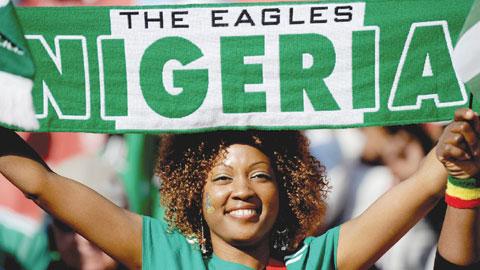
A Nigerian fan cheers prior to Argentina vs Nigeria
By Is’haq Modibbo Kawu
I SHARE the indignation which informed VANGUARD’s editorial of Monday, May 7th, 2012, titled “NIGERIA-MISTAKE SINCE WHEN?” The editorial noted that “contenders for disintegrating Nigeria are increasing” and the latest recruit into this cast was Prof. AngoAbdullahi, former Vice Chancellor of the Ahmadu Bello University, Zaria.
The 73-year old Professor told the audience at Sam Nda-Isaiah’s 50th birthday ceremony, that the amalgamation of Nigeria in 1914, was “a fundamental mistake” adding most pessimistically that ‘the question of a likely disintegration is not a too distant future”.
Abdullahi warned “the Southerners that are propounding dividing the country should know that it is also not something that the north will not want.
We can be on our own…That the north is keeping quiet doesn’t mean we don’t know what we are doing. We want peace and unity but no one can intimidate us…”
VANGUARD’s editorial asked “what part did 1914 play in the quality education and attendant privileges Abdullahi and his generation had? Is 1914 responsible for insecurity in Nigeria? How did 1914 make millions of children- the leaders of tomorrow- street urchins?
Surely, a country with some of the world’s best professors of agriculture is unable to feed itself because of 1914…Matters are more depressing when Gen. Danjuma, a key player in Nigerian affairs joins the debate…Danjuma preached. Who was he trying to deceive? Can governors who do not command a single policeman be the chief security officer[SIC] of anything? Which state has not failed?”
In truth, factions of the Nigerian ruling elite seem to hold 1914 rather like a sword of threat against the progress of Nigeria; they wave it threateningly on occasions, depending on how deep their current frustration is, about the slice of the national cake they are able to get. It is like the proverbial spoilt child at play; and for too long we have lived with this attempted de-legitimisation of our country.
Reject the platform
The narrative is that Nigerians had nothing in common until the 1914 amalgamation by the British. That might be good political talk to mobilise a captive emotion constituency, but the facts of history vigorously reject the platform. The works of the Jihadist scholars, Usmanu Dan Fodio, Abdullahi Fodio and Muhammed Bello vitiate this narrative. The pioneering historical works of Prof. Kenneth Dike and others also show the rich, relentless historical forces at work in the Nigeria area before colonialism. But we do not teach history in our schools anymore, so those able to purvey a reactionary, revisionist versions of history, located in the ethnic jingoism we have spoken about today, have taken over the national space, manipulating the fault-lines of history to de-legitimise the country. There is a romantic delusion that somehow, Nigeria can be broken up to allow ethnic entrepreneurs to claim fiefs to preside over, in a post-Nigeria, ethnic ‘paradise’. Some even romanticise ethnic wars, apparently oblivious of recent human history!
One of the failures of the Nigerian elite, is the inability to settle into a nation-building mode for constructing the country.
Every crisis becomes a reason to seek the disintegration of the country as a preferred solution. I’ve always wondered if our elites know the number of low intensity warfare and socio-economic and political crises which India deals with each day, yet its elite does not canvass the disintegration of the country.
Those who have taken so much from Nigeria turn around to advocate its disintegration. I come from an empire-building background with forefathers who helped in the construction of the great empires of old West Africa.
The lessons of history teach that to build complex countries, such as Nigeria, has never been a tea party. The ruling elite must be responsible and committed. Nigeria’s tragedy is to be saddled with an irresponsible elite; they take so much from the country and when disadvantaged, threaten us with ‘the mistake of 1914’.
The Nigerian people must reclaim our country and its history from its fraudulent elites! 1914 was not a mistake; it was the culmination of a historical process which the dynamics of colonialism merely hastened and used for imperialism’s purpose. We can turn that purpose into a triumphant nation building agenda!
Boko Haram and the ethnicity narrative
LAST week, a suspected ‘operational commander’ of Boko Haram was allegedly arrested in the Farawa Quarter of the city of Kano. If it was an indication of ‘success’ by the under fire Nigerian security forces, the preferred manner of reportage and one which most Nigerian newspapers sensationalised, was that this ‘operational commander’, Suleiman Muhammed, was a Yoruba man! In an immediate riposte, couched in the necessary anger that befitted the ethnic disgust (and denial) reserved for such an occasion, THE NATION newspaper of Sunday, May 13th, 2012, led with a report that the Yoruba (race?) had disowned the alleged commander: “A group of concerned natives of Ogbomosho dismissed the reports as ‘suspicious and lacking in clarity’”
A spokesman, Mr. Afolabi Omotoso, responded that: “we are saying with all emphasis that there is no Ogbomosho indigene bearing that name (Suleiman Muhammed)”. Even a source from the palace of the traditional ruler of Ogbomosho, the Soun, was quoted as saying “we’ll want to know more about the suspect. Who is his father and from which compound or adugbo(ward) does he come from”.
The former secretary of the Yoruba community in Kano added that the arrested individual was not known to the community, because “the Yoruba in the metropolis network very well”. The ‘ethnic’ denial goes on and on! Unfortunately, the mystification about a Yoruba man, not being a member of Boko Haram, or the denial of the origins of the alleged ‘operational commander’, merely shows the depth of sickness which the ethnicity narrative represents in the Nigerian national space today.
Those who deny Suleiman Muhammed’s ‘Yoruba’ origin, operate from some mistaken assumptions which have made it difficult for many of our compatriots, especially from the South, to understand the depth of the crisis associated with the Boko Haram insurgency. One of these assumptions is that because Boko Haram was allegedly some form of Northern conspiracy, a Southerner or a Yoruba person could not have been a member.
But the fact that in recent months we have heard of Igbo, Igala and Yoruba members, has defeated the ethnic and regionalist arguments. The Yoruba terrorist organisation, the OPC, had also warned severally of retaliatory attacks, if Boko Haram ever operated Yorubaland. Again, the basis of its posturing must be located in the fixation with an ethnic understanding of the complex dynamics of social breakdown and insurgency, especially the Boko Haram insurgency.
Many others reduce analysis to the more outlandish statements allegedly from spokespersons of the group. But why should we be surprised that Nigerians from all parts of the country, or of different ethnic origins can be members of the Boko Haram organisation? Social dynamics are far richer than the simplistic frames of ethnic jingoism, the preferred mode of understanding Nigeria, amongst sections of the political and media elite.
Fundamentally, Boko Haram is both religious and ideological. A cursory understanding of the history of Islam, reminds that it was not and never was a racist religion. One of the earliest companions of the Prophet Muhammad was Bilal, of Ethiopian origin, who was in fact, the first Muezzin in Islamic history.
There were outstanding black war commanders and diplomats in those early years of Islamic consolidation. Given this background, it shouldn’t surprise that a Suleiman Muhammed from Ogbomosho, can be arrested as ‘operational commander’ of Boko Haram.
The ideological element must also not be discounted! I went to work in the Nigerian Socialist movement from the age of 16. We were driven by a strong ideological commitment, with comrades from all over Nigeria and even beyond, because of the internationalist basis of Marxism. The ethnic origins or religious confessions of comrades were secondary to the commitments we had to the struggle. Whoever has been forged in an ideological crucible, will understand how ideological commitment can and does trounce ethnicity.
Besides, those playing the ethnic card have also conveniently forgotten the migrations of peoples around Nigeria and their absorption into the host cultures all over the country. This is a process which takes place every day, in ways that most of us do not seem to appreciate in a nuanced manner. However, in the ethnic narrative, history froze and peoples can be simplistically separated into unchanging ‘tribes’, ‘ethnicities’ or even ‘races’, which ethnic entrepreneurs can ride on for political advantages.
This inadequate platform has for too long been used to negotiate advantage by groups of the elite in Nigeria. The narrative becomes more strident, fascistic and threatening in moments of national crisis, as we now have in the country.
I think the fact that Nigerians from other ethnic backgrounds have been discovered to belong to Boko Haram, other than the simplistic assumptions about ‘Northerners’, ‘Hausa-Fulani’ (whatever that means anyway!) or ‘Kanuri’, culprits, who are allegedly a part of a ‘conspiracy’ against the Jonathan administration, has exploded the narrative of the Nigerian ethnic jingoists and ethnic entrepreneurs. It does not matter that Suleiman Muhammed was Yoruba, from Ogbomosho. His origins do not vitiate the fact that a combination of social circumstances has led some Nigerians to take up arms against the Nigerian state.
Our country’s ruling elite must find the means to locate the roots of the problem in order to solve them. The ethnic narrative is far too simplistic and often too reactionary, to be of any meaningful assistance. It obscures understanding of complex social phenomena! Just last week, even the National Security Advicer, Oweye Andrew Azazi, told a Northern Impact Summit in Kaduna, that failure to address economic hardship and lack of economic opportunity have “opened a fertile ground for recruitment, indoctrination, brainwashing and training of terrorists and other insurgents in the country”.
If that was the case, how could a Suleiman Muhammed from Ogbomosho, but resident and perhaps born in Kano, have escaped ‘the failure to address economic hardship and lack of economic opportunity’, that Azazi spoke of? From the ethnic narrative, the fact that he was Yoruba must automatically have given him such ‘immunity’, apparently. That is the absurd cul-de-sac that the ethnic narrative can lead to!
Disclaimer
Comments expressed here do not reflect the opinions of Vanguard newspapers or any employee thereof.