
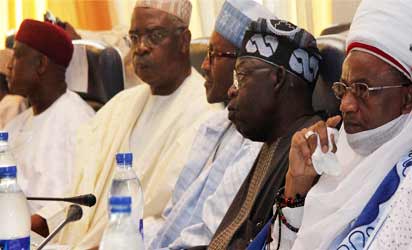
From right: The Etsu Nupe, Alhaji yahya Abubakar; Asiwaju Bola Tinubu; Maj. Gen. Muhammadu Buhari; Event Chairman, Lt. Gen. Theophelus Danjuma and the celebrant, Chief Sam Ndah-Isaiah at the special 50th Birthday Lecture organised for Sam at the International Conference Centre.
By Emmanuel Aziken, Political Editor
A conclave in honour of the publisher of Leadership Newspapers turns into a discourse on the leadership failure of the country.
Did Sam Nda-Isaiah, the pharmacist turned newspaper publisher compound a concoction for straight talking to guests at his fiftieth birthday celebration last Tuesday?
Willy-nilly the fiftieth birthday lecture for the Leadership publisher turned into a serial lamentation of the Nigeria question. It could not have been otherwise, given the insecurity troubles that have recently befallen the nation.
Among the dignitaries at the gathering at the International Conference Centre, Abuja last Tuesday that had the theme, ‘A morning of reflections’ were Speaker Aminu Tambuwal of the House of Representatives, former Head of State Gen. Muhammadu Buhari, former Senate President Ken Nnamani former Minister of Defence, Gen. Theophilus Danjuma; National Leader of the Action Congress of Nigeria (ACN), Asiwaju Bola Ahmed Tinubu, the Guest Speaker, Prof. Ango Abdullahi, former Minister of the Federal Capital Territory, Gen Jeremiah Useni; among many distinguished Nigerians.
Given the array of dignitaries drawn from across the country, it was inevitable that the insecurity problem that has recently engulfed the northern section of the country would become an issue.
While the chairman of the occasion, Gen. Danjuma lamented the increasing slide of the country into a Somalia, the guest speaker Prof. Abdullahi traced the problems of the country to the 1914 amalgamation of the North and South which he described as a fundamental mistake.
In his paper titled: “Nigeria 1914 to date – A Chequered Journey So far”, Abduallahi described the amalgamation of Nigeria by the British Governor-General Lord Lugard as the greatest error to have befallen the country.
While urging the nation’s leaders to take urgent steps to redress the mistake on the point that “delay would be late and dangerous,” he cited other countries such as India, Pakistan and Bangladesh who were also forcibly amalgamated by the British but had to go their different ways.
The Sudan which recently split into Sudan and South Sudan was also similarly colonized by Britain Prof. Abdullahi said as he sought to draw attention to the fault line of Britain colonization.
“Things are more likely to become complex in the future. Until the correct things are done, we cannot ignore these facts or we continue to pretend as our leaders that this is a passing phase. The question of a likely disintegration is not a too distant future.”

From right: The Etsu Nupe, Alhaji yahya Abubakar; Asiwaju Bola Tinubu; Maj. Gen. Muhammadu Buhari; Event Chairman, Lt. Gen. Theophelus Danjuma and the celebrant, Chief Sam Ndah-Isaiah at the special 50th Birthday Lecture organised for Sam at the International Conference Centre.
But before Abdullahi spoke, Gen. Danjuma, a major character in some of the major events to have enveloped the country since before the civil war expressed his reservation on the state of insecurity in the land.
“As far as Nigeria is concerned, I am an optimist. I tell myself each time we seem to stumble as a nation, I tell myself, we shall muddle through. But, in the last few months, I begin to wonder-our house is on fire,” Danjuma said in his remarks.
“The Somalialisation of Nigeria is taking place right now. We need to sit down and get to the root of the problem and find a solution to it. Let us not deceive ourselves, the Chief Security Officer of a state is the governor.
Where are our Northern governors? Borno is a failed state Jigawa is almost a failed state. Kano is threatening to be a failed state. Where on earth are we going? You hear talks about multi-million naira fences around government houses, what about the people?”
National leader of the ACN, Tinubu in his remarks faulted the present leadership of the country and the ruling party, the Peoples Democratic Party, PDP for the problems of the country. As an example of how the PDP is mismanaging the country, he pointed at the problems of the President of the Court of Appeal, Justice Ayo Salami.
“The sack of Justice Salami has put fears into other judges as they may not have the strength of justice to denounce the PDP or give remarkable judgment because of the fear of what happened to Justice Salami.”
Even while he agreed that the PDP rules with impunity, Senator Nnamani, however, observed that the opposition was equally enrobed in the faults and fashions of the PDP.
“I agree with Asiwaju Tinubu on what he said about the ruling party, but all the parties share the same element of impunity.
We should look at what is on the ground now and stop lamenting about what has gone. The first one is corruption. The outcome of the fuel subsidy report by the House of Representatives should be commended. Here the transformative agenda is on trial.
“The security of the country is another matter. Can the people sleep with two eyes closed? Now that the report of the House has come out, will the leadership act on them?”
The former Senate President also made inferences to the controversy arising from former President Olusegun Obasanjo’s denial of any third term ambition while in power.
“There are people who deserve to be in Kirikiri prison today for what they did at that time, in 2006. If there has been a trial of all of us involved in 2006, some people will not be denying now their various roles.
“It is for us as a country to show the world that we can manage ourselves effectively. What do we do with all these investigations? If we don’t set examples, another one will happen. Nigeria is such a resilient country. Despite all that has been taken out of it, it is still standing. I am surprised.”
Erstwhile Minister of Aviation, Chief Femi Fani-Kayode in an apparent reference to the call for restructuring said that devolution of powers should be differentiated from the calls for secession.
It was his opinion that devolution of powers would stabilize and help the country to overcome its present challenges.
Disclaimer
Comments expressed here do not reflect the opinions of Vanguard newspapers or any employee thereof.