
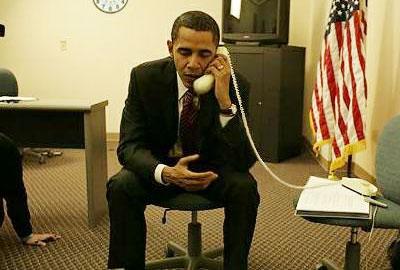
Obama
By Rotimi Fasan
POLARISING as the same sex marriage issue has become in America, and around the world (no thanks to the manner Americans tend to universalise matters that concern them), it simply won’t go away.
And this past week, Barack Obama, the American president, had to make a clean breast of it by stating unequivocally where he stands on the matter. Of course, the fact that only days before Joe Biden, the Vice President, had said he was in support of gay marriage, indicated Obama could no longer shirk the matter.
There was the danger of him being seen as weak and vacillating. He needed to make his position clear before it appeared inevitable, whether he liked it or not. Or so critics of the timing of the announcement say. And so the President spoke, he said, in favour of freedom- in support of the right of Americans to choose who they desire as marriage partners even if of the same sex. It is ironic that in a matter as momentous as this, it was a Black man, the first to be elected president of America, that would speak in a manner that would set the millions of Americans who felt imprisoned by societal opposition to their right to be with who they wanted in marriage- it was a Black man whose words would literally set the captives free. In the end, for the President, the decision was based on personal considerations after due consultation with his family and recognition that they, too, are in support of his position.
Obama’s endorsement of same sex marriage is a personal decision with national and international consequences. His standing for gay marriage has no legal effect whatever on the American constitution; it was a personal decision just as any that could have been made by any other American.
But this was the American president, the first president ever to take such an emphatic stand that many an American politician feared could drown them politically. It is a measure of how far Americans have come on the LGBT issue that Obama could make such a pitch openly. Before now, no American politician conscious of their standing at the polls dare take such a bold stand as he has done.
The game was always to move like Babangida’s two-party system, a little to the right and a little to the left, depending on where the tide went- where public opinion swung. Even for Obama, the decision was a long time coming. As he put it, it had evolved over time during which he must have weighed the pluses and minuses of his chosen path. But more on this later. Suffice to say that his Republican Party rival, Mitt Romney, has been playing yo-yo on the gay rights issue.
In the run-up to his election to the Senate, he was pro-gay right. But now he is a vehement opponent of the same right that he had championed on his way up the political ladder. Obama had moved from a less assured support of gay rights to making an open and unequivocal statement in support of it. The question now is how this would play out in the elections that are just some six months away.
Obama, it is expected, may have to give up precious conservative African-American votes to pay for his decision to support gay rights. But this might be more the wishful thinking of those who would rather find a reason, any whatsoever, to oppose the President’s continued stay in office.
There are, no doubt, many who still see Obama’s election as president as a mistake that must be corrected. But what those sold on his reformist policies and the efforts he’s so far made to stabilise the American economy despite the downturn that ushered him into office in 2008- what this category of Americans would be calling attention to is the fact that the President’s support for gay rights shouldn’t be the dark cloud that should overshadow his impressive achievements.
Black churches and their leaders would be helping Obama a long way by articulating the issues involved in the election as one that should not be driven by the purely cultural choices that the President had to make over his achievements in trying to drive down inflation, stabilise the economy while driving up employment figures.
The conservatives, on the other hand, would and have been having a field day criticising the President for what they see as politicising a cultural and social issue in order to curry votes of the gay community. Really, Obama may not have too much to fear from this camp of American voters whose support for him is at the best of time not as enthusiastic as it might and should be, had partisan considerations not taken the better part of their judgement.
But on the plus side, in reaching this decision Obama might have set his eyes on young American voters, the same demographic that gave him firm and unstinted support in his 2008 bid for the presidency. Many in this group do not support their fathers and mothers in their opposition to gay rights.
Same applies to educated Americans and others less interested in what they consider the personal choices of their fellow compatriots and what the President thought of these choices than in his ability to meet the objectives and promises that gave him the support of American youths in 2008.
Obama would really need to reach out to these important demographic that has borne the brunt of many of the hard choices that the American economy has imposed on Americans. The Republicans, especially the ultra conservative Tea Party section of it, have done much to scuttle Obama’s economic policies in a manner that portrayed him as weak in taking on the opposition and standing firm on his belief; their belligerence and Obama’s conciliatory gestures have but served to disaffect the youths.
The task before Obama as the race to the White House in 2013 heats up is to see how to win more of the youths to his sides while retaining the votes of the Black population as well as reaching into so-called Republican enclaves.
Whatever the case might be for Obama and the Americans, there is no doubt that his support for gay rights would not enjoy much sympathy in many parts of Africa, including Nigeria where the first Black American president apparently has a large following.
Christian groups that have been opposed to the ordination of gay priests would see Obama’s position as manifestation of Satan’s plans. But for Obama, his was a choice based on no less moral and Christian principle than that which enjoins us to treat our neighbours as we would like to be treated. Perhaps on this ground he would be forgiven.
CORRECTION:
In last week’s article, I erroneously referred to former US Secretary of Defence as Christopher Gates when I had meant Robert Gates. The error is regretted.
Disclaimer
Comments expressed here do not reflect the opinions of Vanguard newspapers or any employee thereof.