
By Les Leba
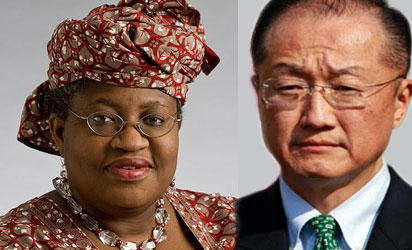
The Nigerian government propaganda machine quickly succeeded in generating media frenzy in the campaign for our current Finance Minister, who also doubles with powerful portfolio of Coordinating Minister for the Economy.
The barrage of support made it seem as if nothing could stop our amiable amazon from clinching the job; her opposition was made to seem inconsequential. So, it was a rude shock for Iweala’s campaign team when Dr. Jim Yong Kim, the Korean American candidate was selected as World Bank President, last week.
Not surprisingly, government’s apologists and some sections of the media hollered ‘blue murder’ as they claimed that Okonjo-Iweala, the self-acclaimed best candidate was bypassed in favour of Washington’s ‘inferior’ and presumably less suitable candidate!
In support of their position, they cited Dr. Iweala’s educational pedigree and progressive career path to the top echelon of the World Bank, as well as her hands-on experience as two-time Finance Minister, plus a brief and controversial stint as Minister for Foreign Affairs in Nigeria.
In terms of the quality of her service delivery in almost five years in government, her admirers refer to the controversial payment of $12bn to the London/Paris Clubs of creditors for $18 debt forgiveness. Dr. Iweala’s campaign team also claimed that her publications of revenue allocations to the states and local governments as significant achievement. Nigeria’s relatively favourable listing by international Rating Agencies was similarly referenced as Iweala’s contribution to the growth of the Nigerian economy.
Instructively, the above credentials have not translated to progressive economic growth or improved social welfare for our people. In truth, Nigeria’s external debt was reduced to below $4bn after the debt exit, but the promises that the $18bn debt write off would release more resources for development have largely remained unfulfilled; in fact, as from 2007, domestic debt burden of about N1 trillion began to rapidly swell, and five years later has exceeded N5 trillion, yet, Nigerians cannot identify the relative developmental milestones achieved.
Apart from decrying the increasing pace of local debt accumulation in the course of the last 10 months of her current stewardship, critics wonder how she expects to speedily redress the fiscal imbalance in favour infrastructural consolidation with her strategy of reducing the 70% recurrent budget by 1- 2% points every year for the next three years!
Besides, Nigerians are in consternation as to why increasing foreign revenue has brought our people deepening poverty! Dr. Iweala does not appear to have the capacity to curb the perennial monetary scourge of excess liquidity or to reduce the rates of inflation and cost of borrowing to the real sector to the beneficent level of lower single digit; worse still, the unemployment rank continue to swell with over 40 million jobless Nigerians,, while the economy’s Coordinating Minister appears unable to resolve the imbroglio of efficient fuel pricing and social welfare enhancement.
So, in reality, it becomes a challenge to identify any of Dr. Iweala’s programmes that has truly benefitted the critical mass of Nigeria’s poor, 70% of whom live on less than the proverbial $2/day.
The above is not to remove anything from Dr. Iweala’s impressive educational background and commendable rise within the ranks of the World Bank in her professional career. On the other hand, we must remember that the World Bank is basically a development institution primarily targeted to support growth and development in poor countries.
Incidentally, critics of the World Bank maintain that current bank reforms as formulated and implemented by IMF/World Bank experts have never resuscitated or truly supported growth and economic transformation in any developing economy!
Now, Dr. Iweala as a true product of that Institution must also be dyed in the wool expert in the design of such destabilizing IMF/World Bank programmes for poor countries; so far, she has never been known to publicly challenge the validity of these programmes and it would therefore, be out of place to expect that she would revolutionise or reexamine the content of these programmes, if she became World Bank President!
Now, let us take a look at the credentials of Dr. Jim Yong Kim, who was Iweala’s main competitor in the race. Interestingly, there was no overt campaign team supporting his candidacy. Indeed, apart from President Barak Obama’s public presentation of his candidate, Dr. Kim has maintained a cultured reticence.
This is not to say that the eminent gentleman lacks pedigree in educational qualification or in effective public service delivery. The following are excerpts of a profile of Dr. Kim from Wikipedia:
Jim Yong Kim is a Korean-American physician, who served as a lecturer at Harvard Medical School, eventually holding professorships in medicine, social medicine and human rights.
Jim Yong Kim, along with other colleagues, co-founded Partners In Health (PIH) in 1987. The organization began with radical new, community-focused health care programs in Haiti, which executed treatments based on local needs and by training community members to implement them.
By the early 1990s, the program in Haiti was serving more than 100,000 people. It achieved remarkable success treating infectious diseases at low cost, spending $150 to $200 to cure tuberculosis patients in their homes, treatment that would have cost $15,000 to $20,000 in a U.S. hospital. Kim was instrumental in designing treatment protocols and cutting deals for cheaper, more effective drugs.
The PIH model was expanded to Peru in 1994. By 1998, extremely successful results curing both common and serious ailments prompted the World Health Organization to embrace the model, and support the adaptation of community-based care to impoverished communities around the world.
Particular success in treating multi-drug-resistant tuberculosis (MDR-TB) prompted international organizations to rededicate efforts to the eradication of the disease, and in June 2002, the World Health Organization adopted prescriptions for dealing with the disease that were virtually the same as PIH had used in Peru.
Kim’s work with PIH to treat MDR-TB was the first large-scale attempt to treat the disease in a poor country, and the efforts have now been replicated in more than 40 countries around the world. PIH now employs more than 13,000 people in 12 countries.
In March 2004, he was appointed as director of WHO’s HIV/AIDS department, after having success creating programs to fight the disease at PIH. Dr. Kim oversaw all of WHO’s work related to HIV/AIDS, focusing on initiatives to help developing countries scale up their treatment, prevention, and care programs.
This included an ambitious “3×5 initiative” that was designed to put three million people in developing countries on AIDS treatment by the end of 2005. The goal was not met until 2007, but according to the WHO, served to push the treatment strategy for AIDS in Africa further and faster than could have otherwise been hoped. As of 2012, the program has treated more than 7 million Africans with HIV.
In recent years, Kim spearheaded the development of a new field focused on improving the implementation and delivery of health interventions in poor communities around the world. His programs operate with the philosophy that progress in developing more effective global health programs has been hindered by the paucity of large-scale systematic approaches to improving program design.
This new field will rigorously gather, analyze, and widely disseminate a comprehensive body of practical, actionable insights on effective global health delivery. Towards these goals, Kim co-founded the Global Health Delivery Project, a joint initiative of Harvard Medical School’s Department of Social Medicine and the Harvard Business School’s Institute for Strategy and Competitiveness.
The global health field case studies produced by this project form the core of a new global health delivery curriculum now taught at Harvard School of Public Health. Kim’s team also developed a web-based “community of practice”, GHDonline.org, to allow practitioners around the world to easily access information, share expertise, and engage in real-time problem solving.
Jim Yong Kim was awarded an MD from Harvard Medical School (Dr. of Medicine – the equivalent of PhD in Medicine) at the age of 33 in 1991. In 1993, he obtained another PhD from the same institution for Anthropology.
It is clear that Dr. Kim is an icon in his own right, even if Dr. Iweala and her campaign team showed little charity or respect for his concrete achievement and interventions in developing countries. Even though he is American, his research and development work seems a perfect fit with the mandate of the World Bank to foster improved welfare in developing countries. Besides, Dr. Kim is a resourceful fundraiser, having privately raised hundreds of millions of dollars to support his work in poor counties.
Indeed, he wields tremendous respect in Washington and the White House, and it is not surprising that a day or so after his appointment, the U.S. Congress showed support for increased funding for the World Bank!
Conversely, Iweala’s candidature is not supported by identifiable success in any developing country including Nigeria, where, in spite of increased fortuitous earnings, our people have become poorer! But this failing did not stop the Honourable Minister from trumpeting “I am the best candidate” slogan all over the world.
The chorus changed to accusations of defective democracy practised by the U.S. and the absence of a level playing ground. Belatedly, they realized that the rules of the game were circumscribed by ratio of a nation’s contribution to the World Bank treasury.
With this recognition, their energies would have obviously been better deployed to changing the rules of the game before promoting Okonjo-Iweala’s candidacy.
Alternatively, in the face of perceived domination, Okonjo-Iweala and her team should have considered formation of a new bank, where the developing countries had controlling interest, even if it is not likely that the largest contributors in such an outfit would cede the right to appoint its prime officials to the smallest contributors.
We will conclude this week’s article with excerpts from a report published recently in the New York Times news service on research by University of Nebraska-Lincoln on Narcissism (inordinate self lovers are known to be unnecessary high on self esteem) and Job Interviews”. “Narcissists are known to be obnoxiously high on self-esteem, and are better able to talk about and promote themselves, which projects confidence and expertise to interviewers.
“In their two-part study, narcissists scored much higher in a simulated job interview than equally qualified non-narcissists.
“The findings also suggest that interviewers need to be aware of the tactics used by narcissists, and the research ultimately concludes that “On the whole, we find very little evidence that narcissists are more or less effective workers. But what we do know is that they can be very disruptive and destructive when dealing with other people on a regular basis,”
Mmmm… well, well, well…, in view of the outcome of the above research, it is likely that maybe the right man won the contest for the Presidency of the World Bank!
SAVE THE NAIRA, SAVE NIGERIANS!
Disclaimer
Comments expressed here do not reflect the opinions of Vanguard newspapers or any employee thereof.