
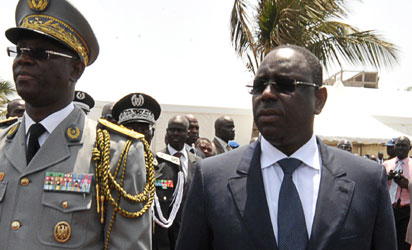
Macky Sall (R) stands alongside Senegalese Armed Forces Chief of Staff Abdoulaye Fall during a swearing-in ceremony, on April 2, 2012, in Dakar. Macky Sall, who was sworn in as Senegal’s president Monday, is a stolid 50-year-old geologist, once tipped as former president Abdoulaye Wade’s designated heir, who defeated his former mentor at the polls. AFP PHOTO
WADE’S concession of his defeat in the presidential run-off election has drawn understandable attention to the politics of Senegal.
It is yet to experience military coups, being the only country in West Africa in this category. What lessons is to be learnt from this fact? Although President Abdoulaye Wade’s candidacy in the just concluded election was technically a violation of the two terms limit, his gracious congratulatory call to his opponent has led to further commendations for Senegalese politicians.

Macky Sall (R) stands alongside Senegalese Armed Forces Chief of Staff Abdoulaye Fall during a swearing-in ceremony, on April 2, 2012, in Dakar. Macky Sall, who was sworn in as Senegal's president Monday, is a stolid 50-year-old geologist, once tipped as former president Abdoulaye Wade's designated heir, who defeated his former mentor at the polls. AFP PHOTO
The European Union spokesperson was quoted as saying the election was “a great victory for democracy in Senegal and Africa” (Vanguard Tuesday March 27, 2012). African Union Commission Chairman, Jean Ping said the peaceful conduct of the presidential election “proved that Africa, despite its challenges, continues to register significant progress towards democracy and transparent elections” (Vanguard Tuesday March 27, 2012).
The President of France, Nicolas Sarkozy, congratulated the Senegalese, pronouncing the importance of Senegal’s example as “goodnews for Africa in general and for Senegal in particular”. What lessons about elections and democracy can we learn from Senegal’s election. The implication of the commendations of the European Union, the African Union and Sarkozy’s exuberant praise reported above is that there are lessons for elections and democracy to be learnt from the case of Senegal. The question is how is such a best practice case study of Senegal politics to be structured? This question calls for a general theory of the politics of election and democracy to inform the specific instances of Senegalese elections and democracy.
For while commendations are routinely made, especially in the UN, EU, and AU monitoring of politics in the so-called Third World, how such commendations are to be evaluated both for their significance and statecraft relevance are not rigorously addressed. Such tasks are left for pro-democracy NGOs to do. This is not good enough, especially when such commendations are used by governments for establishing replicable standards and conditions for development support.
How do we determine lessons to be learnt in the conduct of politics? Specifically, how do we determine what lessons inhere in the facts that President Wade did not use the security forces to set at naught the rejection of his candidacy at the polls? What lessons are contained in the fact that Senegal remains the only polity since its independence that has been coup-free?
I have suggested that these questions are not answered by case studies of completed political events. They are not answered by comparisons of cases of different polities doing the same thing, as it is the case in the conduct of elections.
To tackle the task, beginning with the empirical descriptions of events, a theoretical understanding of the type of conflicts which are resolvable by elections and which are not so resolved must be developed. Similarly, in the discussion of democracy there is need for an appreciation of what democracy is and its relations to elections. Yes, we can appreciate the fact that Ghana and now Senegal have by and large resolved recent competitions for office peacefully.
But whether they will always
conduct elections peacefully in the future cannot be predicted. So even Ghana and Senegal need to know how their conduct of elections peacefully can be sustained. This is the case because conflicts may arise in their polities for which elections are inappropriate and therefore ineffective means of conflict resolution.
This is why it cannot be asked “why is Zimbabwe not Ghana and vice versa? Determining the effectiveness of elections any where requires an appreciation of the nature of politics in general.
Politics is an activity and like any other activity, what is to be learnt by participants is different from what can be learnt by external observers of the same events. In the same sense we can also say what can be known about any practice by participants is different from what can be known by external or outsider-observers.
This observation can be profitably illustrated from reports on the recent “election” of the National Chairman of the PDP. Candidates have different stories to tell about the transparency and the democratiness of the event.
Yet at a deeper level of this explanation of conflict resolution through elections and democracy, it should be evident that the politics of who rules Senegal is different from the politics of who governs Senegal and how governance in Senegal is to be instituted and routinised.
Who rules conflicts are not resolvable by elections. Why? Because who rules disputes are winner-take-all conflicts. Winners are rulers, the losers become subjects.
And subjects can become rulers through another who rules contestations or by becoming assimilated into the ruling class by the democratisation of the class in power.
Elections are not appropriate and therefore not effective for determining who rules disputes. But a careful reader can ask: Was not the 1959 election an election that addressed who rules Nigeria after October 1, 1960 and who governs before independence and after independence?
This is an appropriate question. But what answer has the history of post-independence Nigeria given to this question? Briefly answered, that history has taught the wisdom of treating the two questions as two distinct questions needing different conflict resolution processes for their consensual resolution.
To know what Senegal can teach Africa we need to know what Senegalese politicians are addressing through elections. Have they resolved the class question of who rules Senegal? If not, have they found a way of resolving both who rules and who governs conflicts through elections?
And if the answer is in the negative, another question is thrown up: What is the constitutional basis of governance in Senegal and how have Senegalese politicians developed a legitimative consensus on the matter of governance?
These questions define issues that Cote D’lvoire urgently needs answer to. Through this route the relevance of the questions asked in relations to how generic issues of the politics of rulership and governance are to be studied have been highlighted.
In subsequent essays we will address the relationship between elections and democracy. For it is important to know the difference between the two. To equate the two is wrong. There are modes of competition and resolution of conflict generated in the process that studiously avoid elections and in which elections are but the post facto ratification of pre-election selection. We have seen the usefulness of this caution in the recent PDP elections of its national officials.
Disclaimer
Comments expressed here do not reflect the opinions of Vanguard newspapers or any employee thereof.