
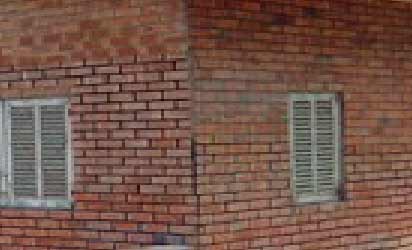
…Brick House
By Jude Njoku & Kingsley Adegboye
Successive Nigerian governments have paid lip-service to the need for alternative sources of building materials in view of the escalating cost of the conventional or imported ones.
In 1991 for instance, the Association of Housing Corporations of Nigeria AHCN, championed the use of locally sourced building materials when in collaboration with the Akwa-Ibom state government, it built an estate at Uyo with local materials. But that initiative was not followed up.
Similarly, efforts by the Nigerian Building and Roads Research Institute NBRRI to popularise the use of local alternatives to the conventional building materials have met a brick wall, apparently because of our penchant to regard anything locally made as inferior.
But with the high cost of land, funds, materials and labour almost making affordable housing a mirage, the need to resort to homegrown building materials has again taken the front burner. One of the materials that readily comes to mind is burnt bricks which experts posit, could be cost effective especially in building houses for the lower income and vulnerable groups.
Making a case for alternative sources of building materials, the President of Real Estate Developers Association of Nigeria, REDAN, Mr Olabode Afolayan, said his company built and sold two-bedroom standard houses at N2 million a unit using the hydraform technology which is similar to bricks.

...Brick House
The estate, according to the REDAN boss, comprises 200 units of two-bedroom Standard houses, 200 units of two-bedroom Super while the rest are three-bedroom bungalows. But the two-bedroom Standard houses were sold for N2 million per unit.
Although the hydraform technology is South-African, Afolayan said it uses 7,5 percent cement content, no plastering, no painting, no mortar. “With it, we have been able to reduce the cost of construction by about 40 percent,” he said.
“In look, it is similar to our own mud or brick but not in process. The brick has to be burnt while the hydraform is hydraulic system, compression,” he said.
But an Architect, Mr. BonsObiadi gave an insight on why most architects who are the building materials specifiers, find it difficult to recommend bricks to their clients. He stated that although red bricks are fine in outlook, their main problem is with the artisans or bricklayers who claim it is stressful to lay bricks and the fact that they do not have exact standards of workmanship.
According to him, you need to find the right kind of bricklayers because most masons do not know how to lay bricklayers can lay bricks.
Obiadi who noted that mud or brick was used in the past before civilization changed it to sandcrete blocks, said: “It is generally believed that bricks are difficult to lay, maintain and takes longer time to build. Building with sandcrete blocks, it is cheaper both in terms of material and labour. Truly speaking, I don’t like bricks because when water leaks through bricks, they get whitish and look ugly. Blocks don’t behave that way”.
Continuing, he said: “Yes bricks look good and beautiful at first but fall apart after a while due to our poor labour skills and use of weak material like bonding cement mortar. Efforts to popularize the use of bricks failed because the manufacturers did not market the products well and did not spend money training workers for their products. However, more or less, our attitude to bricks has a lot to do with their deficiencies”.
Despite Obiadi’s views, it is believed that the ideal building material should come from the environment and replaced after use. Such materials, according to experts, require little or no processing and all the energy inputs would be directly, or indirectly, from the sun. The ideal material should also be very affordable.
Mud bricks are made by mixing earth with water, placing the mixture into moulds and drying the bricks in the open air. Straw or other fibres that are strong in tension are often added to the bricks to help reduce cracking.
According to them, the most effective use of mud bricks in building healthy and environmentally responsible housing, comes from understanding their merits and accepting their limitations. Although the use of earth construction is well established in energy efficient housing and is one of the oldest known building materials, much about its properties and potentials still remain undeveloped and poorly researched. However, with thick enough walls, mud brick can create load bearing structures to several floors high.
The appearance of mud bricks reflects the material they are made from. They are thus earthy, with colour determined by colour of clays and sands in the mix.
Advantages
•Cost is greatly reduced because you do not need plastering or painting
•Raw materials are readily available
•They are a beauty to behold
•With thick enough walls, they can be used to do several floors
Drawbacks
•Dearth of competent bricklayers
•Bricks are difficult to lay, maintain and takes longer time to build
•Largely undeveloped and manufacturers are not doing enough to popularise its use or train the artisans to handle them
•Could become ugly when the building starts aging
Disclaimer
Comments expressed here do not reflect the opinions of Vanguard newspapers or any employee thereof.