
…satellite
By Prof. Dike N. Kalu
They assist humans to make predictions of disaster such as dangerous storms, flooding and tsunamis so that corrective measures can be taken before they occur. Satellites have unlimited capacity to view the entire globe and take pictures of any nook and cranny of the earth.
So satellites can give you information on the earth’s resources, environmental issues such as landslides, mudslides, gullies, oil pollution, or just the topography of the land, and they can even give you a good idea of population densities by determining the fraction of a region that is inhabited.
Satellites are also used for educational purposes and for continuing the study of the universe. Scientific satellites such as the Hubble telescope carry out scientific missions. Satellites have become indispensable for military purposes and are used for intelligence gathering and reconnaissance.
Although their military role is understandably guarded in secrecy, it does not seem to be waning but, luckily, as you have seen, it is no longer the only use of satellites.
In short, the functions of satellites are only limited by the degree of sophistication of one’s imagination. I think it is easy to see why the president and the interested public are excited about the successful launching of a Nigerian satellite. I will however emphasize that since no one satellite can accomplish all the different functions of satellites, a satellite is usually built with a special function in mind, making it a very expensive venture.
One of the lessons to learn from this discussion on satellites, which is really a recent technology, is that a technological advancement is not necessarily an end but rather can become a tool for addressing old or new problems.
For instance, because of the perceived usefulness of the then nascent telephone in the fifties, advanced nations agonized about how telephone signals could be relayed cross the Atlantic Ocean as it was near impossible to lay cables or string overhead wires across the vast ocean to carry telephone signals as is usual for conventional telephones across land masses.

...satellite
But after the Russians launched the first artificial satellite into orbit around the earth in 1957, industrialized nations applied the new technological development to address their age-old problem of transatlantic telephone communication.
So the successful launch of the Russian Sputnik encouraged the Americans to experiment on routing telephone signals first to an orbiting satellite which then relayed the signal back to the earth to telephone masts across the Atlantic Ocean. By 1960, the American telephone giant, AT&T had applied to the US government for permission to launch the first experimental communications satellite. This is a good example of the use of new technology to solve an old problem; this is a staple in science.
Another example of the use of new technology to solve old problems is the development of navigation satellites. Industrialized nations had for a long time struggled with the fact that the navigation of ships was compounded by the fact that there was no easy way to determine the exact position of vessels that were in the ocean out of sight of land.
However it occurred to John Hopkins University scientists monitoring the Russian Sputnik that satellites could be used to decipher the position of a vehicle anywhere at any time. Their calculations and work in this area led to the development of a technology that is now used to locate exactly where ships are at sea or the ocean.
Now there are about 26 satellites in orbit dedicated to this effort, and it’s this navigation technology that led to the development of global positioning system (GPS) which is now installed in every late model car in industrialized nations. GPS utilizes satellites to assist you to drive to any location known or unknown simply by plugging in your address and that of your destination in a device.
Unfortunately, satellites are very expensive. The cost varies depending on the size, the materials used to build it, its payload or what it’s carrying and the job it is supposed to accomplish. However, no matter the type, satellites cost hundreds of millions of dollars to design, construct, launch and monitor and maintain after they are launched. Commercial satellites are even more expensive and their cost can run into billions of dollars.
Student #4: From what you’ve said it sounds like every country will profit from the use of satellites; but at the same time it seems that not every country can afford them because of their great expense. My question is, is it possible for a country that cannot afford to build and launch its own satellite to get the information it requires simply by using other peoples’ satellite for a fee?
Professor: That’s a good question and one that many people struggle with. One journalist expressed essentially the same sentiment a little differently. He noted that many developing countries are building similar expensive environmental satellites that have the capability of taking pictures of any part of the earth.
He wondered if it was prudent for countries that appear to have more urgent problems like feeding their people to engage in building expensive satellites. According to him, the problem becomes even more worrisome when one considers that free satellite data are available from the United States and Europe.
Before going further with the journalist’s dilemma, let me first disabuse you of the notion of free data. If something is absolutely free, you should examine the circumstances very carefully to see if it is really free and if it really meets your needs.
Secondly, you should consider the fact that the cost of the free satellite data may be so exorbitant that building your own satellite may turn out in the long run to be cheaper especially when you consider that the source of the apparently free data could be withdrawn at a moment’s notice.
However, if you focus only on just the cost you’ll miss the point because developing countries will then always remain consumers waiting for the innovations of others. Developing countries, by having their own satellites, will be putting themselves in a position where they could one day become the experts in addressing problems that are peculiar to their region through the use of satellite technology.
Finally it has been suggested that developing countries may be trying to build their own satellites in order to help promote their national self confidence and to develop their countries’ space scientists and engineers and thereby generate indigenous role models for their children.
Student #5: I noticed that the Nigerian satellites were actually built in Britain and launched in Russia. Can these satellites really be characterized as the product of indigenous effort by our scientists and engineers?
Professor: In answer to your question, you might like to know that it’s not unusual to have an advanced country make and launch the satellites of other countries especially those of developing countries in the beginning of their space adventure. I hope you will agree that it is not necessary to expect developing countries to go through the trial and error that advanced nations had to go through to develop satellites.
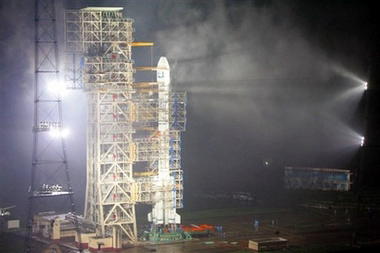
Yes, the Nigeria’s spacecrafts were built in Britain and launched into orbit from a launch pad in Yansy, Russia. The lamentation by some that Nigeria’s satellite efforts were therefore foreign based is misplaced because this is actually how it should be at this stage of our development.
In fact, the launching of the earth’s numerous satellites is by only 10 countries. On the day that Nigeria’s satellites were launched, Russia also lunched satellites for six other countries.
However, every country should consider several issues before embarking on building and launching satellites. One of these issues is of course cost. We already saw that a satellite program is very expensive and could cost millions of dollars if everything went well.
The price tag could run into billions if something went wrong like damage to the vessel, the payload does not function properly or something goes wrong with the launching.
The case becomes more complicated if the developing country is one in which the rulers seem to be more interested in their personal welfare than in the welfare of the nation and do not apply public money for what it is designated for.
All along, we’ve been buying the products of technology: electricity, cars, trains, airplanes, medical technology, communication technology, and now space technology. Initially it’s okay to buy technology if you can afford to do so. But you must also position yourself to be a producer of technology. That’s why we must invest in our schools and in today’s children.
It is not enough for your engineers to learn and be able to operate other people’s technology. Anyone can do that. What is more important is to have an environment where your people can make original contributions to the pool of world science and technology. Industrialized nations know and practice this all the time.
For instance, the launching of the Sputnik in orbit in 1957 motivated progressive governments to promote science in all their schools. In the US, science home-work increased in schools and children’s interest in science was promoted and encouraged because industrialized nations could see the potentials inherent in putting a satellite in orbit. Some countries even recruited engineers from other countries to teach them how to make better engines for space travel and, at the appropriate time, they sent them back home. Self reliance was seen as a must.
Not too long ago, the computer was born. American legislators quickly realized its potential and so their government mandated the electrical wiring of all elementary schools so that computers could become accessible to everyone starting from school children.
They did not let computers become a status symbol. Rather they realized that it is in the long term interest of their nation that everyone is computer literate and can be a participant in the technological advances taking place in the world stage. Those who are privileged to make this possible in Nigeria have a moral obligation to do so.
I am not implying that developing countries should compete with the industrialized world in the development of technology; far from it. What I am suggesting is that we position ourselves in a state to be able to utilize and apply advances in technology. If you are not scientifically equipped, you cannot fully appreciate technology which is the outcome of science just as the latter is the seed-corn of technology. No country can fully appreciate technology without encouraging science.
So, a fundamental question a technological advocate should ask is, How is science in your elementary schools, high schools, and universities? If the answer is “not good”, you are obligated to do all you can to reverse that answer because we are now in a technological world.
You, as the leaders of tomorrow, should be always aware that a solid foundation in science should begin in elementary and high schools if we are to become intelligent consumers of and the desired contributors to world technology.
The sorry state of science in our schools today should be viewed as a national disgrace and an emergency. Go tell that to your legislators.
Disclaimer
Comments expressed here do not reflect the opinions of Vanguard newspapers or any employee thereof.