
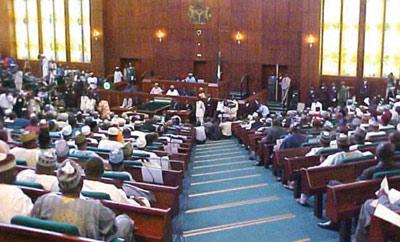
*House of Representatives members in session
By Les Leba
In mid February, President Jonathan requested National Assembly approval for a loan of $7.9bn from motley of International Development Banks. The funds, according to Mr. President, would be dedicated to the completion of various pipeline projects.
The consensus of public reaction is that Nigeria should not accept this loan; the reason for such caution is not farfetched, as the agony/relief of the heavy penalty of almost $18bn to exit our extant external debt of about $35bn in 2006 is still palpable. Worse still is the fact that promises that savings from the debt exit would be used for social and fiscal enhancement have remained unfulfilled.

*House of Representatives members in session
Meanwhile,the components of Nigeria’s debt profile has rapidly exploded from less than N1trn to N5.62trn for domestic debts, and $2.9 to $3.96bn for external debt since 2006. In spite of the sharp rise, no one can confidently identify those projects, which accounted for the bloated debt burden.
By December 2011, the N5.62trn domestic debt, consisted of N353.73bn treasury bonds, while treasury bills accounted for N1.73trn and federal government bonds make up N3.45trn. The external debt burden, on the other hand, currently hovers around $3.5bn, of which, concessionary multilateral loans add up to $2.9bn and commercial loans account for $597.65m.
Concessionary multilateral loans attract 2 – 3% interest, while commercial loans such as the $500m Eurobonds would attract up to 7% and above.
Thus, the fresh loan request of $7.9bn will bring total foreign debt to $11.5bn. However, in view of the recognized abysmal failures of government interventions in business, critics have insisted that even if the concessionary rate makes the offer of $7.9bn attractive, the destined application of the loan is inappropriate, as it is not in consonance with government’s transformation agenda of leaving business in the hands of the private sector.
In other words, the $7.9bn loan could be better applied to critical deprivations in areas such as education, health, environment and mass transportation; i.e. those areas with long gestations, and where private investment is usually less forthcoming.
Nigerians also find it inexplicable that the same pointsperson in the advocacy for the controversial debt relief six years ago, is now the main advocate for a new debt burden! However, Dr. Okonjo-Iweala’s disposition may be best explained by presumably the very low cost of such loan, when compared to the interest rate of 15% and above that much of government’s domestic borrowings now attract.
The sum of .54trn for federal government bonds is the biggest component in the domestic debt profile, which ballooned from almost less than N1trn (about $10bn) in 2004 – 5 to over $35bn today.
The Debt Management Office in its various prospectus have never indicated any specific project related to these debts, but have always maintained that the loans are designed to develop the domestic bond market and/or set a benchmark for long time borrowings and the financing of budget deficits.
Well, it is difficult to understand why anyone would want to pay over 10% for money it does not require in order to establish a standard cost for market long-term funds.
It is also inexplicable that in spite of a host of fiscal reforms and privitisation of erstwhile drain pipe public enterprises and the simultaneous draw down of over $20bn from the ‘illegal’ excess crude account, average annual deficits of about N600bn were still incurred between 2006 – 2012!
In view of the high cost of funds, one cannot understand why the deficits were not covered from the excess crude account before sharing of any net balance!
In spite of claims that banks were too cash-strapped to lend to the real sector, it is inconsequential that government was paying double digit interest rates for borrowing trillions of naira that would ultimately be kept idle and out of circulation in the guise of mopping up excess liquidity (cash)!
Indeed, in May 2008, this column alerted the National Assembly on the rapidly increasing debt burden on the economy, but our words of caution went totally unheeded, while debt service charge has risen to over N540bn in the 2012 budget.
The article “National Assembly Fiddles as Debt Burden Cripples” was first published in May 2008, and it may be necessary, once again, to sound another alarm on the inordinate growth and cost of our debt burden, and hope that this time around, the National Assembly and other well-meaning Nigerians will listen and arrest our further descent into a debt trap.
Nigerians welcomed the democratic dispensation, which was revived in 1999 after an extended retrogressive and oppressive military dictatorship. Our people had become disillusioned with the failed promises of coup plotters as they endured an unending sliding rape of their standard of living and a direct frontal attack on their dignity.
Most Nigerians timidly watched with mouths agape as erstwhile ordinary Nigerians in military gear and their cohorts and apologists quickly swelled the ranks of the noveau riche as the middle class and intelligentsia were gradually emasculated by the military’s obtuse policies which encouraged idleness and also depleted the purchasing power of the working class.
The majority of our citizens feared for their lives, and was too timid to question the irresponsible brigandage of which they were victims!
It has become sadly clear that our military dictatorships did not have a monopoly of shallow intellectual depth and self-interest in government! The expectation that the presence of freely elected National and State Legislative Assemblies would check the excesses and philandering of the Executive Arms of government has obviously been misplaced.
However, critics observe that the bulk of the emerging civil political class were bedmates and surrogates of the ‘outgoing’ self-serving military dictatorship. Indeed, some would say that the only positive contribution of the National Assembly to the growth and stability of our nation was the principled stand under the patriotic leadership of Ken Nnamani against tenor elongation by Obasanjo!
I do not recall any robust legislative debate at anytime on how our industries can be revived, or how the increasing level of unemployment can be halted or how inflation and rapidly rising food prices can be stemmed, or how indeed, the dwindling income values of workers can be reversed!
So long as Ministries and Parastals continue to pay billions of Naira to Legislators to carry out oversight functions, and so long as Legislators continue to collect unconstitutional kickbacks for constituency projects which are never implemented and so long as the Legislature budgets contain much extra fat for subsequent sharing and so long as no one will audit the income and expenditure patterns of the Federal and State Assembly Members, who cares what the Executive arms of government do with the rest of the money?
Indeed, so long as the legislature’s padded budgets are fully allocated and paid, the economy can continue to retrogress and our people can continue to wallow in poverty for all they care!
Yar’Adua’s 2008 federal budget is a case in point. Inspite of the fact that the budget was submitted to the National Assembly last year, wranglings between the Legislature and the Executive with regard to bloated and unsubstantiated allocations endured until the end of March, thereby violating the spirit of a 12 month budget and incurring the potential collateral damage of non-implementation, unspent budgets and corrupt embezzlement of state funds in December 2008!
In an article in this column (see “2008 Budget, More Questions than Answers” 21/04/2008), I sighted notable flaws in the proposed budget, and why the budget will lead to unmitigated failure by year end. I noted that: “is not the quantum of allocation that is the issue, but the manner in which the money is spent and the framework within which the money is spent.
A budget which is operated within a defective monetary and economic blueprint will achieve the wrong results. have a faulty monetary framework.
The National Assembly is totally oblivious of the disastrous impact of monthly sharing of substituted naira for our distributable export dollar revenue; commercial lending rates hovering around the industrially unfriendly rates of around 20%, our ever increasing domestic pump price of fuel in the face of vastly improved and still rising external dollar reserves are all the results of naira substitution for our dollar earnings.
This same framework ensures that we made interest payments of over N372bn to mainly
the banks in return for money that CBN had earlier placed in their care in 2007; even though the money so borrowed by CBN and the Debt Management Office (DMO) are simply sterilized or stored in vaults to accumulate dust rather than for infrastructural development!”
But we all know that a fool and his money are soon parted; so, it is for a nation state which continues to accumulate useless and unnecessary debt burdens while paying astronomical rates of interest for monies borrowed and then kept idle in vaults!
Indeed, such domestic debts have more than doubled to N2200bn in the last four years and yet no one can point a finger at any project or benefit conferred by such high borrowings on the Nigerian people; but the banks and other speculative investors both foreign and local go home smiling for having a fool as a trading partner.
Of course, only a fool will borrow his own money back from a bank at a cost higher than what the bank is paying him for keeping the same funds. There is no sectoral allocation (including votes for vital infrastructural development) in Yar’Adua’s 2008 budget that is higher than the estimated N500-600bn we will pay as interest charges for such useless loans in 2008!
Only a fool will also discountenance and endorse a 20% interest payment on otherwise acclaimed soft loans. In the Guardian edition of 22/5/05, pg 112, the Director General of the D.M.O., one Abraham Nwankwo indicated that “…84% of the Nation’s $3.7billion external debt is accounted for by loans from concessionary sources like the World Bank, African Development Bank and IFAD.
These are loans obtained at very low charges and concomitant charges of 0.5%. These loans are used for poverty alleviation programs in education, health and agricultural sectors”.
Nothing wrong with this on the surface, but surprisingly, the 2008 budget has earmarked interest provision of about $600m (i.e. about 20% of principal) for this loan of $3.7bn! This is outrageous and out of sync with the traditional low cost for such loans, it is also inexplicable that CBN would borrow at such high rates from the same 14 banks in which it has recently placed $14bn of Nigeria’s reserves.
Nonetheless, the National Assembly in its self-serving wisdom has ignored this faux pas as they grumble and rumble over the disbursement of the bloated budget already assented to by Yar’Adua on threat of impeachment.
Save the Naira, Save Nigeria!!
Disclaimer
Comments expressed here do not reflect the opinions of Vanguard newspapers or any employee thereof.