
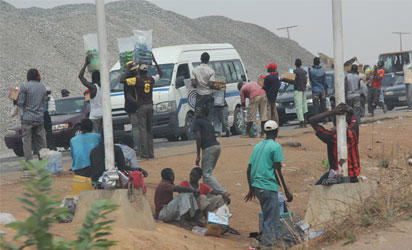
Street traders on the Expressway in Abuja
By Rotimi Ajayi, Favour Nnabugwu, Chris Ochai & Laide Akinboade
ABUJA, the Federal Capital Territory has certainly come of age. Established on February 3, 1976, the Territory serves as reachable centre from all parts of Nigeria.
The founding fathers conceived it as part of the efforts at making Nigeria a truly united nation. Following its creation by the Murtala Muhammed Administration, the succeeding government of Olusegun Obasanjo put together the master-plan and commencement of physical infrastructure started in 1980 under the administration of former President Shehu Aliyu Shagari.
The pace of development was, however, very slow and insignificant until 1991 when abruptly, General Babangida announced the relocation of the seat of Federal Government to Abuja. This relocation revved up the speed as all Federal Government Ministries, Departments and Agencies were mandated to relocate within certain time limit.

Street traders on the Expressway in Abuja
With the acceleration of movement came increasing population and major social problems. Since Abuja became a reality, influential Nigerians began to see it as new place of abode and this resulted in aggressive acquisition of land within the territory. Many influential Nigerians with means used their positions to acquire plots of lands and by 2003, the process of land acquistion had been bastardized and heavily tainted with corruption. The result was gross distortion of every aspect of the Master-plan as drawn by former Obasanjo Administration.
Fatefully, by 2003, the same Olusegun Obasanjo had the responsibility of reviewing the Master-plan with a view to seeing how much of it could be redeemed. To do this, he immediately appointed Mallam Nasir el-Rufai, as Minister of the Federal Capital Territory.
El Rufai, within months of his assuming office did not let anyone in doubt about his zeal and determination to put things right. He set at it by re-organizing the administrative machinery of the Territory giving it a global standard. This reorganization led to many of the FCT government activities being computerised. He also put sanity into acquisition of lands and development of Houses in the FCT.
Another major achievement of the el-Rufai administration was in social development. He meticulously pursued the management of Abuja roads, markets and streets in such a way as to enable easy movement of traffic, decent and easy access to goods and services as well as adding aesthetics to the streets.
Beggars, poor people with disabilities who had thronged the roads in Abuja to solicit for alms were relocated to places where government catered for them and placed in skill acquisition. Similarly, street traders were banned from Abuja streets with some of them relocated to a central place of operations.
The evacuation included newspaper vendors and telephone card vendors. This particular project was to make Abuja streets befitting of a capital but alas, the project died with the exit of el-Rufai.
Today, the situation has turned 360 degrees. Abuja has so degenerated that residents of the FCT long with nostalgia for a return of those good old days of Nasir el-Rufai. It is now a common sight on every Abuja road including the major roads of Nnamidi Azikiwe International Airport, Kubwa-Kaduna Express Way, the Three Arms zone, and virtually all roads in all the Districts to behold road traders, vendors, alms solicitors (beggars) and magic peddlers. These people constantly harass motorists and sometimes do it in very aggressive manner. Phone and bag snatching in moving vehicles are becoming daily stories in Abuja.
Just as the hawkers and vendors cause traffic headache on the roads during the day, traders virtually make driving impossible on some major roads at night. The notorious points are the Berger Yard at Lugbe Airport road, Karu under-bridge, and Area one roundabout. All these places are almost impassable points at night due to activities of road traders.
But what is the opinion of those engaged in this trading activities? Joshua Ekene, phone accessories hawker, said: “I have been doing this business for over three years now. And to be fair, it has not been easy at all. Under rain or sun, one is compelled to be moving around the major streets, roads as well as some corners just to make a living.
Our major problem is the frequent harassment by officials of the Abuja Environmental Protection Board, AEPB. Let me tell you that those of us you see trading along the roads are not happy doing the business that way, but we cannot help the situation.
“This town (Abuja) is not conducive for poor people like us who do not have any body to help us. Most of us cannot afford to rent shops. It is my wish to rent a shop and equip it with goods but unfortunately, I cant afford to pay N1 million or N2 million just to rent a shop. Please tell the government that we are suffering. This is our country and we should not be made to suffer this much.
Many of my friends have suffered loss as the result of activities of the AEPB who often times swoop on them and cart away their market (goods) without returning them. My advice is that if the government does not want to see us here, they should try to make things easier for us by building cheap and affordable shops for us. The type we can afford to pay.
No one wants to be suffering under the sun. So tell the government to do something for us because we too want to enjoy our lives.”
But to Chinedu Anayo, wrist watches and second hand phone handset seller, it is boast all the way. He said: “Nobody can push me into hunger. You know hunger can kill someone and I won’t allow myself to be killed by hunger. I have come to Abuja to live and no amount of threat of arrest by officials of Abuja Environmental Protection Board can alter my resolve to be doing this business for now, since I don’t have that kind of huge amount of money to rent a shop. Yes, there are risks associated with selling along the roads, especially, because a vehicle can knock you down or kill you, but that is not my portion in Jesus name.”
Mallam Bako Idris, a hawker said: “This is what I am doing for now and anybody who wants to get me out of this place should provide another work for me. I don’t care whether there is Environmental or not because they are not the ones feeding me. I came to Abuja to struggle for living and God has been faithful to me.”
His colleague, Kabiru Danladi, a hawker added: “I like what I am doing. Selling something on the road is better than indulging in criminal activities. I am not doing something unusual.
The Abuja Environmental and their policemen should concentrate more on fighting criminals instead of innocent people like us. They should leave us alone. There is risk in every business and if in the course of this work, a vehicle knocks me down and I die, so be it.”
Speaking on the sprawling street hawking and night trading on Abuja roads, head of Corporate Affairs of Abuja Markets Management Limited, Mr Innocent Amaechina told Vanguard that the body had spaces for all categories of traders ranging from huge capital to low capital traders but added that the agency had no mandate to monitor street traders or night markets.
Facilities management
He said: “Abuja Market Management Limited is a subsidiary of Abuja Investment Company Limited and we are mandated to provide facilities management services in market places within the cities. We manage and regulate those areas designated for trading. Every other activity outside the designated trading places is not within our mandate.
“We cannot go to the streets to chase hawkers. If you must know, most of the night marketers are handbag traders who take off at the mere sight of government agencies. It is the job of Abuja Environment Protection Board, AEPB and I know they are up to the task.”
The current Minister, Bala Mohammed, appears to be completely lost as to what to do to Abuja, the Federal Capital, since he assumed office. Apart from the initial spark of correcting the debilitating speed rumps put in place by his predecessor, Adamu Aliero, Bala Mohammed could be said to have gone completely into administrative slumber.
Sources within the office of the Minister lamented his penchant for not staying in the office to attend to urgent and needy matters. He is said to be almost always at the State House. The immediate implication is that files, which have direct bearing on urban and rural development, pile up in the ministry without being attended to.
Just as the Minister does not stay in office, his Directors and some of the Mandate Secretaries have taken cue from him and are rarely available at their desks. So who will redeem Abuja, the Federal Capital?
Disclaimer
Comments expressed here do not reflect the opinions of Vanguard newspapers or any employee thereof.