
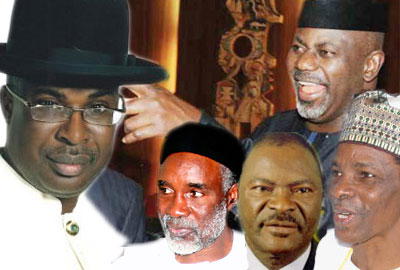
…the sacked governors
By Josef Omorotinmwan
WHEN Chief Olusegun Obasanjo says Nigeria is wobbling, he probably means that this is not the type of Nigeria he would have liked to bequeath to a godson.
But we saw some of these things coming. As far back as last May, this column had in an in-house trial titled “Towards Illegal Occupancy”, adjudged Governors Timipre Sylva of Bayelsa State, Murtala Nyako of Adamawa, Aliyu Magatakarda Wamakko of Sokoto, Ibrahim Idris of Kogi and Liyel Imoke of Cross River as illegal occupants of their respective Government Houses.
Evidently, some judges are either outright lazy or too mechanical in the area of interpretation – or something beyond comprehension. Such would accept words on their surface value without searching the books or reading the minds of the lawmakers. They maintain that the duty of the court is to interpret the law as it is and, accordingly, that which is not overtly expressed by the lawmakers should be excluded by the judiciary.
On the contrary, this column has maintained that, in practice, it is not unusual in constitutional interpretation, to introspect into what the framers of the Constitution had in mind at the time of inserting a particular clause into the Constitution.
Our point of departure with some judges has been on Section 180(2) of our 1999 Constitution, which provides for a four-year tenure for a Governor “from the date when he took the Oath of Allegiance and Oath of Office”.
We search in vain for where the framers of our Constitution demonstrated any preference for technicalities over man’s yearnings for substantial justice. At no time did they intend that the clause “from the date when he took the Oath of Allegiance and Oath of Office” should be used to smuggle tenure elongation into our system, contrary to the discordant voices from the Federal High Court and the Appeal Court.
Hon. Justice Adamu Bello of the Federal High Court asserted, “The legal implication is that the nullification of the 2007 election in these respective States equally means that the previous Oath of Office and Oath of Allegiance previously administered to them was also nullified.
From nothing, nothing comes and you cannot put something on nothing and expect it to stand; it will collapse.” The concurrence of the respected Justices of the Appeal Court was still more repugnant, “When a thing is void, it never existed, and in the same vein, if election is void ab initio and a fresh election conducted, it appears that the first election never happened before.”
This column maintained, “Even granting that the Hon. Justices are right, we have drawn sufficient attention to the accounting principle, which holds that for every debit, there must be a corresponding credit. True, the legal implications of an annulment have been properly enunciated. But where do such implications stop?
The Justices have succeeded in showing us just one side of the account. If we say that the entire period before the re-run has been nullified, that also presupposes that all the actions taken by the affected Governors before the re-run also stand nullified.
If the law now assumes that the Governors were legally not in office during the period, what of all the actions they took during the same period – the bills they signed into law, all the contracts they awarded, all the appointments they made, all the foreign travels, the goodwill they enjoyed and all the fine girls; as well as their stay in Government House without paying any rent…?”
In total agreement with our stand, the Supreme Court finally issued an eviction order on Friday, 27 January 2012. The sack of these Governors raises a number of fundamental questions: The Apex Court is such a dignified body that people are unable to breath down on it. That explains why all election cases should get to the Supreme Court, instead of governorship and legislative election cases terminating at the Appeal Court. We have seen some obvious cases of miscarriage of justice at the tribunals and appeal courts.
The case that finally evicted the Governors limped to the Supreme Court by sheer accident rather than by design. We are quickly reminded of the re-entry of Governor Chibuike Amaechi into the Rivers State Government House, courtesy of the Supreme Court. Just see the fine product that had been successfully “buried below six feet” by the PDP at the lower levels of the Judiciary!
Even as good as the Supreme Court decision is, it did not dig deep enough. No one should be seen to be benefiting from his iniquities. Having occupied Government House illegally for almost eight months, the Supreme Court should have added a line mandating the Governors to be surcharged for their drawings during the illegal occupation.
Again, why should it take the Supreme Court donkey years to unknot a simple constitutional interpretation? In such critical moment, in the US that we copy, that case would have been determined within 48 hours.
Bayelsa State provides an interesting case study. How will the President and his PDP be feeling now that the rejected stone has become the cornerstone at a time when they had squandered all their “badwill” on one of the aspirants and to their chagrin, Sylva now stands as the PDP candidate? The case of “Goodluck” Sylva has apparently been enhanced by the delay. Last April, young Timi Alaibe who was to be the Labour Party candidate was the one to beat. Alaibe has since moved back to PDP.
Jonathan and Sylva are dancing nude at the market square. We see Jonathan and the PDP pulling through with their bold face; but except Sylva capitulates, a reenactment of the Rivers (Omeha/Amaechi) situation is possible.
Kogi is better left alone for now. The situation there is so messy that time and space cannot accept an analysis here.
Disclaimer
Comments expressed here do not reflect the opinions of Vanguard newspapers or any employee thereof.