
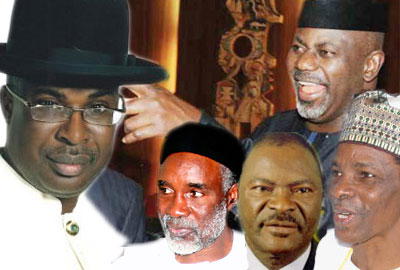
…the sacked governors
By Awa Kalu
The culture of losers filing petitions against the result of elections announced by different electoral bodies in Nigeria since Independence has taken very deep root and it is very doubtful whether there is anything in the offing that will negate this habit. I am not aware of any serious or concerted effort by political scientists or sociologists to study the cause or effect of election petitions.
But I am aware of the legal ‘niceties’ or nuances that accompany election petitions. In that connection, it is important to point out that quite a handful of discerning and critical observers have lamented the tendency of some clever election litigates to use judicial apparatus to upset the will of the electorate.
By virtue of legal and political theory, sovereignty belongs to the people. That sovereignty is exercised through the ballot box and thus, once the people have spoken through that sacred box, the verdict of the people, it is argued, ought to be respected. The inevitable question has always been, how do you know when the people have spoken appropriately or correctly?
The question has always loomed large because it that power has been acknowledged is a powerful elixir, a tonic, an aphrodisiac, an intoxicant, an unruly horse, etc., and it is generally accepted that power corrupts while absolute power corrupts absolutely. In that connection, our successive constitutions and the several Electoral Acts that have been in use over the years, have without exception, made provisions for the periodic conduct of elections.
Without exception, such Acts have also provided grounds, on which an election may be questioned and once an election is successfully questioned, consequences follow. We have not always been happy with the attendant consequences and that is the crux of the judgment delivered by the Supreme Court on Friday, 27th January, 2011 in respect of the consolidated appeals arising from the quest to determine the appropriate tenure of State Governors under the extent Constitution.

...the sacked governors
Put in context, virtually all Governorship elections end up at the appropriate Tribunal. In some cases, the Tribunal upholds the election and on appeal, the matter is determined one way or the other. A tale of five Governors is about a victory at the Court of Appeal that turned out to be a Pyrrhic one.
The Governors of Bayelsa, Kogi, Adamawa, Cross-River and Sokoto States won the gubernatorial elections conducted in their respective States in 2007. The usual petitions were filed by their opponents in their respective States and by coincidence, the Governors lost but when they were sent temporarily out of their cozy government houses, events proved that ‘there is no killing the beetle! The Governors each won the re-run election and were returned to office but on different dates.
When it was time for general elections in 2011, the Federal High Court sitting in Abuja, ruled that having been restored to office on a date different from 29th May, 2007, governorship elections were not due on any of the dates fixed for election in 2011. The Independent National Electoral Commission appealed to the Court of Appeal and lost in that the Court affirmed the judgment of the Federal High Court.
A twist of fate then occurred. Brigadier-General Buba Marwa, a gubernatorial candidate of the Congress for Progressive Change (CPC) in Adamawa State and his sponsoring political party applied to the Supreme Court praying for leave to appeal as a ‘party interested’ in the subject matter.
At the end of the day, the apex Court threw a bombshell which exploded the myth that the Court’s decision in Peter Obi v. INEC in which it was held that the tenure of a Governor is calculated from the date on which the Governor subscribes to the Oath of allegiance and swears the Oath of office.
In Peter Obi’s case, the facts indicate that Dr. Chris Ngige was declared the winner of the election held in 2003 in respect of the office of Governor in Anambra State. Mr. Peter Obi who contested the said election on the platform of the All Progressive Grand Alliance (APGA) was aggrieved by the declaration and challenged same at the Tribunal. The matter became protracted and by the time it was concluded at the Court of Appeal, Enugu, Dr. Ngige had served a substantial part of the tenure of four years allowed by the constitution.
Having been sworn-in after a long drawn legal battle, the Independent National Electoral Commission gave notice that it would conduct governorship elections in Anambra State in respect of the general elections in 2007. Mr. Obi took umbrage and approached the Federal High Court for declaratory and injunctive reliefs and in the end the Supreme Court held that Mr. Obi, in his own right, was entitled to spend four years sleeping with ease in Government House. He was not elected to complete a tenure which Dr. Ngige had begun.
The difficulty which the Supreme Court solved in the latest judgment on tenure is to change the point of view that the tenure of office of a Governor is not in all cases inextricably tied to the date on which the oath of office is sworn.
Accordingly, it may safely be said that when the election of a serving Governor is annulled and a re-run is ordered, the tenure of that Governor, if he wins the re-run, is reckoned from the date on which he was first sworn-in. In the case of the five Governors, having been sworn in on the 29th May, 2007, their tenure was deemed to have lapsed by effluxion of time by virtue of constitutional provisions in the month of May, 2011.
In rationalizing this conclusion, it would be best to borrow the reasoning of His Lordship, Hon. Justice Walter Onnoghen, J.S.C., who wrote the lead judgment. He said: “The fact that there was an election in 2007 as a result of which the 1st Respondents (Governors) took their Oaths of Allegiance and of Office are facts which cannot be wished away, just as the acts they performed while occupying the seat.
The said governors may not have been de jure governors following the nullification of their elections, which is not supported by the acceptance of their acts in that office as legal and binding on all and sundry, they were certainly governors de facto during the period they operated ostensibly in accordance with the provisions of the constitution and Electoral Act and as such the period they so operated has to be taken into consideration in determining the terminal date of their tenure following, what I may call, their second missionary journey vide a re-run election particularly as the constitution unequivocally grants a tenure of four years to a person elected governor of a state calculated from the date he took the Oaths of Allegiance and of Office which was the 29th day of May, 2007.
It is settled law that the time fixed by the constitution for the doing of anything cannot be extended. It is immutable, fixed like the rock of Gibraltar. It cannot be extended, elongated, expanded, or stretched beyond what it states. To calculate the tenure of office of the governors from the date of their second Oaths of Allegiance and of Office while ignoring the period from 29th May, 2007 when they took the first oaths is to extend the four years tenure
constitutionally granted the governors to occupy and act in that office which would be unconstitutional. It is therefore clear and I hereby hold that the second Oaths of Allegiance and of Office taken in 2008, though necessary to enable them continue to function in that office, were clearly superfluous in the determination of the four years tenure under Section 180(2) of the 1999 Constitution”
The judgment, as would be expected, has elicited comments and a fair dose of criticism and inevitably, has thrown up a few constitutional questions. These will be examined anon.
Disclaimer
Comments expressed here do not reflect the opinions of Vanguard newspapers or any employee thereof.