
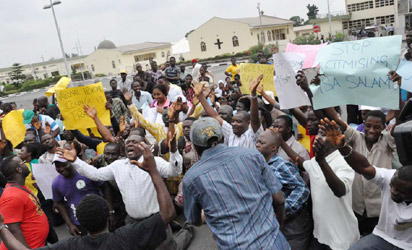
Protesters
By Helen Ovbiagele
One has seen, over the years, many unpopular government decisions/their fall-outs in this country, but the recent fuel subsidy removal, effective on the first day of the new year, takes the biscuit for being the most baffling, insensitive and reckless, so far.
When on January 2nd I saw fuel priced 139 naira per litre at an NNPC filling station, I thought it was for diesel, and I was rejoicing that the price has come down from the 145-150 naira that it had climbed to in recent months.
“Ma, that’s the new price per litre for fuel, not diesel,” the driver told me.
I didn’t believe him, so, we stopped and asked an attendant there. “Did you people make a mistake on your board? That 139 naira per litre is for diesel, isn’t it?”
“Madam, that’s the new price for petrol here, but it’s more at other filling stations.”
I bought what I could and staggered home in disbelief. Who would be uncaring enough for human welfare and well-being to hike petrol price more than 200%, without adequate warning, and at a time when many families are recovering from Christmas expenses, have rent to pay, have bills for school fees, uniform, books, etc to settle? Not to mention feeding. It has always been a standing joke in the country that January is the longest month of the year.
This is because, after the heavy expenses during Christmas celebrations, the pocket is empty and it would appear as the month drags on, that pay day would never come! When you slam an outrageous increase on us like that, how is the common man expected to survive? As it turned out, many people who went to their hometowns to celebrate Christmas became stranded there because, as soon as the fuel price increase became effective, transport fares soared.
We heard that people had to resort to desperate moves in order to get money for their return to their base. Some sent SOS to friends and relatives to send them recharge cards so they could sell them for their fares. A few sold their blackberry mobile phones at giveaway prices. One of them said he just had to get back to his job in Abuja immediately, or get the sack.

Protesters
“Blackberry phone will come again when there’s money. Meanwhile I have to ensure the safety of my job by returning to my post on the appointed day. There are no ready jobs around,” the man was reported as saying.
I’m sure some other people must have done some drastic things to get money. Perhaps things they may live to regret sooner or later. God forbid!
So, how did we get to the mess which made the NLC/TUC to call a nationwide strike, and which unfortunately, led to some losses of lives and property? Did our government really believe that people would swallow the increase just like that and meekly get on with their every day living? Of course not! If the Trade Unions had not called a strike, I’m sure the masses would have taken the law into their hands and things would have really got out of hand. Desperate situations can lead to desperate actions.
Many young people are restive at any given time, primarily due to the frustration of prolonged unemployment. Those who were lucky to get a university education have no jobs after the youth service. Many are secondary school dropouts due to lack of funds. There is no safety net from the government to catch these ones, by giving them vocational training with which to earn an honest livelihood, and make them responsible citizens.
When at a time I wrote a piece saying that it was better to do away with the national youth service, rather than allow our young people who are posted to the northern parts of the country to get slaughtered for being southerners and Christians, I got many text messages from young people themselves, asking that the service should not be stopped, stressing that it’s the only sure job that many of them have at the end of their university education for a while, as there are no ready jobs for the majority of them. That was very touching. Any unreasonable fuel increase means that some of them from desperately poor background may no longer be able to afford the transport fares with which to go in search of jobs.
Yes, for many months now, the government had been telling us that fuel subsidy would be removed, and the money used for much needed development. We were not told in plain language, what would be developped, where, when and at what cost. To compound the issue, some Nigerians who had been in government in the past, tell us that there’s no fuel subsidy of any sort and there had never been!
This is very confusing for us the masses, as some of us don’t know who and what to believe. Across the world, citizens are called upon sometimes to make sacrifices through the austerity measures taken by government so that the nation can move forward. It’s happening in some eurozone countries (e.g. Greece, Italy) as their economies and their euro crash, and the economically stronger countries in the EU are called upon to bail them out.
Any decision that brings human suffering is never welcomed by human beings, so, citizens in these countries are protesting strongly about being asked to tighten their belts so that their governments do not continue spending more than it earns, and plunge their nations further into debts.. Fair enough! But in our own case, hardships brought on us through governance are hard to understand and accommodate.
It has been asked a trillion times by people, why an oil producing country like Nigeria, (5th in the world in the Bonny Light category, we’re told) should import finished petroleum products from abroad under any guise. We have four refineries in the country, which, if they work at full capacity round the year, would make us self-sufficient in fuel demands, and also enable us to export to neighbouring countries.
As far as I can remember, there’s been no time that any refinery here works at full capacity, let alone expect all of them to produce at all times. Why is this? Is there a jinx on our refineries or what? No government yet has been able to make all of them work at any given time. We often hear of TAM (Turn Around Maintenance) at the refineries, but no-one can confirm whether it does take place and what relief it has brought to fuel supply.
It’s the half-truths at best, and being left in the dark most of the time that infuriate those citizens who have Nigeria’s best interests at heart. If the economy is in trouble, tell us the truth and support the claims with credible documents and evidence that we can understand and accept. Honesty is always the best policy.
If the government felt that it has no other way to cut down on spending than the removal of fuel subsidy, it should have engaged the Labour unions in meaningful talks for at least three months, and both parties could then have arrived at a new pump price, without the need to call for a nationwide strike.
It has been a hard time for all of us, and the losses have been huge, most especially the loss of human lives. On the roadside last weekend, fuel was sold for 250 naira per litre on the black market!
We’re relieved that the strike has been suspended and the pump price brought down 97 naira per litre. If this is now the new price, I hope the unions will negotiate that there would be no fuel increase for at least fifteen years, and when our refineries are able to meet local demands, the price would be brought down yet again.
Disclaimer
Comments expressed here do not reflect the opinions of Vanguard newspapers or any employee thereof.