
By Les Leba
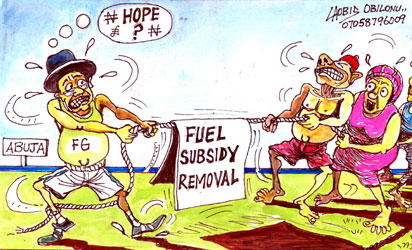
I am amazed and saddened by the theatrics of the government team as they push for adoption of subsidy removal by Nigerians. The tragic cast could be contenders for Nollywood Oscar Awards for superb acting skills.
Indeed, they, like professional mourners, have wept louder than the bereaved! The eminent trio of Okonjo Iweala as Finance Minister and defacto Prime Minister, Lamido Sanusi as Central Bank Governor, and Diezani Madueke as Minister of petroleum together constitute President Goodluck Jonathan’s engine room.
The question, however, is, can we believe these disciples of President Jonathan? Let’s first examine the impact of fuel subsidy removal on our economy and incomes, and thereafter, discuss an alternative economic model that will abolish subsidy painlessly and indirectly put increasing purchasing power in the hands of the common man, with industrial growth, lower single digit inflation and interest rates and increasing level of employment as genuine collaterals.
Nigerians have become suspicious of government promises over the years; for instance, we recall the same promises that billions of dollars saved from erstwhile interest payments on debts owed the Paris/London Clubs would be applied for the same purposes of growth and development currently canvassed in support of fuel subsidy!
We were assured that budget deficits would reduce as increasing revenue accrue to the federal treasury after privatization of several inefficiently run and struggling government enterprises. Regrettably, in spite of the sale of these enterprises at give-away prices, infrastructure and welfare enhancement have not improved meaningfully, and national debt has reached an all time high of over N5tn.
Worse still, assets of privatized companies have been commercially cannibalized with huge job losses to the economy. Nigerians also recall that Banking Consolidation was promoted as the correct road to jumpstarting the economy and providing small and medium enterprises with needed capital for development.
Inexplicably, Nigerians were alarmed to find that government became the major customer of the banks after consolidation, and cost of funds has never fallen to single digit, the benign level required for the real sector to grow and stimulate increasing employment.
Furthermore, over $12bn may have been spent by government in the power sector in the last decade, and government has only succeeded in barely sustaining an additional 1000MW to our power generating capacity!
Government also only succeeded in promoting such image of distrust by the insincere and insensitive manner fuel prices were raised from N65/litre to N140/litre as from January 1, 2012!
The inordinate burden of more than double transport fares for those Nigerians who had travelled to their villages for the end of year holidays instigated much anger and frustration that became fuelled by the perception of government’s insincerity in bringing forward subsidy removal to 1st of January rather than April, as earlier suggested by Dr. Iweala at a nationally broadcast interview. The fact that Dr. Iweala has since refuted making such a comment in spite of indelible evidence has not also added to the credibility rating of members of Jonathan’s inner cabinet.
In spite of above culture of distrust, is there any real hope that removal of fuel subsidy will lead to economic growth and increasing employment? To answer this question, let us quickly look at those indices, which are universally recognized for promoting economic growth and development.
Simply stated, no country can sustain double-digit growth rates when inflation rate remains stuck at over 10% with food inflation at over 15%, or where interest rates constantly exceed 20%, in a market where the real sector is largely crowded out of credit by government. No country can also grow with an exchange rate mechanism that instigates depreciation of its national currency wherever export dollar revenue fortuitously increases!!
The above requirements are without prejudice, of course, to availability of regular and adequate power supply in a reasonable ambience of security.
Fuel price is without doubt, a factor of exchange rate, and increasing competitive activities of importers will have only minimal impact. The government team knows this, but they dare not dwell on it, or even publicly recognize the relationship between fuel price and naira exchange rate, as this could upset their well-laid applecart and expose the horrid ugliness of their rumps!!
There is no way that this increase in fuel prices could lead to positive and sustained economic growth and development, as high interest rates and a weakening naira would fuel inflation rate that would eat up a significant portion of all incomes, while those Nigerians who earn less than N350/day, now pay over N200 (i.e. over 50% of their daily income) for the shortest journey to and from work.
Thus, Sanusi’s public declaration at the NPAN-organised Town Hall Meeting that the inflationary impact of subsidy removal would not exceed 2% on the current rate of ‘just over 10%’ should be taken with a pinch of salt!
Fuel price increases would most certainly make most Nigerians poorer by reducing their purchasing power and reducing level of demand, which would in turn result in reducing industrial capacity utilization and may ultimately lead to factory closures and increasing level of unemployment!!
Furthermore, rising inflation caused by fuel subsidy removal would ultimately also lead to a weaker naira, which would further compound production cost for all industrialists for both local and imported raw materials; high material costs, cost of funds at 20%+, inflation at over 10% are factors, which would make made-in-Nigeria products uncompetitive, price wise while proposed 100% increase in import duty of rice and wheat in 2012 will send many Nigerians to early graves!!
So, if it is patently clear that fuel subsidy removal would jeopardize CBN prime mandate of price stability; why then should any well-meaning Nigerian such as the eminent members of government’s economic team subscribe to its adoption? It does not require knowledge of rocket science to appreciate that unbridled inflation will engender adverse impact on growth and social welfare!
Additionally, government’s team must recognize that the origin of fuel subsidy is closely tied to naira depreciation; Nigeria began accommodating subsidy in fuel pricing, when government recklessly devalued the naira in mid 1980s.
Subsidy became necessary to cushion the inflationary impact of deliberate naira devaluation. Curiously, in spite of the worsening rate of naira, (from less than 1:1 to 162:1) overtime, and the threat of spiralling inflation, government has now contrived to take away even the palliative of fuel subsidy, this time, with the promise that subsidy values in excess of N1.2 trillion would be better managed by government, rather than be left as purchasing power in the pockets of Nigerian income earners, particularly the poor.
A more beneficent approach to petroleum pricing would be the adoption of a pricing mechanism that would improve the value of the naira! It is apparent that the current mechanism for determining naira rate against dollar is badly flawed as it consciously favours dollar appreciation against the naira, even when we are beneficiaries of increasing dollar earnings, with imports’ demand cover in excess of 30 months!
(Compare current rate of N162=$1 with upto 30 month’s imports cover and N80=$1 in 1996 with barely four months’ imports cover). It is curious that the Economic Team recognizes the distortions and impairments caused by monopolists and cartels in any market.
For this reason, they rightly demanded for deregulation of the fuel market; but inexplicably, they have maintained a code of silence on CBN’s monopoly of the foreign exchange market, where CBN supplies 80% of dollar demand. The distortions caused by this monopoly is in reality the main cause and need for fuel subsidy; it is the mother and father of fuel subsidy!
The process whereby CBN captures crude oil export revenue and prints and substitutes naira as monthly allocations is the real POISON in the economy!
This monetary payment model induces higher cost of borrowing, collapsing industrial landscape, increasing unemployment, double digit inflation rates and a persistently weaker naira, as a result of the huge money supply (excess liquidity) induced by CBN’s distructive payments system!
Indeed, CBN’s forex market stranglehold is not in consonance with principle of federalism, as constitutional beneficiaries of dollar-derived revenue are paid bloated naira cash sums instead. Those constitutional beneficiaries subsequently return to buy back dollars for their imports at a premium price from money deposit banks to whom CBN had sold our ‘monetized’ dollars!!
Nonetheless, adoption of dollar certificates for the payment of dollar revenue will predictably reverse the fortunes of the naira in line with normal market dynamics of demand and supply, and petrol prices will fall drastically, as naira rate to the dollar makes a dramatic recovery.
A strong market-determined naira rate will ultimately eliminate any notion of subsidy and may, in fact, accommodate up to 10% sales tax on the reported 35 million litres of pms consumed daily.
Interestingly, the economic management team, has never faulted this analysis; indeed, the Vision 2020 document recognizes this reality in its Monetary Policy Trust Statement, part of which reads as follows: “MONETARY POLICY THRUSTS: Dealing with the EXCESS LIQUIDITY CHALLENGE requires innovative approaches, in view of the source of the problem.
One potentially ENDURING SOLUTION, which would avoid the CREATION OF NEW MONEY and boost the NAIRA VALUE in the foreign exchange market, RELATES TO THE ALLOCATION OF FOREIGN EXCHANGE EARNED FROM OIL TO THE THREE TIERS OF GOVERNMENT RATHER THAN MONETISING IT..
But this may be a recipe for capital flight. Therefore, the Central Bank would need to develop capacity for LIQUIDITY FORECASTING AND PROGRAMMING”.
Obviously, CBN’s liquidity forecasting capacity has failed and CBN, ‘inadvertently’ now funds Bureau De Change requirement for dollars, which predominantly ends up with smugglers and treasure looters. It is clear that the perennial scourge of excess liquidity, unstoppable double digit inflation rate, higher cost of lending, which all derive from CBN’s substitution of humongous naira sums for distributable dollar revenue, can be quickly and painlessly turned around, if CBN’s stranglehold is dismantled and distributable dollar revenue is paid to beneficiaries with the instrument of federal government dollar certificates (strictly not cash), which all constitutional beneficiaries would need to convert to naira at any commercial bank at their convenience.
This solution has been on the table for over 10 years, but I am aware that its adoption would reduce the public space for corruption, increase the purchasing power of all income earners, reengineer the banks to support the real sector, and significantly reduce the accumulation of those useless public debts, incurred primarily for the purpose of restraining commercial banks ability to unleash uninhibited credit expansion from the excess liquidity brought about by CBN’s substitution of naira for distributable dollar revenue. Equally, reassuring also is that with rapid appreciation of Naira exchange rate, fuel subsidy will no longer be an issue! Halleluiah!
SAVE THE NAIRA, SAVE NIGERIA!!
Disclaimer
Comments expressed here do not reflect the opinions of Vanguard newspapers or any employee thereof.