
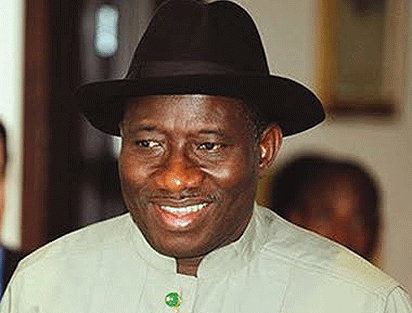
President Goodluck Jonathan
By John Amoda
Feasibility of transformation governance policies as Jonathan’s development strategy (3)
WHEN the above is the case, the problematique of constitutional government in Nigeria is civilian electoral government, not unconstitutional military rule. The puzzle for the rank and file of the Military as well as the generality of the Nigerian populace is why Military governments voluntarily withdraw from office only to return at will to office.
Thus for the Nigerian mass, both military and nonmilitary, democracy is not contemplated and no group has made the mobilization of the people for democracy its goal.
Given such a situation should elected civilian governments and the media be indulging in microanalysis of Democracy and Democratic rule annually? Does this celebration of tenure of civilian rule represent in fact the substitution of wishfulness for constitutional rule for deliberate and pro-active mobilization of the people for democracy?
The answer to this question of the prospects of democratic constitutionalist government and governance in Nigeria is immediately determined by the outcome of the contestations between pro-military rule political parties and pro-civilian rule electoral parties within the context of the postcolonial transition. Any interest for democratic constitutionalist order of politics in Nigeria must as a matter of strategic concern address the structure of the Nigerian society that economically marginalizes the rural and the urban poor.
The structure of the Nigerian society and the prospects of its restructuring are internationally determined. The international dimension of the structure of Nigerian society must be addressed because Nigeria as it is presently organized is the result or reformist decolonization politics of the British Empire.
This definition of the political enterprise reflects the balance of power between the pro-reform interest groups and the anti-reform interest groups in the context of demand for change in and of the British Empire.
We may appreciate the issue of contexts better when we remember that the agitations for equality amongst citizens of the United States became a matter of state policy in 1857. The election of President Barack Hussein Obama in 2008 only marks the ascendancy of the anti-racialist reformist block of the American Establishment.
See how long the transition has been in the anti-racialist reformist politics of the United States of America! It is in the same manner as we demarcate the period of reform in the USA by the election of Obama contextualized by the 1857 Dred Scott Decision of the Supreme Court of the United States, that we should demarcate the context of reform by the decision of the Colonial Government to plan for responsible government in the colonies.
Independence of the colonies was and remains a phase in the reform of the British Colonial State. To only address issues of politics internal to Nigeria and not to view Nigeria perspectively is to focus attention on the feet with no commensurate attention to the path taken in Nigeria’s political journey.
This focus on the national to the exclusion of the international has now been problemmatised as realism in contrast to the “escapism” of concern with the past. The “either-or” problemmatisation of change of order is ideologically inspired. It serves the interest of the pro-empire elites in Great Britain and in Post Colonial Nigeria. The national is contextualized by the international as the external is contextualized by the internal.
The past provides a perspective for the analysis of the present just as the present provides a point of viewing the entire course of past, present and future flow of events. The pervasiveness of the Either-or fracture of the course of change denies the statecraft analysts perspectives necessary for preparing plans for transformation of orders of politics.
Counting the existence of civilian rule in terms of years of the absence of the Military from government is not a practical exercise when we do not know why the Military withdraw into the Barracks. Why is the military still in the barracks? Are they now permanently in the barracks?
Are we dealing with taming rather than change of nature? lnspite of change in the policy of the African Union with respect to Military rule, governments are still being toppled by coups.
The coups in Gambia, in Liberia and most recently in Guinea are coups by the other ranks; these coups show the dissemination of capabilities for staging coup” throughout the rank and file of the Armed and Security Forces.
The complexity of managing the affairs of state did not deter the disk jockey of Madagascar or the captain of logistics of Guinea. In such perilous circumstances, interest in democracy and democratic government must go beyond the “Empire Day” celebration of “Democracy Day”.
Disclaimer
Comments expressed here do not reflect the opinions of Vanguard newspapers or any employee thereof.