
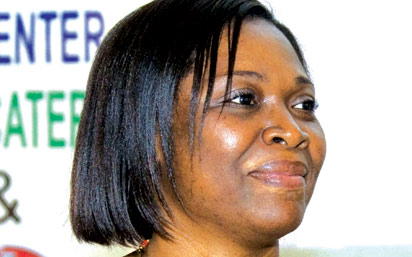
Mrs.Dotun Akande…. The economic cost of not acting, and swiftly too, will be borne by the entire society; not just the families!
By JOSEPHINE IGBINOVIA
Her passion is to see every child surmount autism just the way she was able to help her son who was diagnosed with the developmental disability at age 2 overcome it and move on to mainstream society. Autism is a complex neuro-developmental disability that typically appears during the first three years of life as a result of a neurological disorder that affects the normal functioning of the brain.
Both children and adults with autism are said to show difficulties in verbal and non-verbal communication, social interactions and leisure or play activities.
In this interview, Mrs.Dotun Akande, Founder/Proprietress of the Patrick Speech and Languages Centre in Lagos, advocates for early intervention which she stresses is the only way out of autism.
Her words:
‘We want to let the world know that autism is not a death sentence; these children can be worked with. Parents too should know that having a child that has this challenge is not the end of the world. Early intervention is the key; so, all you need do is to help that child come out of that problem.
With early intervention, you can make a wonder of that child. My son Abolade was two years old when we discovered he had autism, and because we worked hard at it, he is now in a regular school! Abolade is 13 years old now! As a matter of fact, he is doing very well in regular school and is also one of the top pupils in his class!
Right now at PSLC, we are alarmed at the number of families coming up with autism now. Even science has estimated that more families will come up with autism in the next 10 years! We cannot pinpoint why this is so, and we also do not know the cause.

Mrs.Dotun Akande.... The economic cost of not acting, and swiftly too, will be borne by the entire society; not just the families!
Some are saying it is connected to genetic factors, some are saying it is incompatibility, some say it is environmental, etc. We really cannot pinpoint the cause. Some also say that it has been dormant in the gene of some parents, and has therefore started manifesting in their children.
Chances are someone you know; a fellow employee, business associate, friend or family member is touched by autism in some way! Startling, global statistics show 1-110 children affected in the US, 1 in 150 in the UK and South Africa and 1 in 38 in Korea. Unfortunately, there are no statistics for Nigeria but it is as pervasive compared to 1 in 10,000 a decade age.
Recent statistic from the Center for Disease Control indicates autism is the fastest growing developmental disability with a 10-17 percent annual growth rate. It is 5 times more common than Downs syndrome and 3 times more common than Juvenile Diabetes. It is a problem that affects children, families, schools and consequently, our entire nation and world.
Overall, the incidence of autism is four times more common in boys than in girls and typically appears during the first 3 years of life. Autism is one of the most heritable neurodevelopment disorders. If one identical twin has it, so will the other in nearly 9 out of 10 cases. If one sibling has the disorder, the other siblings run a-fold greater-than-normal risk of having it.
From every indication, a significant number of our young adults globally would be individuals with autism unless something is done to forestall this! This is also because science has estimated that more children will be diagnosed with autism that with AIDS, diabetes and cancer combined.
That’s why as a society, we must work towards ensuring that we provide proper support and early intervention that guarantees that the children will grow to be successful and independent individuals who can and will contribute to the growth and development of the nation. The economic cost of not acting, and swiftly too, will be borne by the entire society; not just the families!
As a centre, one of the strategies we have designed to show that these children can be worked with is an annual show tagged ‘Talent in Autism Concert’. The concert is a platform to exhibit and celebrate the unique talents and skills of children with autism.
It is truly an enriching experience witnessing the array of talents displayed by the children. In our last concert which was the third edition, we had performances by the pupils of PSLC, ranging from bible reading to music, dance, choreography, pantomime, and playing of musical instruments. I mean, those were only a tip of the iceberg of what children with such special needs as autism could do if given opportunity to special education.
I must gladly say that we are making progress at working with thesechildren and reintegrating them into normal society. Presently, we have over forty children with us, and the beauty of it all is that from time to time, these children are able to move into regular school while we take in new ones.
In fact, in our 5 years of existence, we have been privileged to witness a large number of children recover from autism and be reintegrated to mainstream society and this is the hope and goal for all our children.’
Disclaimer
Comments expressed here do not reflect the opinions of Vanguard newspapers or any employee thereof.