
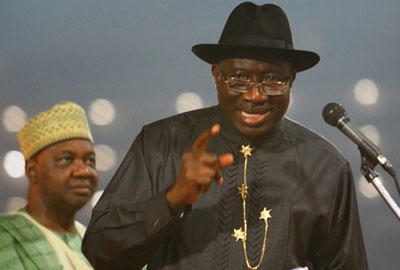
President Goodluck Jonathan
By Les Leba
President Goodluck Jonathan presented year 2012 budget proposals to the National Assembly barely a week before the Christmas recess! Incidentally, the 2012 budget is the first budget crafted on the foundation of the transformation agenda “which spells out the strategic direction of Jonathan’s Administration”.
The 2012 budget was designed, according to the President, with the underlying theme of “fiscal consolidation, inclusive growth and job creation”; objectives, which the government hopes to achieve by paying due attention to “macroeconomic stability, structural reforms, governance, and building institutions and investment as priority areas.” Nigerians may be excused for the feeling of déjà vu, as these are the same objectives and strategies of previous administrations’ budgets.
Any expectation that, with the international credentials of the Finance Minister, budget sectoral allocations would favour capital infrastructural enhancement and reduce systemic bloated recurrent expenses from over 70% was rudely shattered recently, by her expressed intent to slowly redress the imbalance at an annual rate of 1 – 2%, an indication that we cannot trust government’s promise on rapid infrastructural enhancement during Jonathan’s tenure (compare this with Lagos State’s consistent over 70% capital budgets).
Undoubtedly, a critical factor of successful budgets is implementation; regrettably, a tradition of late presentation has characterized budget enactment process, and Mr. President’s very late submission is a red flag signal that successful implementation would be impaired, as legislative debate, if thorough, may extend well into the second quarter of 2012!!
This is not to say that Nigerians would necessarily have been better off if budget 2012 was submitted as early as September 2011 to allow extensive debate; this is because, full implementation of a bad plan will never guarantee delivery of economic growth and development.
Indeed, either partial or full implementation of budget 2012, as it stands, will certainly stifle growth and deepen the level of poverty! Conversely, even when government’s objectives and economic strategies are well defined, in a budget statement, an inadvertent or ‘mischievous’ mismatch of resources, processes and unanticipated policy contradictions will ensure failure to deliver on promises of increasing employment, lower single digit interest and inflation rates to stimulate economic growth!
In the light of foregoing shortcomings of inappropriate recurrent/capital budget and extremely late budget submission, let us now evaluate the potential effectiveness/success of 2012 budget proposals.

President Goodluck Jonathan
Ultimately, the question is whether or not President Jonathan’s expectations of fiscal consolidation, inclusive growth and job creation can be successfully achieved! Notably, without macroeconomic stability, it would be an uphill task to institute structural reforms, or improve governance or successfully build institutions and investments as envisaged!
Macroeconomic stability is characterized by a social environment predicated on low inflation rate (not more than 0 – 4% as in successful countries) so that income values, particularly pension funds, are preserved, and therefrom encourage a savings culture that supports growing investment climate.
High inflation and interest rates above 10% have serious retrogressive impact and excludes macroeconomic stability, yet, there are no overt strategies in the 2012 budget to promote beneficent interest and inflation rates as monetary policy reform is sadly disregarded, and CBN’s self-administered poison of excess liquidity will continue to distort and destroy the economy and make Mr. President’s expectation of inclusive growth and job creation an unattainable dream.
Similarly, a rapidly increasing debt burden without commensurate infrastructure and human capacity enhancement is not also synonymous with macroeconomic stability. A quadrupling of domestic debt to over $35bn within five years, without improvement in social and infrastructural structures, is an aberration of macro-economic stability.
We recall the media hype of imminent crisis when our foreign debt was barely $35bn in the first coming of Okonjo Iweala; Nigerians have not forgotten that in retrospect, we gleefully parted with over $18bn from our reserves on the pretext that our economy will quickly rebound thereafter and savings from debt relief will enhance our infrastructural base and social welfare!
The outcome of these bloated promises is self-evident in deepening poverty in the land; yet, Nigeria’s total debt burden (foreign + domestic) today approaches a princely sum of $40bn, but surprisingly, we are told there is no cause for alarm! Yet, we will require over N540bn for debt service in the 2012 budget in place of about N250bn allocation just over five years ago!
Furthermore, the 2012 budget deficit of almost N800bn will compound our debt burden with additional CBN and Debt Management Office (D.M.O.) ‘purposeless’ borrowings for liquidity mop up and deepening of the bond market respectively in 2012! With so much acknowledged “waste, inefficiency, corruption and duplication in government”, as publicly acknowledged by the Honourable Minister!
Why must we condone a huge deficit of almost 20% of total expenditure, while our legislators, political jobbers, and other public servants earn emoluments and allowances that would make counterparts in more developed aid-donor countries green with envy! Thousands of ghost workers have been discovered in the public service, but inexplicably, the direction of recurrent expenses remains northwards!!
Dozens of ailing public enterprises, which drained the treasury, have since been privatized, and yet the size of recurrent expenditure has remained over 70%! Media reports suggest that only about 70% of funds in the 2011 budget have been released by November 2011 ending, leaving unspent about one third (over N1.5 trillion) of the expenditure budget!
It would be rational expectation that the excellent tax revenue of over N3 trillion from the better-managed Inland Revenue Service in 2011, and best ever customs duty collection would nullify or drastically reduce the deficit value in the 2011 budget, but inexplicably, there is no such luck.
In like manner, in keeping with tradition, a substantial part of the 2012 budget proposals will remain unreleased/unspent by December 2012, but you can bet your last kobo that the projected deficit value will not diminish!! If the government is confident of its ability to reduce waste, inefficiency, corruption and duplication in government, and is also committed to reduction of unhealthy and misguided reflex government borrowings with treasury bills and bonds, it would be inappropriate to provide for about N800bn as deficit in the 2012 budget!!
In all honesty, there is nothing in the 2012 budget proposals to show that the serious distortions and weaknesses in our economy can be remediated; the paradox of a currency constantly under downward pressure, particularly when our export reserves rise is apposite to principles of market economics and macroeconomic stability.
In the same vein, we recall that even though the 2011 revenue projections were predicated on $75/barrel and 2.3 million barrels/day of crude oil, cumulatively, oil prices and output remained above budget benchmarks most of the yearstime, according to the Oil Minister in a media interview! Yet, government has failed to satisfactorily explain why these fortuitous events did not wipe out or significantly reduce the value of the 2011 deficit!!
Budget 2012 may not be different, as the increasing possibility of revival in U.S., European and Asian economies may ensure that next year’s price/output, benchmarks of US$70/barrel and 2.4mbpd respectively are exceeded but even this plus the best revenue collection efforts of the Federal Customs Service, and controlled focus of Okaru Omoigui of Federal Inland Revenue may ultimately, in keeping with tradition, still fail to reduce the projected 2012 budget deficit of about N800bn.
Above contradictions will make the prospect of macroeconomic stability in 2012 a mere expression of intent and we should recognize that the other pillars in Mr. President’s transformation strategy will collapse in sympathy!
In the light of little correlation between budget sectoral allocation and performance, most Nigerians have lost faith on the impact of nominal values of sectoral allocations. In any event, allocations for health, education and power sectors have remained way behind best practice budget ratios; for example, while the UNESCO recommendation for education is about 25%, the 2012 budget allocates less than 10% to this critical sector!
It is also pertinent to comment on the humongous sum of N921.91bn security allocation in Jonathan’s budget proposal. We can understand the need to beef up security to counter the destabilizing forces currently besieging our country, but discerning Nigerians are likely to cry foul and insist that the solution to rising wave of insecurity is job creation, and not increased importation of police, army and other security equipment, which do not create jobs and add minimal value to our economy.
A better alternative application of the N920bn security vote would be to fill the huge gap between demand and supply of affordable accommodation throughout the country.
In view of the employment generation and multiplier capacity in the execution of mass housing programmes; each state could be provided with mass housing programmes of about N30bn annually from the N920bn security vote. Thus, in Jonathan’s four-year term, each state would benefit to the tune of N120bn for mass housing; in this manner, Jonathan would put more Nigerians to work and also provide the basic need of shelter for millions of Nigerians nationwide; this would be a good example of inclusive growth!
What, however, stands out like an elephant in a living room in the 2012 budget is the absence of any mention of fuel subsidy, which, by government’s accounts gulped up N1300bn in 2011!! If fuel subsidy is eliminated without first deregulating the monopoly of the CBN on the foreign exchange market, the already oppressive inflation rate of over 10% will be rapidly exceeded.
In spite of government’s promise of the beneficent impact of fuel subsidy removal, in reality, the higher fuel prices will drive spiraling inflation and decimate the purchasing value of all income earners and government’s promised benefits will never materialize (remember similar promises were made for debt relief and privatization of public enterprises)!
Alternatively, the accommodation of fuel subsidy may increase the 2012 deficit and loan requirement to over N2000bn; i.e. about 40% of total expenditure and over 60% of recurrent expenditure for 2012.
It’s a sure case of tails you lose, heads I win!! Nigerian public will ultimately groan under the pressure of debt service charges, which may gulp up over 30% of federal revenue, and the proposed 100% duty on rice and wheat (major stable commodities for all Nigerians) will drive nails into the coffins of millions of Nigerians.
The real sector will consequently be crowded out by government’s huge appetite for loans and our hope of industrial rejuvenation, and economic growth will dim, as increasing job losses are propelled by spiralling inflation and a disenabling environment, and in the words of Asa, the Nigerian music icon, “there is fire on the mountain, but tragically, no one seems to be on the run,… but, one day the river will overflow and there’ll be nowhere for us to go and we will run, run… wishing we had put out the fire, oh no….”
Disclaimer
Comments expressed here do not reflect the opinions of Vanguard newspapers or any employee thereof.