
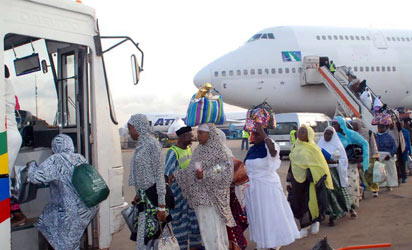
The last batch of 2011 pilgrims to Saudi Arabia by Med-View carrier arrived the Murtala Muhammed International Airport, Ikeja, Lagos recently.
By Haruna Razaq
Some Muslims erroneously claim that the art of celebrating the return from Hajj is the practice of Prophet Muhammad (s.a.w). They often support this view with the notion that “when the prophet returned to Madinah after his Hajj, he offered a sacrifice to thank Allah.
Truly the Prophet (s.a.w) offered a sacrifice in order to thank Allah but did not make celebration as practiced by some Muslims.
In fact, it is good for someone who performs Hajj upon his return to express gratitude to Allah through: Nafila Shukur (two raka’ats of thanking Allah), Sujud Shukur (prostration of thanking Allah), Azkar (words for thanking Allah).

The last batch of 2011 pilgrims to Saudi Arabia by Med-View carrier arrived the Murtala Muhammed International Airport, Ikeja, Lagos recently.
Also, it is permissible to just gather to welcome a pilgrim when he returns, to walk with him, to visit him and say Salam to him, to congratulate him, ask him to supplicate on ones behalf etc.
In addition, it is recommended to prepare a feast as an act of being grateful to Allah. Indeed, the scholars mentioned the food that a person who returns from a travel prepares for the people who visit him among the desirable food. This travel includes a person who returns from Hajj too.
Unfortunately, after the Salaf, a lot of customs and rites have been attached to the practice which lack evidence from Qur’an and Sunnah. It is nothing but sheer ignorance. This practice varies culturally and socially from place to place and country to country. For example in Egypt Edward William writes around 1833 that “Egyptians would decorate the entrance to the home of Hajj three days before his return.
The door and the stone around it are painted in red and white camels are drawn in green, black or red. The Hajj in question may write to his relatives in advance asking them to commission the paintings. On the night following the Hajj return, he usually throws a party for his friends, called the Nazla:
Furthermore, the habits of celebrating the return of pilgrims in contrary to dictate of Shariah are common in many of the present day Muslims countries including Nigeria.
The worst mode of Hajj celebration was introduced in recent time by some ignorance Muslims in Nigeria entitled “Sabaka night”. Religious scholars in the area condemned the practice and declared it Harram in Islam because it involves Riya (showing off), Israaf (extravagance) singing, dancing accompany with alcohol.
Alhaji Moshud Olanrewaju Adepoju (formal Ewi King and now eminent Islamic scholar in Nigeria) claimed that sabaka night was introduced by Alhaji Abdul Jabar (a.k.a Oko Osho Oko Aje). Prominent in Sabaka night celebration are musicians, actors and actresses, area boys and other so called Muslims.
The act of rejoicing is innate but Islam has laid down when and how the Muslim should rejoice. Therefore Al-Hujaj is expected to increase in righteous acts and move away from what Allah has forbidden except if he wants to be of those who answer the call of Shaetan.
Disclaimer
Comments expressed here do not reflect the opinions of Vanguard newspapers or any employee thereof.