
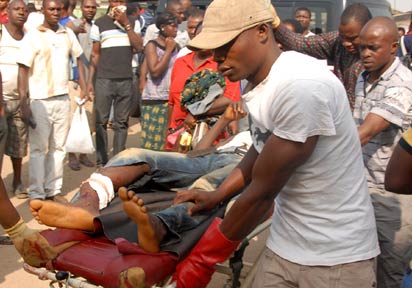
Helping the injured at Madalla, Suleja on Christmas Day.
By Is’ haq Modibbo Kawu
I HAVE reflected very much on diversity and the essential unity of our humanity in the past 24 four hours. Television images from home have been very disturbing. The tragic and unacceptable killings of people worshipping during this season of goodwill have triggered my stroll on the shores of hindsight.
And the earliest lessons I have learnt, include the discovery that there can be no one way of being human; while there is no inferior or superior human experience, only a variety of these experiences and each is valid. All are contributions to the treasure house of human experience.
It is remarkable for me, that growing up in the very conservative religious settings of my home during the 1960s helped me to validate these values that I have spoken about.
My forebears were Fulbe Jihadist scholars with roots in the Empire building traditions of the old Western Sudan. We retain a profound sense of history about those traditions. Nevertheless, I always marvel at the level of tolerance and respect for other values.
As a growing kid, we had living in our compound in Ilorin, a certain Mr. Gabriel, a Yoruba man, who seemed permanently drunk every Saturday night. But unfailingly, every Sunday morning, my Uncle, Ahmadu, who also taught us the Qur’an, would knock on Gabriel’s window, reminding him that he had to go to church.
A regularly groggy Gabriel would reluctantly leave the house and return about two hours later, to bed. Much later, we discovered that Mr. Gabriel regularly used the forced break from sleep, to go ‘kill’ his hangover from the previous night, by walking down Niger Road to help himself to more drinks.
But some lessons were taught by my uncle’s unfailing action: Gabriel could not keep God waiting and the fact that we had a different confession from his never invalidated his human experience. The “other” and his being and world view were as valid as our own sureties!
As television showed images of the destruction from Nigeria as a result of the BOKO HARAM Christmas Day bombings, the tolerance I learnt as a growing kid stuck out to me forcefully as what we have lost but a value that we must regain, if we hope to build an inclusive and tolerant country.
I am on a short break from the hurly-burly of Nigerian existence and in the past few days, been travelling through Addis Ababa, Ethiopia and writing these lines from my hotel in central Dubai.
Everytime I pass through the Bole International Airport in Addis, I wonder why the much-vaunted ‘giant of Africa’, cannot get its act together in practically every sector of existence. Take power supply for example. We have spoken and written volumes but have been unable to break the yoke.
Yet, we all agree that a modern society cannot be built without power. The Ethiopians are harnessing their potentials. According to the World Bank, Ethiopia has the second largest hydropower potential in Africa, after DR Congo.
Its government aims to produce 20, 000 MW of electricity over the next ten years; this is part of a 25 year plan to spend $12B in the sector. It has potential to produce 45, 000MW and the Grand Ethiopian Renaissance Dam that is presently under construction, will have an installed capacity of 5, 250MW and 15, 128 GWH annual energy generation. It is the largest dam in Africa.
Ethiopia plans to export power to neighbouring Kenya, Sudan, Yemen and even Egypt, with which it is locked in controversy over the use of the waters of the Nile. The Ethiopian HERALD newspaper of December 15, 2011, similarly reported the plan to achieve a seven-fold increase in renewable energy production in the next five years.
The Ethiopian Prime Minister, Meles Zenawi, is Africa Union’s special representative on the environment, and already, villages in Northern Ethiopia, are hosting several wind farms, as part of this holistic national strategy to ensure adequate power production.
Our ruling class continues to dither in the most basic decisions; while most of the time, individuals are far more interested in what they will get out of projects not what benefits their country. But even more fundamentally frightening, is the inability to build a national consensus about the country and its values, by the different factions of its ruling elite.
Many work actively to delegitimise the country and others are trapped in secessionist projects or outright plans of disintegration! It is these painful thoughts that I have continued to wrestle with as I spend this Christmas away from home.
But I remain an incurable optimist, because I see no other way, than a Nigeria, whose people pull together, to achieve its latent potentials. The building of a counter-hegemony located in its working people, the poor, patriotic intellectuals and sections of the national bourgeoisie, for me, is the platform to achieve the national liberation that Nigeria requires. But it has to be worked for! So as Tiny Tim said, in Charles Dicken’s A CHRISTMAS CAROL: “God Bless us all; everyone”.
Heating up the national security state
TWO weeks ago, President Goodluck Jonathan’s Labour and Productivity minister, Emeka Wogu warned the Nigeria labour movement not to “overheat the system”, with threats of a general strike and mass protest over plans by the administration to remove fuel ‘subsidy’.
Chief Wogu said the labour movement was ‘merely acting on speculation’, saying there was no sufficient reason to go on strike: “…they (NLC/TUC) are going to go on strike because of anti-people policy, the big question is: does it qualify as a condition to go on strike?
You know if a strike is declared, people will not go to work, so does this contemplation which you mentioned qualifies [SIC] the NLC to go on strike?”
Chief Wogu must certainly reside in cloud cuckoo land, not to know that central to the economic policy of the administration he serves as minister, is the removal of fuel ‘subsidy’, which even his principal accepts will engender discomfort; ‘yes, we know there will be little pain’, according to President Jonathan.
So the chief has tried to be clever by a half, by claiming that those planning to resist the unpopular policy are about to ‘overheat the system’.
Significantly,, the base of opposition to the fuel ‘subsidy’ removal plan has broadened to take in practically all the leading lights of Nigerian civil society; with notable individuals and even the CNPP having signaled their intention to join the working class in the planned movement of resistance.
If the system is becoming ‘overheated’, the culprit is the administration itself; ‘freed and faired’ into power, but has frittered away the trust and support of the Nigerian people. Even the old despot, General Olusegun Obasanjo, was reported to have cautioned against removal of ‘subsidy’, warning that the move could ignite chaos. President Jonathan’s inaction has become a major butt of jokes around the country!
And central to the present situation in Nigeria today, is the increasing rollover of the state into a more openly national security state. The 2012 budget plan allocates a whopping N921.9B to security. In a recent article for Africa Confidential, of December 16th, 2011, titled ‘The Business of Terror’, long time Nigeria watcher, Patrick Smith, described the “staggering sum” as “a BOKO HARAM campaign bonanza for the generals and private security companies”.
Smith added soberly, that “the huge diversion of resources will not achieve its aims without a clear strategy to address the grievances that the militants exploit”. It is significant that Patrick Smith locates as central to the grievances of militant anti-state organisations today, as “Nigeria’s winner-takes-all capitalism, in which the winners are always the same”.
And all of us know, that even blindfolded, we literally can reel out the list of the perpetual winners that Smith has talked about: beneficiaries of ‘subsidy’ and perpetual donors at PDP fund-ri
sing dinners!
Ever since President Jonathan scampered behind the rocks at the Aso Villa to celebrate Nigerian Independence, it became clear that regime survival is the most important piece of the jigsaw of administration in Nigeria. Our national security state depends more and more on Zionist Israeli security personnel.
Patrick Smith said “we hear that Israeli intelligence experts (mostly ex-Mossad officials) may be retained as security consultants….Nigerian (and Kenyan) officials have also been on counter-terrorism trips to Israel”.
But in this “business of terror”, Nigeria also bleeds huge sums of money that could have been ploughed into the development process which might stem the terrorism which the administration is throwing huge sums of money at.
Patrick Smith said further that “the fight back against BOKO HARAM has been hugely lucrative for some. Contracts for training and security equipment are heavily inflated. So-called security officers and associated political appointees sell questionable services to security agencies.
Private security companies such as the USA’s re-branded Blackwater, operating in Iraq, Pakistan and the Middle East, are doing business in Nigeria, along with those who were fighting the insurgencies in the Delta. So dear Chief Emeka Wogu, it is not acts of resistance by the working people that will “overheat the system”; the regime you serve as minister poured petrol and dollars on the fire of the national security state a long time ago.
That is the ghost haunting the Nigerian state; not resistance of anti-people policies.
Disclaimer
Comments expressed here do not reflect the opinions of Vanguard newspapers or any employee thereof.