
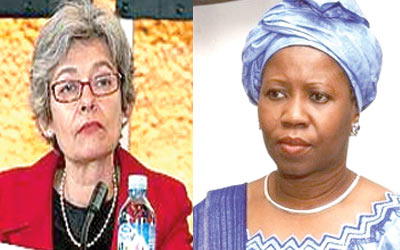
Dr. Irina Bokova Director General, UNESCO & Amb. Mariam Y. Katagum Nigerian Permanent Delegate to UNESCO
BY EMMANUEL EDUKUGHO & HOPE IGBARUMA
THe 36th General Conference of the United Nations Educational, Scientific and Cultural Organization (UNESCO), took place between 25th October and 11th November 2011 in Paris, whereby Nigeria was elected into the Executive Board and the Council of the International Bureau for Education (IBE).
The Conference, which is considered to be UNESCO’s highest ruling organ, admitted some countries as Associate Members. It also approved the admission of the new Republic of South Sudan and Palestine as the 194th and 195th member states respectively.
The General Conference, consisting of the representative of the member states, meets in ordinary session once every two years, and is also attended by Associate Members and Observers from Non member states, intergovernmental organizations and Non-Governmental Organizations (NGOs).

Dr. Irina Bokova Director General, UNESCO & Amb. Mariam Y. Katagum Nigerian Permanent Delegate to UNESCO
In a valedictory speech, the immediate past president of the 35th General Conference, Ambassador Davidson Hepburn, noted the displeasure of member states over the slow pace of progress in making Education For All (EFA) a reality. He underscored the needs for the General Conference to adopt a Resolution on climate change education for sustainable development of Small Island States.
Goals and programmes
Further, he canvassed for greater efforts towards the realization of the goals and programmes of UNESCO by 2015, so as to bring some immediate impact.
According to Education Vanguard sources, Mrs Katalin Bogyay of Hungary was elected president of the 36th General Conference for a period of two years. In her address, she remarked that “the clock is ticking, only four years remain for us to meet the 2015 dead line for the internationally agreed Millennium Development Goals, notably those concerning UNESCO’s fields of competence, in education”.
In her opening address, the Director General of UNESCO, Mrs Irina Bokova, stressed the need to reinforce cooperation in the face of challenges confronting the world today. “The global economic crisis is hitting the poorest countries badly,” adding that “the stakes of peace and sustainable development today, lie precisely in education, the sciences culture, and knowledge sharing, thereby necessitating a more and better UNESCO”.
Nigeria’s Minister of Education and President, National Commission for UNESCO, Prof Ruqayyatu Ahmed Rufa’i, conveyed the greetings and goodwill of President Goodluck Jonathan and that of the people of Nigeria, to the 36th General Conference.
Professor Rufa’i noted that a number of momentous events, such as devastating natural disasters, terrorist activities and political movements, had taken place in several parts of the world since the 35th General Conference, which held in 2009.
She re-affirmed Nigeria’s solidarity with, and condolences to, all nations adversely affected by these occurrences, and stated the recent bomb attack on the United Nations building in Abuja had strengthened the resolve of Nigeria to achieving global peace in fulfillment of the UN mandate. Participants were also informed that the Federal Government of Nigeria had since provided temporary office accommodations to UNESCO in Abuja.
Professor Rufa’i reiterated the Federal Government’s unwavering support to the ongoing reform programmes of UNESCO at all levels, and expressed satisfaction with the priorities and main lines of major programmes of concerns and needs specific to Sub-Saharan Africa in general, and Nigeria’s Transformation Agenda, in particular.
She further stated that, as current Chair of the E-9, and having recently hosted the 8th E-9 Ministerial Review Meeting, including the establishment of Self-Benefiting Funds-In-Trust with UNESCO to the tune of $6.4 million, Nigeria was doggedly carrying out a number of activities aimed at taking literacy to the next level consistent with internationally agreed standards.
Professor Rufa’i commended the Executive Board for adopting the reports on the feasibility for establishing two category 2 institutes/Centres in Nigeria, among ongoing beneficial programmes in the realm of Culture, Social and Human Sciences, Information and Culture.
Our sources further revealed that at a reception in honor of the Minister of Education, Professor Rufa’i, the Minister of State For Education, Barrister (Chief) Nyesom Wike , as well as Heads of parastatals and other Nigerian participants, the Permanent Delegate and Ambassador of the Federal Republic of Nigeria to UNESCO, Ambassador Mariam Yalwaji Katagum, enjoined all participants to actively participate and ensure, hard work, commitment and team spirit so as not to only derive maximum benefits from Nigeria’s presence at the General Conference but to bolster her visibility among the comity of nations.
Ambassador Katagum crystallized the Transformation Agenda of the Government and suggested the various platforms and target programmes which were germane to its realization. She confirmed the state of preparedness of the Delegation towards ensuring and facilitating a successful General Conference.
As part of the General Conference, the following Heads of State took part and addressed the delegates: Georgi Parvanov, President of the Republic of Bulgaria; Susilo Bambang Yudhoyono, President of Indonesia; Alassane Ouattara, President of the Republic of Cote d’Ivoire; Ali Bongo Ondimba, President of the Republic of Gabon; Tillman Thomas, Prime Minister of Grenada; Pascal Irenee Koupaki of Benin; and Raila Odinga, Prime Minister of Kenya.
Disclaimer
Comments expressed here do not reflect the opinions of Vanguard newspapers or any employee thereof.