
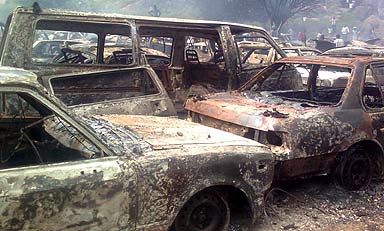
*Burnt ‘offerings’ of motor vehicles…after one of several violent clashes in Jos
By Taye Obateru, Jos
Dialogue and engagement have been the panacea prescribed for peace by most commentators on the protracted crisis in Plateau State. While there are those who assert that series of dialogues over the years have not achieved much because they fail to address the crux of the matter, peace and conflict management experts insist that dialogue must continue even if the results are not immediately evident.
This might have instructed the series of engagements organised for residents by various groups in the past few weeks all geared towards fostering understanding among the people and healing the wounds created by the recurring crisis.

*Burnt ‘offerings’ of motor vehicles...after one of several violent clashes in Jos
Among the series of dialogue sessions was a Community Action Peace Initiative to three communities in crisis- prone Jos North Local Government Area organised by the Centre for Conflict Management and Peace Studies of the University of Jos in collaboration with the Royal Netherlands Embassy in Abuja.
Peace advocacy
The Peace Advocacy to Angwan Rogo, Angwan Rukuba and Jenta Adamu communities, was a town hall of sorts where different people bared their minds on the negative effects of the crisis and the way forward. From Angwan Rogo which is a Muslim community to Angwan Rukuba and Jenta Adamu which are largely Christian communities, the people spoke of their frustrations over the recurring crisis with various suggestions on how to bring it to an end.
Under Secretary of the Royal Netherlands Embassy, Annie Meke who spoke at the various sessions, underscored the importance of dialogue for resolving the protracted crisis in Plateau State. She described it as the only way out and urged the people to embrace peace in resolving their differences.
Her position was echoed by Executive Director, Advancement Office, University of Jos, Professor Victor Dugga who explained that the collaboration between the university and the Royal Netherlands Embassy was the institution’s way of contributing to fostering peace and thanked the embassy for partnering with the university in the task. He believed that giving the people an opportunity to express their feelings was an important step towards finding a solution to the problem.
Village Head of Angwan Rogo, Mallam Abdullahi Maikano said the community was delighted that the university initiated such a dialogue in the search for peace. He described peace as a two-way process which requires the cooperation of parties to a crisis and was optimistic that with sincerity from both sides, peace would be achieved.
He used the opportunity to appeal to the university authorities to grant members of the community concessions in the area of admission and employment as the host community of the institution. He said this would give them a sense of belonging.
At the session in Angwan Rukuba, various speakers also spoke on factors they considered contributory to the unending crisis and what they feel should be done to address them. Many stressed the need for security personnel to be impartial and vigilant to enjoy the cooperation of the people, especially in intelligence gathering.
Some others spoke on the need for parents on both sides of the divide to instill the right values in their children which will not make them prone to being used for negative things like violence. In the same vein, other speakers identified high rate of youth unemployment as a key factor which make them ready tools for violent activities. They called on government to take action to address the problem if enduring peace would return.
Similar concerns were raised at the dialogue with the Jenta Adamu Community. A speaker, Rose Adamu suggested that surveillance at the country’s borders and the state’s boundaries with other states should be intensified to check the influx of illegal immigrants who she alleged were often imported to unleash violence in the state.
Another speaker, Yusuph Yacoub said short and long term measures should be adopted to tackle the problem. He emphasized that bringing those involved in violence to justice would be a potent deterrent strategy for perpetrators of violence.
Responding to the submissions at the different locations, Director, Centre for Conflict Management and Peace Studies of the University of Jos, Dr. Audu Gambo said the various opinions would be collated and presented as a report to relevant authorities for necessary action. He said the institution as an impartial arbiter would continue to work hard for peace to return to the state.
The issue of addressing youth unemployment was core during a similar dialogue forum between Christian and Moslem youths in the state as participants recommended the establishment of a youth empowerment scheme to engage the youth in gainful activities.
They were unanimous that there was need to counter the traumatizing and destructive experiences that crisis-affected youths have undergone. The youths made the call in a 15-point communiqué at the end of a Plateau Oneness Dialogue forum jointly organised by the state government and Youths Action Initiative Africa, YAIA, noting that the prolonged violence in the state had resulted in psychological injuries to people which ought to be addressed.
“We need to create conditions for positive and constructive roles for youth in the society, so they will not turn to violence in an attempt to satisfy their needs. An important way to avoid future conflict is to draw on the energy and capacities of youth as the leaders of tomorrow’s societies.
Government at all levels should understand that when youth demobilize from armed conflict, they need more jobs, food, and medical care. Youth empowerment programmes that enhance entrepreneurship and vocational skills should be provided by government,” the communiqué said.
Truth and reconciliation commission
The communiqué jointly signed by Mr. Samson Itodo of YAIA and the Director General, Office of Research and Planning, Mr. Chris Kwaja, recommended the setting up a truth and reconciliation commission where people can air their feelings on the wrongs done them for possible remedy.
According to the communiqué: “A truth and reconciliation commission should be constituted to genuinely reconcile and unite all contending forces involved in the crisis. There is need for government to create the commission for citizens to meet and forgive one another as the prolonged violence has caused many citizens psychological injuries”.
Itodo had explained at the opening ceremony that the body and the state government were partnering in appreciation of the need to engage young people at all levels in addressing the security challenges facing the state.
“When the youth are shielded from social and economic stresses and can participate in decisions that affect their lives, they are more likely to pursue peaceful change. It is time for youth to set aside personal, parochial, primordial and partisan considerations for sustainable peace and development of our dear beautiful Plateau State,” he said.
At another of such dialogue jointly organised for “young minds” with the theme, “Civic Moral Education: A Panacea to Conflict” by Apurimac Onlus in collaboration with New Era Educational and Charitable Support Forum, one of the speakers, Shannon Frediani said getting to know people and accepting them for who they are was key to peaceful co-existence.
Frediani who represented a body known as Shannon Freedom said: “When you listen to my story and I listen to your story, then we are not longer strangers but friends. A heart to heart connection and not a surface connection and meaningful dialogue is what is needed to stop this cycle of violence”.
Special Adviser to Governor Jonah Jang on Peace and Reconciliation, Mr. Timothy Parlong, equally harped on the importance of dialogue when he feted Muslim and Christian youths to mark the Eid-el Kabir celebration. He said nothing can replace dialogue in the search for peace as, according to him, the more people talk, the more they understand one another and eliminate chances of misunderstanding.
As the series of dialogue continue, many are hopeful that it would ultimately, achieve the objective of promoting understanding and ending the cycle of mutual suspicion and bitterness that has been the underlying cause of the orgy of violence in the state in recent times. This, they believe, is the only way to make them worthwhile.
Disclaimer
Comments expressed here do not reflect the opinions of Vanguard newspapers or any employee thereof.