
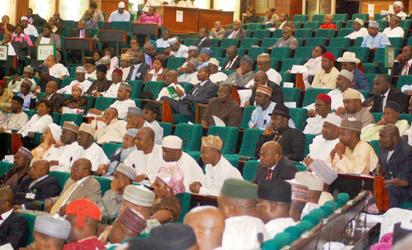
File Photo: Cross section of House of Representatives members at the National Assembly in Abuja Photo : Gbemiga Olamikan
By BEN AGANDE, Oscarline Onwuemenyi & EMMA OVUAKPORIE
ABUJA—The Chairman of the House of Representatives committee on Capital Market and Institutions, Hon. Herman Hembe has disclosed that his committee will investigate the on going recapitalization of the eight rescued banks in the country, saying that from reports received so far, there are indications that the process has been largely flawed and the laws, rules and procedures guiding the exercise have not been followed.
Meanwhile, the Nigeria Deposit Insurance Corporation, NDIC, has washed its hands off the N5 billion of public funds trapped in eleven failed banks liquidated after the consolidation exercise in 2006, noting that it was the responsibility of the Federal Inland Revenue Service to go after such funds.
A Civil Society watchdog in the nation’s extractive industry, Publish What You Pay (PWYP) had called on the NDIC to explain to Nigerians whathappened to the funds lodged in the liquidated commercial banks.

Cross section of Committee Chairmen during the Inauguration of House of Representatives Committees at the National Assembly in Abuja on Thursday. Photo : Gbemiga Olamikan
In a swift reaction to the story published in Vanguard, the NDIC, in a letter signed by the Director, Claims Resolution Department, M. A. Ahmed, noted that of the banks listed by the transparency watch group, Publish What You Pay, only four banks are in liquidation and under the control of the Corporation. “The banks are, City Express Bank Plc, Gulf Bank Plc, Liberty Bank Plc and Metropolitan Bank Ltd.”
“The six banks have either merged with other banks while two had their revoked licensees restored by the Central Bank of Nigeria.”
House of Reps to investigate recapitalization exercise
Meantime, in an interview with Vanguard shortly after he was sworn in as chairman of the committee, Hon. Hembe said regulatory bodies that are supposed to carry out activities that would instill investors confidence in the sector have chosen to do the exact opposite of their responsibilities.
According to the lawmaker, “The capital market in Nigeria is in a state none of us can be proud of. The All share index that rose to 57,990.22 points by December 31 2007 with market capitalisation of N13.29 trillion with over 300 listed securities on the exchange has by 2011 witnessed a 56 per cent decline to 20,202.50 points and a market capitalization value of N6.44 trillion.
“It is further disheartening that while the investor has lost confidence and needs all the encouragement from regulators to keep investing in the Market, activities of some of these regulators tend to do the exact opposite. This Committee will work assiduously towards strengthening investor confidence and check anomalies as they arise.
“Let me particularly point to the on going mergers and acquisition of Banks, which operations fall directly within the purview of this Committee. The process has largely been flawed and Laws, Rules and procedure have not been followed. We will step in to ensure the rule of law.
“Following my appointment, I have received quite a number of petitions regarding these mergers particularly with respect to the fact that some very high bids were disregarded in favour of lower bids. It is my resolve and that of this committee to intervene in the best interest of the Nigerian investor”, he said. Hon Hembe maintained that his committee would carry out more interventions as may be required to put the country on the path of greatness.
FIRS should go after N5bn oil money in distressed banks
— NDIC
In a letter addressed to PWYP, it said: “The Corporation (NDIC) is responsible for the liquidation of banks whose operating licencees had been withdrawn by the Central Bank of Nigeria and appointed by a court as the official Liquidator of the defunct bank.”
The Corporation, therefore, charged the Federal Inland Revenue Service (FIRS) to “contact the respective new banks that acquired the old banks that merged with them, Societe Generale Bank Ltd and Savannah Bank Plc to account for the un-remitted collections on its behalf.”
The letter further stated: “In respect of the four banks, under the control of the Corporation, balances due to FIRS were either classified as deposits or creditors. Under liquidation payment priority, depositors are paid in full subject to available fund before creditors are considered.
“From the records of the closed banks, the balances due to FIRS from each of the closed banks had been established and FIRS had either collected insured deposits or/and liquidation dividend declared to date on its deposit balances or file claims for its credit balance.”
The PWYP had expressed concern over the “attitude of the Nigeria Deposit Insurance Corporation towards the liquidation and merger of 11 commercial banks, which collected petroleum profit tax from oil companies and have refused to remit such fund to the CBN, and the role of the NDIC as liquidator to the failed banks, to have liquidated these said banks without a reflection of trapped funds paid to the CBN.
“These discrepancies became obvious with the release of the NEITI audit report of 1999-2004, where it was captured that 11 commercial banks had trapped N5 billion public funds from the Extractive Industry (EI),”.
According to PWYP, “to withhold public funds unconstitutionally is a crime and against human rights. To further, trade with such funds and declare profit on it, transgress the money laundering act. We use this medium to re-emphasise our call on the NDIC to explain to Nigerians how the revenues from oil and gas reported to be trapped in these failed banks were liquidated.”
Disclaimer
Comments expressed here do not reflect the opinions of Vanguard newspapers or any employee thereof.