
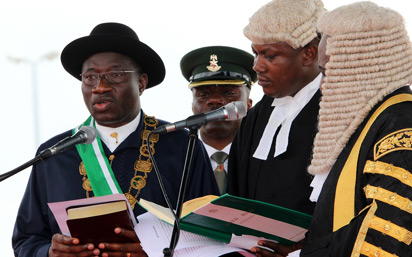
President Jonathan taking his oath of office.
By Rotimi Fasan
It’s been two week’s since theterror attack on the United Nation’s building in Abuja that left over 20 people dead and many more with serious injuries. During these two weeks the extremist group, Boko Haram, has been front page news.
The year 2011 has witnessed dramatic increase in the activities of the fringe group that has murdered Nigerians of diverse religious, ethnic and professional backgrounds in their hundreds and destroyed properties worth billions of Naira.
From Maiduguri to Bauchi, Kaduna to Abuja, Boko Haram members have demonstrated a single-mindedness of purpose that is yet to be recognised to say nothing of its being matched by the Goodluck Jonathan administration. Each new attack by the group gets more brazen than the last; as with each such attack the confidence level of the group increases.
Hardly can the same be said of the authorities and the last attack at the UN building brings into sharp perspective the helplessness that appears to have entered official government response to the activities of the insurgent group, leading it to seek, rather belatedly since it knows its limitations in this regard, the expertise of foreign security agencies.
There appears a mixture of confusion and panic in Abuja’s response and there’s no greater sign of this than the hurried changes effected in the security arrangement around the President’s residence. It’s as if Aso Rock suddenly feels exposed and vulnerable to attacks from Boko Haram.
But if the residents of Aso Rock lock themselves behind the tight barricades of the Villa, to whom does the President leave or entrust the security of the rest of Nigerians? Are people now to take charge of their own security the same way they’ve been taking care of ordinary municipal services that ought to be provided by government?
Nigerians provide their own power from generators that pollute the environment with noise and noxious fumes; drill bore holes for their water supply, construct roads leading to their homes and clear refuse from their neighbourhoods by dumping them in drainages that get blocked and lead to flooding which in turn washes away their loved ones and properties. At the end of the day one wonders what government exists for.
Bomb throwing and summary execution of Nigerians by Boko Haram leave Nigerians with the notion that the group has become a law unto itself. Its actions are quite loud and eloquent where government stammers its way through badly conceived responses.
This definitely leads to comparison between President Jonathan and what his rivals to the office of president would have done with the Boko Haram matter had they won the election. However invidious such comparison may seem they just can’t but be made and one can’t imagine a Mohammadu Buhari who would not be clear-eyed and decisive in his response, qualities which Jonathan worryingly appears to lack.
There seems a clear lack of decision in the action of the President. Although elected into office on his own terms since May he continues to act in the same tentative manner he acted as Vice President just elevated from the position of deputy governor of Bayelsa. His tentativeness can only add grist to the mill of the argument of those who see him as anything but his own man, one who would fall for anything because he can’t stand for what he believes in.
Yet, we must ask, what does the President believe in? Why does he appear perpetually looking across his shoulders for the approving glances of persons whose intentions are aimed at bringing down his government by showing he is incompetent to lead Nigeria?
There are too many contending forces, centrifugal in all dimensions, pulling at the seams of his government and he doesn’t appear able to provide adequate response. Bomb throwing, assassinations have become the order of the day.
The increasingly sophisticated terror tactics of the Boko Haram are clear indicators of its preparedness to carry its campaign even further.
It simply doesn’t issue threats: It acts in deadly earnest. A so-called anti-Western group that hardly took responsibility for its fugitive actions in the past has suddenly become one that issues press notices of its attacks and assuring Nigerians of more deadly attacks.
Human beings respect and respond to those who seem to know where they are headed, and in its battle with government and attempt to win the heart of Nigerians, Boko Haram appears the better contender.
The last time Afeez Ringim, the IG, made statements the group considered beyond his mouth, it went after him within days with a suicide bomber. I feel bold to call that June attack at the Louise Edet House a suicide attack in the wake of the attack at the UN House.
The police called it a suicide attack initially only to return, days later, with a revised version that was meant to downplay the gravity of the matter by claiming it was not a suicide attack. Yet the seriousness of the attack, the casualty rate which must have been downplayed too, all pointed in the direction of a suicide mission. Not given to idle talk, Boko Haram waited to re-enact its act.
The UN House attack which followed what Boko Haram considered the UN support for the fight against it has now cleared the air and the Police can go on with their lame denial if they so desire.
Yet the worrying thing is the feebleness of official responses to the spate of attacks by the Boko Haram that is now spreading round the country in a copycat fashion.
Boko Haram is in the news mainly because of the religious tinge to its grievance and its misconceived mission of opposition to so-called Western education. But it continues to make use of alike lethal and benign products of its supposed Western education in its retrogressive mission. We can’t be entirely sure though that Boko Haram has not been lionised beyond its powers.
How are we sure there are no groups of Nigerians fishing in the troubled waters created by the group? Is it the case that there is nothing political to what is happening? The fact that Boko Haram wears a religious face seems to be hampering Jonathan and his security chiefs as to what to do.
Where they should take the fight to these murderers and be proactive, they continue to wring their hands in helpless resignation, building or allowing others to build all sorts of conspiracy theories. But Nigerians need to feel and live secure. They need more than the rhetorical assurances of their leaders.
They need firm action and that cannot happen until Goodluck Jonathan recognises that he is the Commander-in-Chief.
Disclaimer
Comments expressed here do not reflect the opinions of Vanguard newspapers or any employee thereof.