
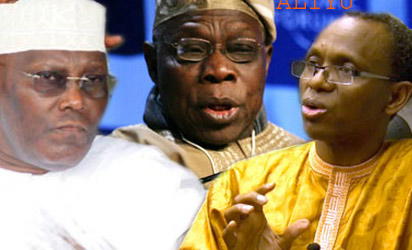
Atiku Abubakar, Olusegun Obasanjo and Mallam Nasir Ahmad El-Rufai
By Henry Umoru
ABUJA—FORMER Minister of the Federal Capital Territory Administration, FCTA, Mallam Nasir Ahmad El-Rufai, yesterday told the Senate Adhoc Committee investigating activities of the Bureau of Public Enterprises, BPE, that the overbearing interference of former President Olusegun Obasanjo and his Vice then, Atiku Abubakar, crippled the privatization programme.
El-Rufai who was the Director-General of BPE from 1999 to 2003 noted that the decline of the privatisation programme started when somebody who had earlier been sacked by the BPE, was brought to replace him.

Atiku Abubakar, Olusegun Obasanjo and Mallam Nasir Ahmad El-Rufai
He said that he repeatedly disagreed with the former President when he made moves to dictate to him. He said he also disagreed with Atiku Abubakar when he (Rufai) insisted that the laws must be followed, even as he said that former President Obasanjo blocked the successful privatization of Nigeria Airways following the stories he received from former Minister of Aviation, Chief Kema Chikwe.
Probe targeted me —el-Rufai
El-Rufai who appeared before the Committee at 3.11p.m and was left to go at 4.15 pm., said: “All I can say is that during my tenure in BPE we tried to do everything by the law. We tried to resist any attempt at political interference. There was never a time that either President Obasanjo or Atiku Abubakar told me to sell an enterprise to A or B and I listened.
We follow due process. Privatisation was a mechanical process and there was never a time that we deviated from that process. In the 33 transactions that we did we followed the book. If there were lapses that came after I left it was because authorities appointed people that did not understand what privatisation was about but saw BPE as cash cow. Before I left the President called me and said now that you are going to FCT how can we continue what you have started.
The President and I were always quarrelling over privatisation. On Nigeria Airways we quarrelled on the pages of newspapers but he called me and said you have done a decent job give us idea of who should be appointed. I then wrote a memo addressed to the vice president and suggested that my successors should come from within because we have spent a lot of money to train them. I recommended three directors and three deputy directors.
The government of the day decided they were not going to appoint anybody from inside BPE. They brought someone who literarily was fired from BPE and that was the beginning of discarding of rules, doing things capriciously promoting people from one level to three levels and the institution have suffered from it since then. You should have a session with the BPE staff themselves they were 120 in number.
“Except when the vice president called me and said I got call from A and B to help the guy win this bid and I said Mr. Vice president you know the rules. Tell him to bid the highest prices because the highest price wins. He replied saying I know but I want to tell you in case they contact you I don’t want them to say I didn’t pass on their message.
President Obasanjo blocked the privatisation of Nigeria Airways practically because Kema Chikwe will go and tell him stories and what is the result today? The company is dead. 2000 jobs have been lost.
“We never investigated anyone for corruption except in my last three months and the only person we investigated ended up being the DG so it is part of the problem. BPE can be improved but I think the key is to have the right people in there and protect them from political interference and fund them properly.”
According to him as the DG, ‘’I supervised the privatization of 23 of the 122 enterprises that have been privatized to date (amounting to 18% of the total). These enterprises came from sectors including hotels and hospitality, banking, cement and oil marketing. Most of them are doing well, and a few have even gone international. For instance, Oando is now listed on the Johannesburg Stock Exchange. Some of the companies are listed below: Unipetrol (now Oando) African Petroleum; National Oil (now Conoil) Ashaka Cement; WAPCO, CCNN; BCC Calabar Cement, Capital Hotel, Abuja (Abuja Sheraton); Festac ’77; Nigerian Hotels Limited (now Southern Sun, Ikoyi); Nigerian Hotels (Caterers’ Court, Ikoyi) Nigerian Hotels (House 8 & 9 Lees Road, Ikoyi); and Nigerian Hotels (Audit Section, Ikoyi)”
Returned N57bn to FG
The former Minister who reminded the public what the goals were when the government decided to pursue the policy of privatisation, said that the government decided to reduce or eliminate the drain inefficient public enterprises constituted on the public treasury, adding that he had 33 transactions, closed 23 and returned N57 billion to the Federal government Treasury, adding that from 1970 to 1999, the Federal government invested over $100 billion in building enterprises, but earned only 0.5% return on investment from the. He said that the companies were costing the government N265 billion annually to maintain.
According to El-Rufai ‘’what has happened by the late 1970s it was a period that public enterprises were not working instead they were not only a drain on the economy they were providing services, they were not solving the problem they were meant to solve but they were captured by the elites for their own benefits.
“In the BPE then we crafted a phrase which we called the ‘the reverse Robin hood’ they were stealing from the poor and givento the rich. Because only the rich and the connected get the services. Nigeria’s privatisation was not driven by any ideology.”
From subsidised foreign exchange, to import duty and tax exemptions and not paying VAT, to revenues they don’t remit this is what the FG paid to keep public enterprises. “In that during Abdusalami’s regime, the budget of the Federal government was N300,000 but we spent N265 billion supporting inefficient, corrupt, and epileptic public enterprises.
That was the philosophy behind privatisation and commercialisation of the companies. 33 privatisation a transaction, 23 were closed as at the time we left, and we remitted N57 billion to the treasury. Apart from one of the companies all were doing very well.”
So to blame privatisation for these companies not doing well is being economical with the truth.
‘’We spent over $100 billion USD from 1973 to 1995 to establish public enterprises. But their return was 0.5 percent per annum it is in the vision 2020 report. Tell who will keep such companies? Only an idiot will do that.
‘’Example NITEL for 25 years only provided 400,000 telephone lines after putting in $7 billion USD the most expensive phone system in the world and they actually think they were doing you a favour if they give you a telephone line.
‘’So this is where I want us to begin from. And to say that the purpose is to create jobs is wrong. That was not the mandate to BPE is to reduce these companies from the treasury, make them more efficient, open up the market for competition so that other operators can come in. NITEL had 11,000 employees, they will lose jobs but how many jobs were created by the telecom industry?
‘’In the year 2000, as at December, 2000 the total liabilities of 39 public enterprises was in excess of N1.1 trillion and they have accumulated loses of N92 billion naira and they consume over $3 billion USD per annum or about N10 million a day. The justification for selling them was very clear and we did it.
‘’The only thing that is working in Nigeria today is what is run by private sector. Today we produced 9000 mega watts of power in our homes with generators and NEPA is giving us 3000.”
When asked to say whether the privatisation process was beneficial to Nigerians as a whole?, he said, ‘’I am reluctant to judge my successors. So when I ever I do job I move on and don’t look at what my successors do. We were working 20 hours in day and seven days a week.”
Disclaimer
Comments expressed here do not reflect the opinions of Vanguard newspapers or any employee thereof.